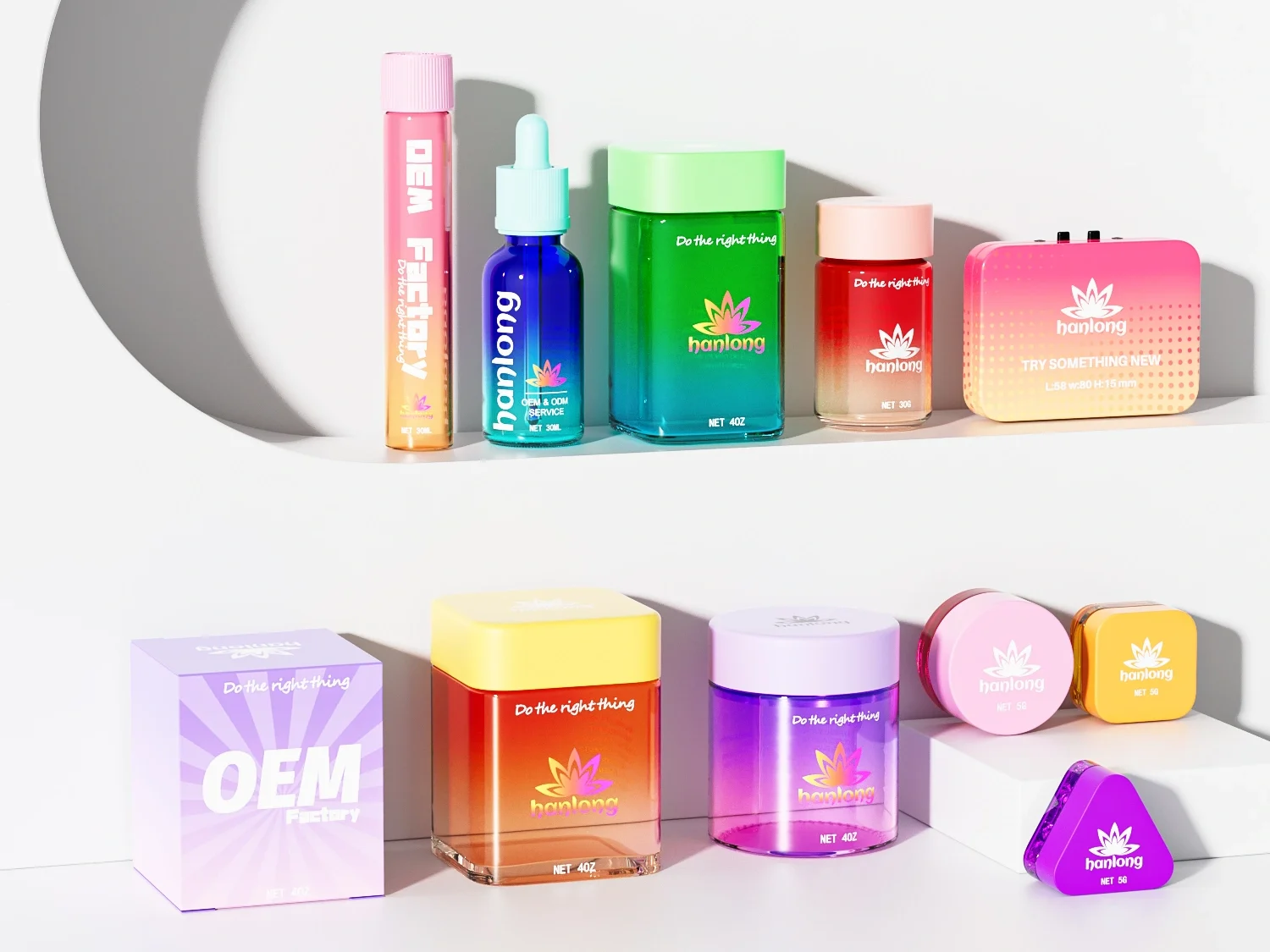


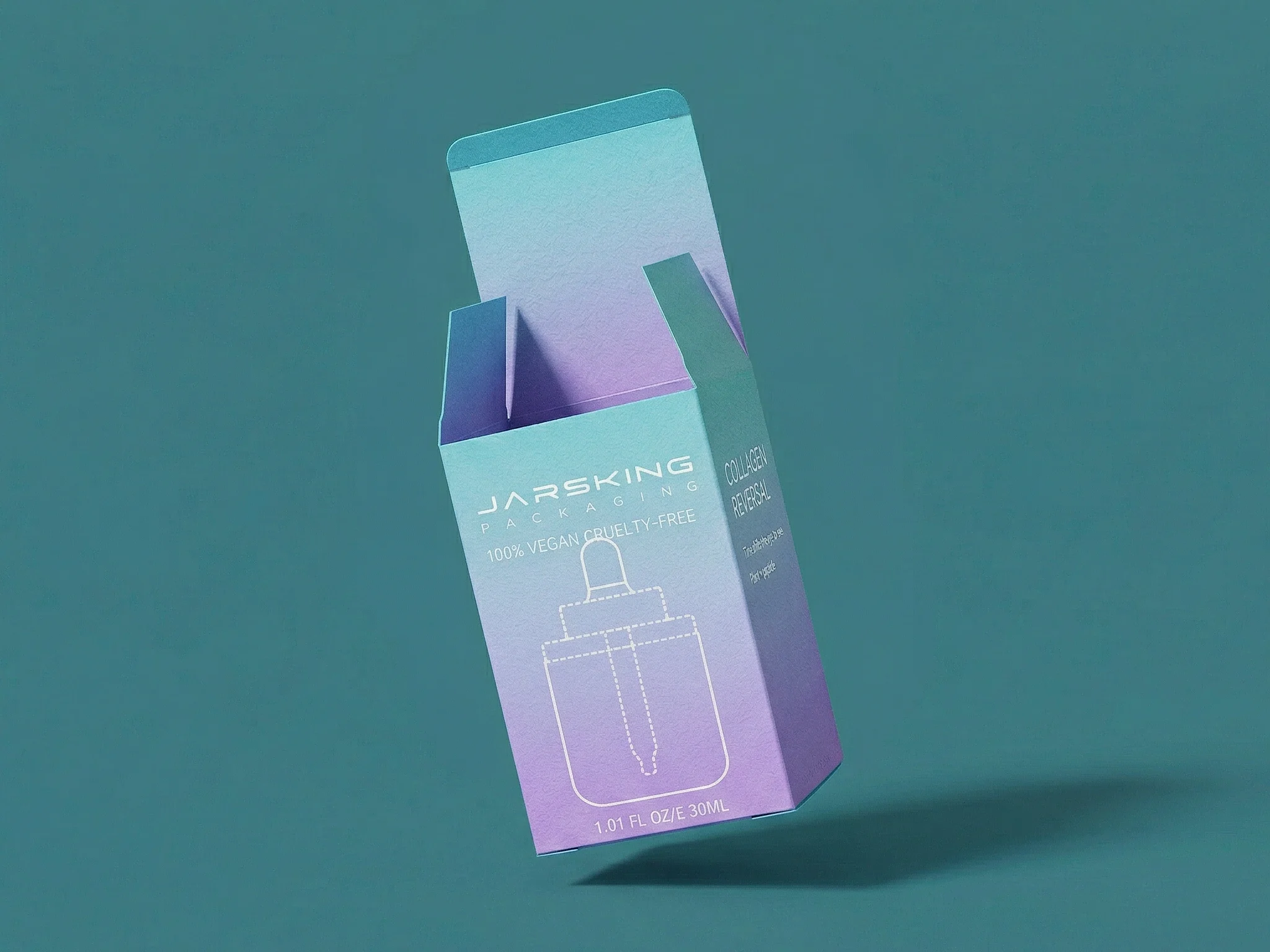











You’ve decided your next collection needs sustainable packaging. You open a browser, search “eco-friendly cosmetic packaging,” and spend the next three weeks requesting samples — matte white bottles, kraft-textured tubes, stone-finish jars — only to discover that half of them don’t match your brand aesthetic, a quarter are made from materials you can’t verify, and none of them come with any documentation about what happens to them at end of life.
This is not a supplier problem. It is a briefing problem.
The beauty industry is at an inflection point. Consumer demand for genuinely sustainable packaging has never been higher. Regulatory pressure is accelerating — Regulation (EU) 2025/40, better known as the PPWR (Packaging and Packaging Waste Regulation), enters application in August 2026, and it will reshape what “compliant packaging” means for every brand selling into the European market. And yet, most beauty brands still treat sustainable cosmetic packaging design as a browsing exercise rather than a strategic design decision.
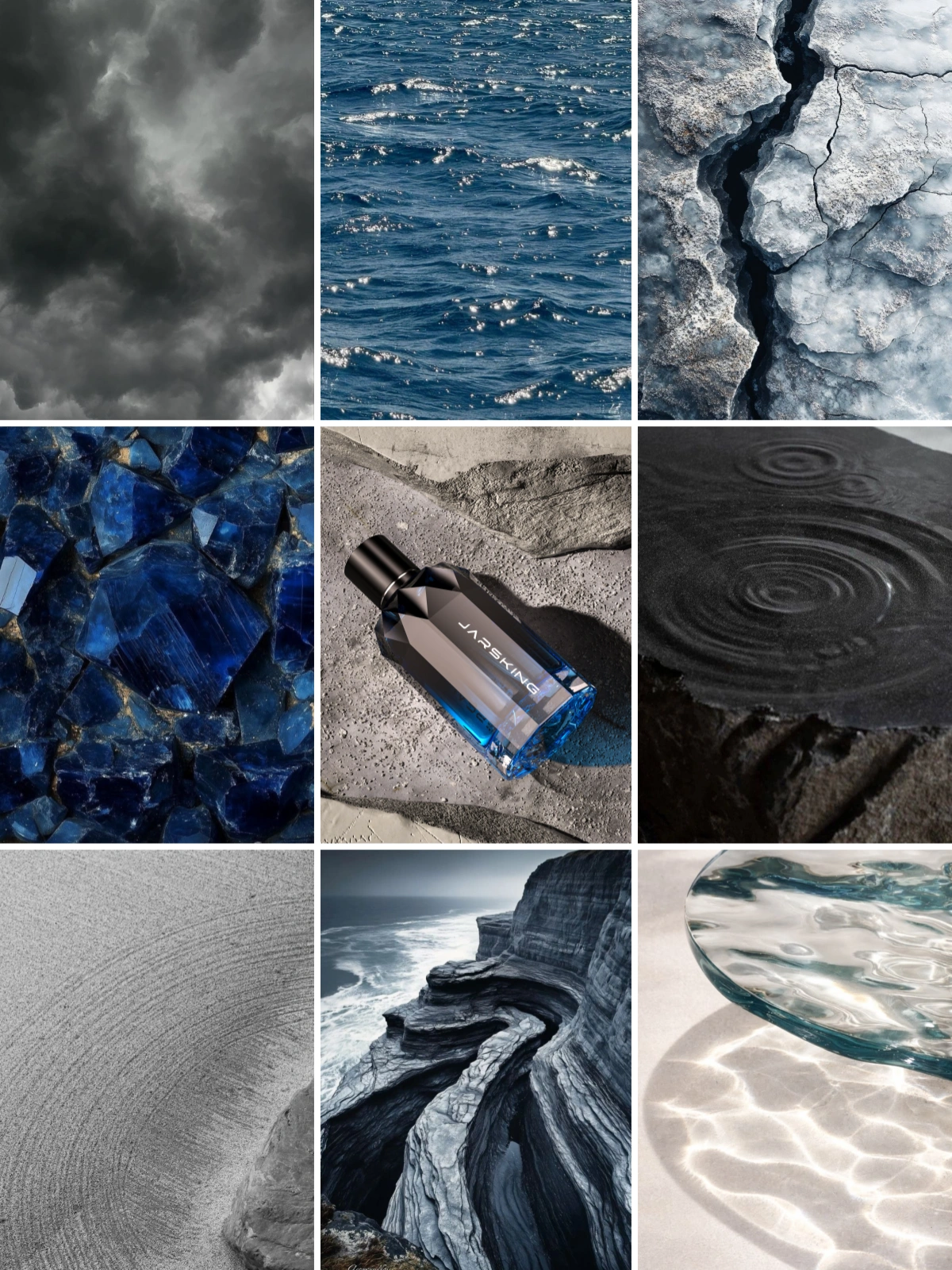
The solution starts before you ever speak to a supplier. It starts with a moodboard — but not the kind you pin on Pinterest. It starts with a CMF (Color, Material, Finish) moodboard: a structured visual brief that connects your brand’s identity, values, and aesthetic language directly to the material family best suited to carry it.
This guide will walk you through exactly how to build one, how to use it to choose between PLA bio-composite, CaCO₃ mineral composite, and wood fiber composite packaging, and how to ensure that the material you choose positions your brand ahead of PPWR compliance from the first brief. Explore Jarsking’s packaging design moodboards and proposals service to see how this process works in practice.
Why Sustainable Packaging Is Now a Design Problem, Not Just a Material Choice
For most of the last decade, “sustainable packaging” was treated as a category switch — swap your conventional plastic jar for a bamboo-print alternative, add a leaf icon to the label, and call it done. That era is over.
Packaging waste in the EU grew by 20% over the last several years, and regulators have responded not with voluntary guidelines but with binding law. PPWR (Regulation EU 2025/40) entered into force on February 11, 2025, with core obligations applying from August 12, 2026. It is not an update to the old Packaging Directive — it is a full replacement, directly applicable across all EU member states simultaneously, with no room for national variation. For the first time, packaging recyclability, recycled content targets, minimisation rules, and labelling requirements are baked into a single, enforceable regulation.
This matters for design because PPWR compliance is not something you retrofit onto finished packaging. By 2030, all packaging placed on the EU market must be “Design for Recycling” (DfR) compliant. The regulation grades packaging from Grade A to Grade E — Grade E packaging (less than 70% recyclable) will be effectively banned from the EU market. If a brand selects a multi-material packaging component today without understanding its recyclability grade, they may be investing in packaging that is non-compliant within four years.
The implication is clear: material selection is now a design decision, not a procurement one. A structured moodboard forces that decision to happen at the brief stage — before tooling, before sampling, before investment. Brands that build their material choices into the moodboard phase arrive at compliant, on-brand packaging faster and with fewer costly revisions.
What Is a Sustainable Packaging Moodboard — And What Makes It Different from a Vision Board
A vision board tells you what something looks like. A CMF moodboard tells you what something is made of, and why.
CMF stands for Color, Material, Finish — the three physical properties that define how a piece of packaging is experienced in the hand and on the shelf. A CMF moodboard collects visual and written references across all three dimensions, aligned to a specific brand intent. It is the document that bridges the gap between a brand’s creative direction and a supplier’s manufacturing capabilities.
For sustainable packaging specifically, a well-built CMF moodboard captures five things:
Brand values and sustainability narrative — Are you a bio-innovation brand, a mineral provenance brand, or a forest and botanical brand? Each tells a fundamentally different story, and each points to a different material family.
Texture and surface language — Smooth and clinical, stone-weighted and raw, or warm-grained and tactile? These are not just aesthetic preferences; they map directly to material properties.
Shelf context — Luxury retail counter, clean beauty indie DTC, or wellness apothecary? The distribution channel informs the perceived premium of the material choice.
Regulatory context — Is your brand targeting EU markets, requiring PPWR compliance? US markets, requiring alignment with California’s SB54 EPR requirements? Both? This belongs in the brief, not in a post-launch compliance review.
Material direction — Which family of eco materials — PLA, CaCO₃ composite, or wood fiber composite — best carries the brand’s visual and values language?
Based on industry experience, brands that present a structured CMF moodboard to their packaging partner reduce their material sampling rounds significantly — because the supplier understands the full brief before a single prototype is made. Read more about how Jarsking translates moodboard briefs into production-ready designs in the full cosmetic packaging design process from moodboard to manufacture.
PPWR — What Every Beauty Brand Needs to Know Before Choosing Packaging in 2026
What PPWR Is and Why It Matters Right Now
PPWR — Regulation (EU) 2025/40 — is the most significant overhaul of EU packaging law in three decades. It entered into force on February 11, 2025, and its core obligations begin applying on August 12, 2026. Unlike the Directive it replaces, PPWR is a Regulation — it is directly binding in every EU member state without requiring national transposition. There are no opt-outs and no country-level variations to navigate.
Critically, PPWR applies to all packaging placed on the EU market, regardless of where it is manufactured. This means US, UK, and Asia-based beauty brands selling in Europe are fully within its scope. If your brand is exporting to the EU — or planning to — PPWR is your compliance framework, and it starts now.
Check out Jarsking’s blogs for detailed info:
PPWR 2025 Explained: Complete Guide to Europe’s New Packaging Regulation
PPWR Compliance Requirements – The 5 Critical Pillars Every Brand Must Master
PPWR Enforcement Guide: EPR Registration, Digital Passports & Penalties (2025)
Your PPWR Action Plan – Industry-Specific Strategies and Compliance Roadmap
The Key Requirements That Impact Packaging Design
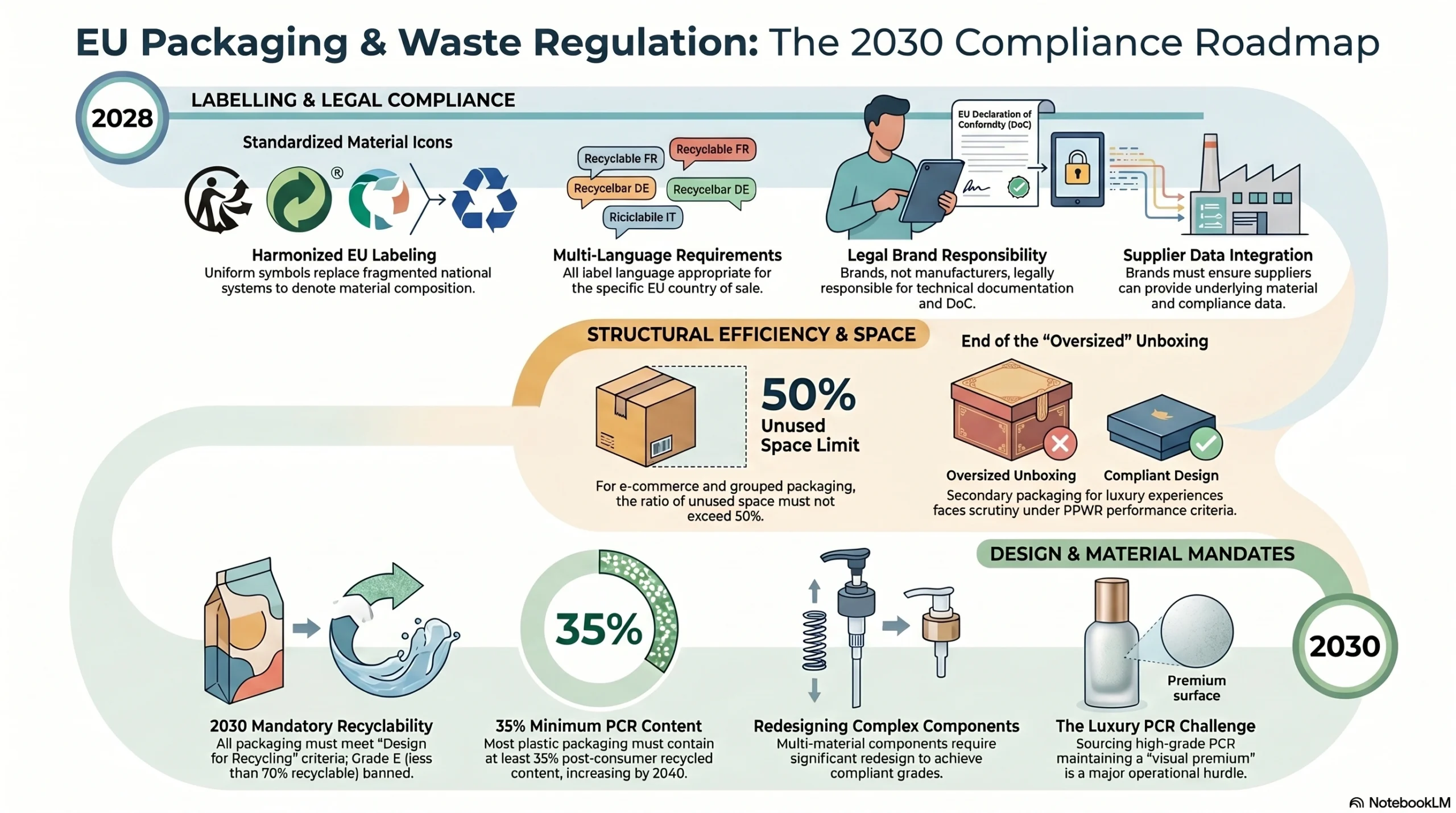
Mandatory recyclability by 2030. All packaging must meet “Design for Recycling” (DfR) criteria and achieve a minimum recyclability grade. Grade E packaging — defined as less than 70% recyclable — will be banned from the EU market by January 1, 2030. Multi-material components such as complex pumps or mixed-material caps will require significant redesign to achieve compliant grades.
Minimum recycled plastic content. Most plastic packaging must contain at least 35% post-consumer recycled (PCR) content by 2030, rising further by 2040. For luxury skincare brands, sourcing high-grade PCR that doesn’t compromise visual premium will be one of the sector’s biggest operational challenges.
Packaging minimisation and the 50% rule. For grouped or e-commerce packaging, the unused space ratio must not exceed 50%. Oversized secondary packaging designed purely to create a luxury unboxing experience will face direct scrutiny under PPWR’s performance criteria.
Labelling. From 2028, mandatory harmonised EU material composition labels will be required across all packaging. The European Commission is expected to adopt uniform symbols to replace fragmented national systems such as France’s Triman. Label language must be appropriate for the country of sale.
EU Declaration of Conformity (DoC). Every packaging unit placed on the EU market must be supported by technical documentation and a Declaration of Conformity. Brands — not just manufacturers — bear legal responsibility for this documentation. Your packaging supplier must be able to provide the underlying material and compliance data.
What This Means for Your Moodboard
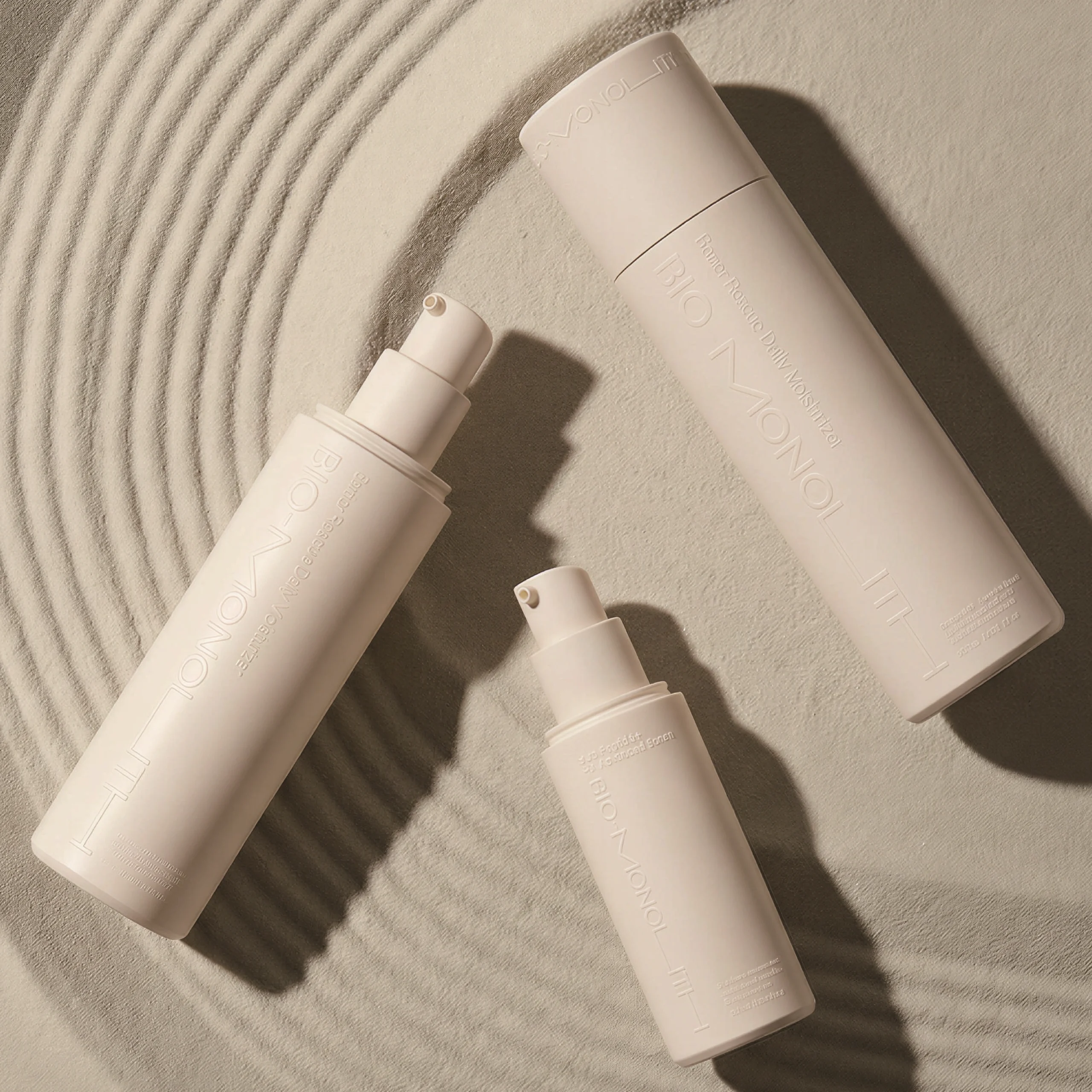
PPWR compliance is a design phase decision. When your CMF moodboard is built to include regulatory context — specifically, whether your packaging needs to meet PPWR’s recyclability grades, recycled content targets, and minimisation rules — it gives your packaging partner the criteria needed to recommend compliant materials from the first conversation. Choosing a bio-derived or plant-composite material from Jarsking’s sustainable collections, such as the PLA Bio-Monolith Series, positions your packaging ahead of the 2030 recyclability mandate before a single prototype is cast.
For the official regulatory text and up-to-date compliance guidance, refer to the EU Environment PPWR page.
The 3 Sustainable Material Families — And the Moodboard Language That Points to Each
Not all eco packaging tells the same story. The three material families below each carry a distinct aesthetic language, a distinct sustainability credential, and a distinct brand archetype. Your moodboard should surface which one belongs to your brand — because getting this right at the brief stage means you sample the right material on the first round.
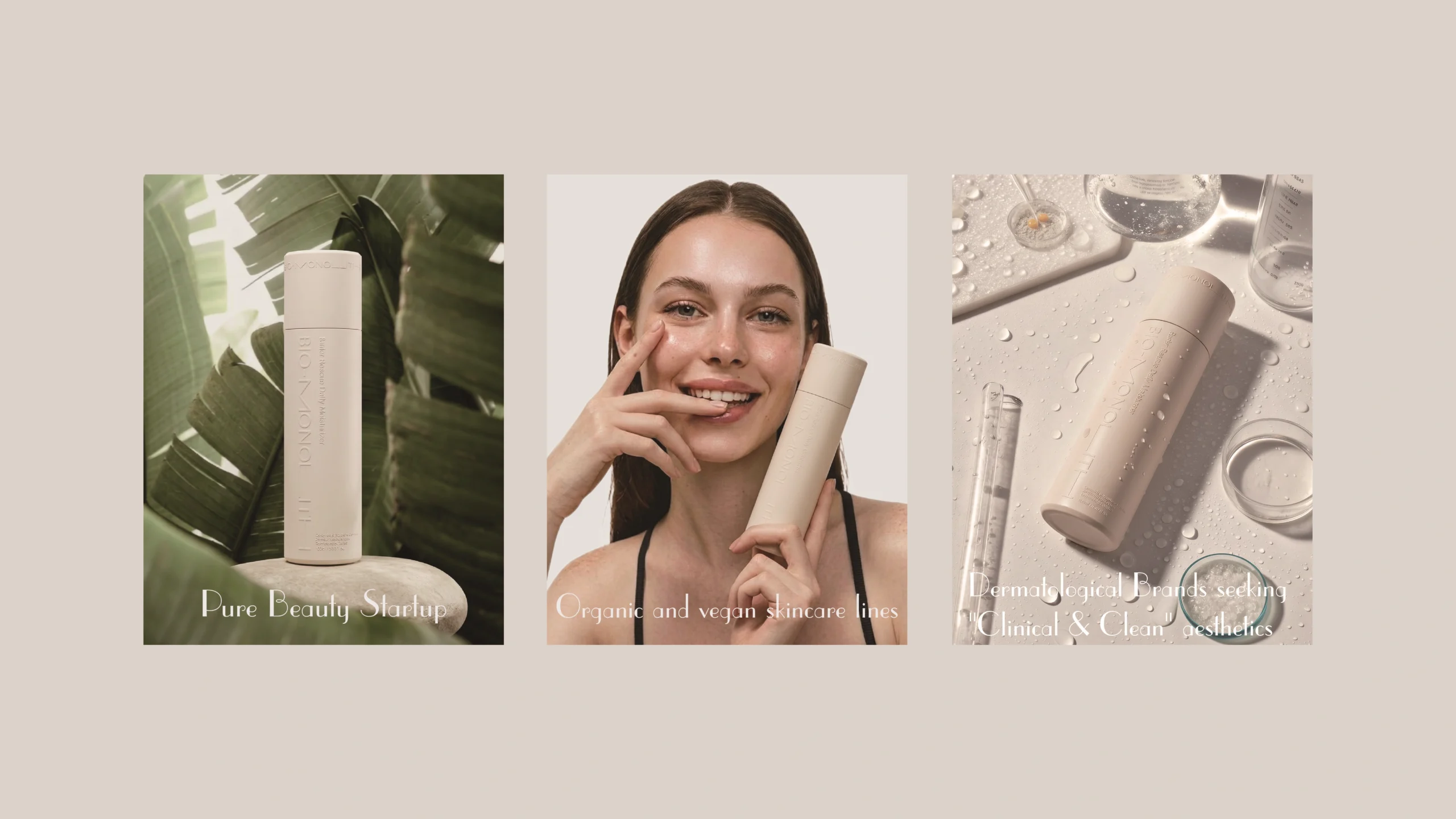
PLA Bio-Monolith — The Material for Bio-Innovation Brands
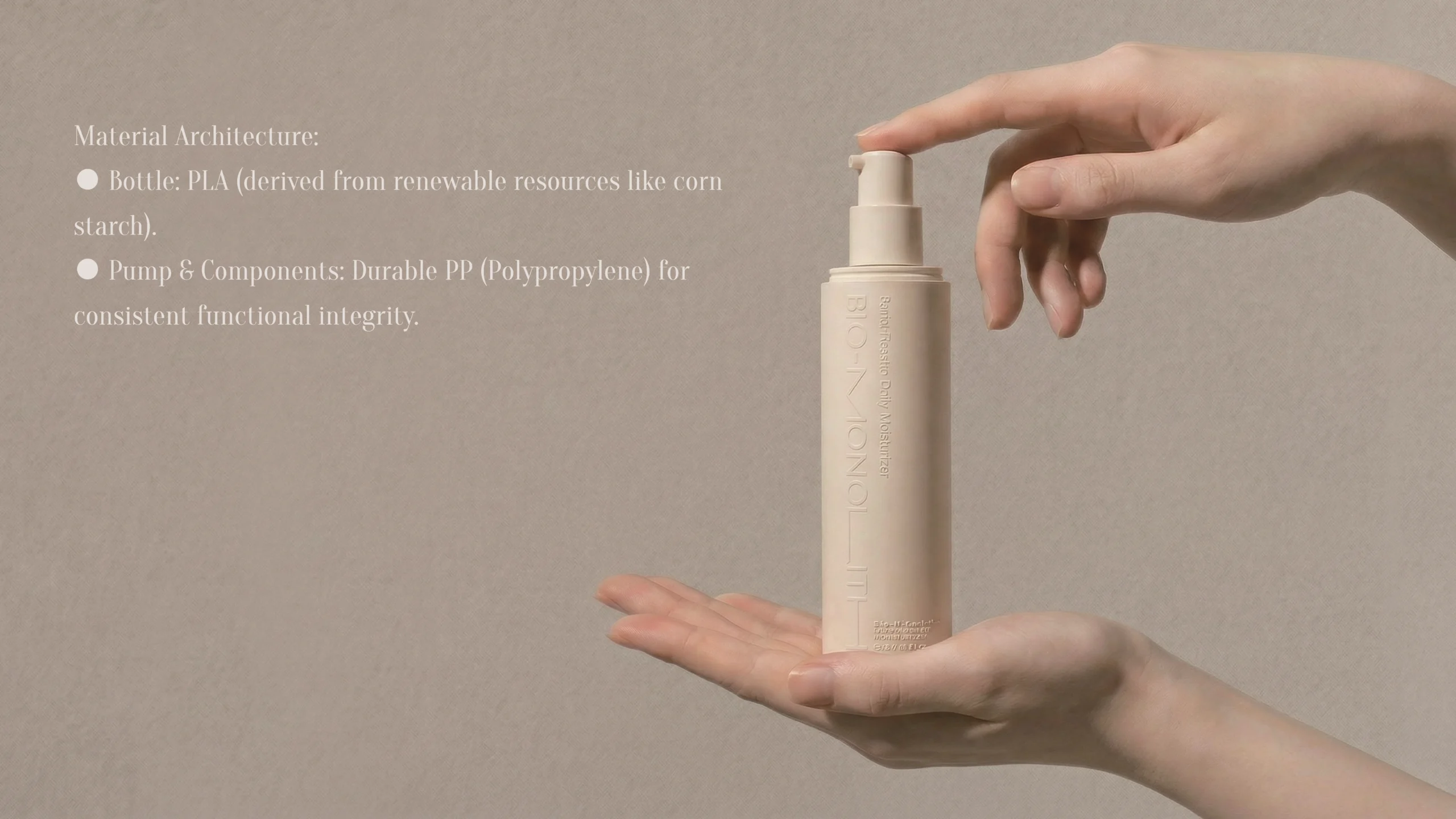
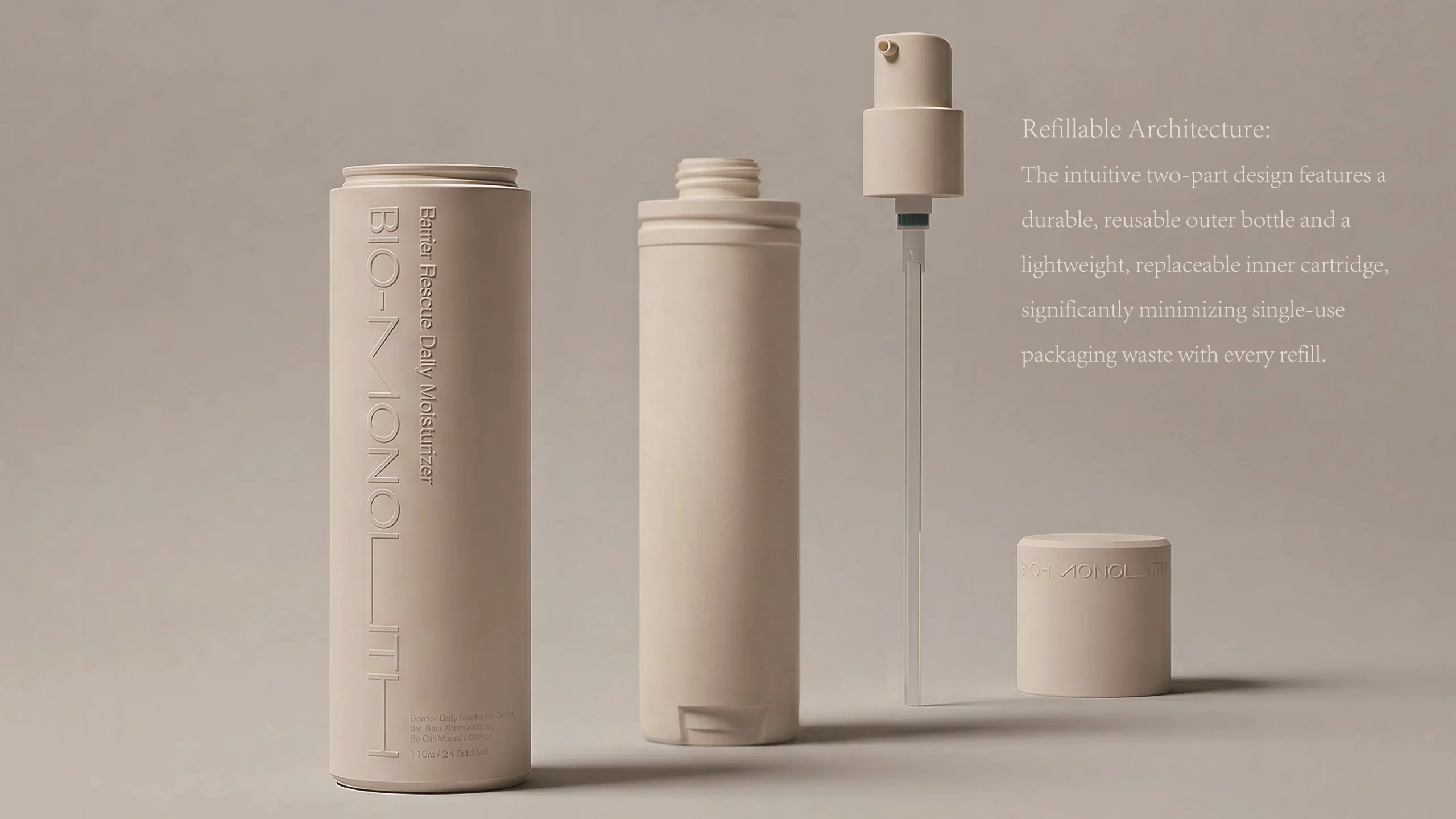
PLA (polylactic acid) is a bioplastic derived from renewable plant sources — typically corn starch or sugarcane — making it a fossil-free alternative to conventional petroleum-derived plastics. Under industrial composting conditions, PLA can biodegrade fully, and its production generates significantly lower carbon emissions than standard polymers. For PPWR purposes, PLA’s bio-derived origin aligns well with the regulation’s direction of travel on reducing fossil content in packaging materials.
The moodboard language that points to PLA:
Visual references: glacier-white laboratory interiors, precision-engineered scientific instruments, clean architectural forms, medical-grade surfaces
Color palette: glacier white, pale sage, soft aqua, warm neutral off-white
Texture direction: smooth, semi-matte, low-texture, precision-formed
Brand archetype: biotech skincare, science-led serums, “lab-meets-nature” positioning, clinical minimalism
Key words on the board: precision, bio-derived, translucent, clinical, pure
If your moodboard looks like the inside of a clean Nordic laboratory, PLA is your material. Explore Jarsking’s PLA Bio-Monolith Series — a range of cosmetic packaging built around bio-derived PLA composites designed for brands that lead with a science-and-nature narrative.
Best suited for: Serum brands, skincare biotech startups, minimalist clean beauty, DTC-first indie brands building EU-facing ranges.
CaCO₃ Composite Mineral Strata — The Material for Mineral Provenance Brands
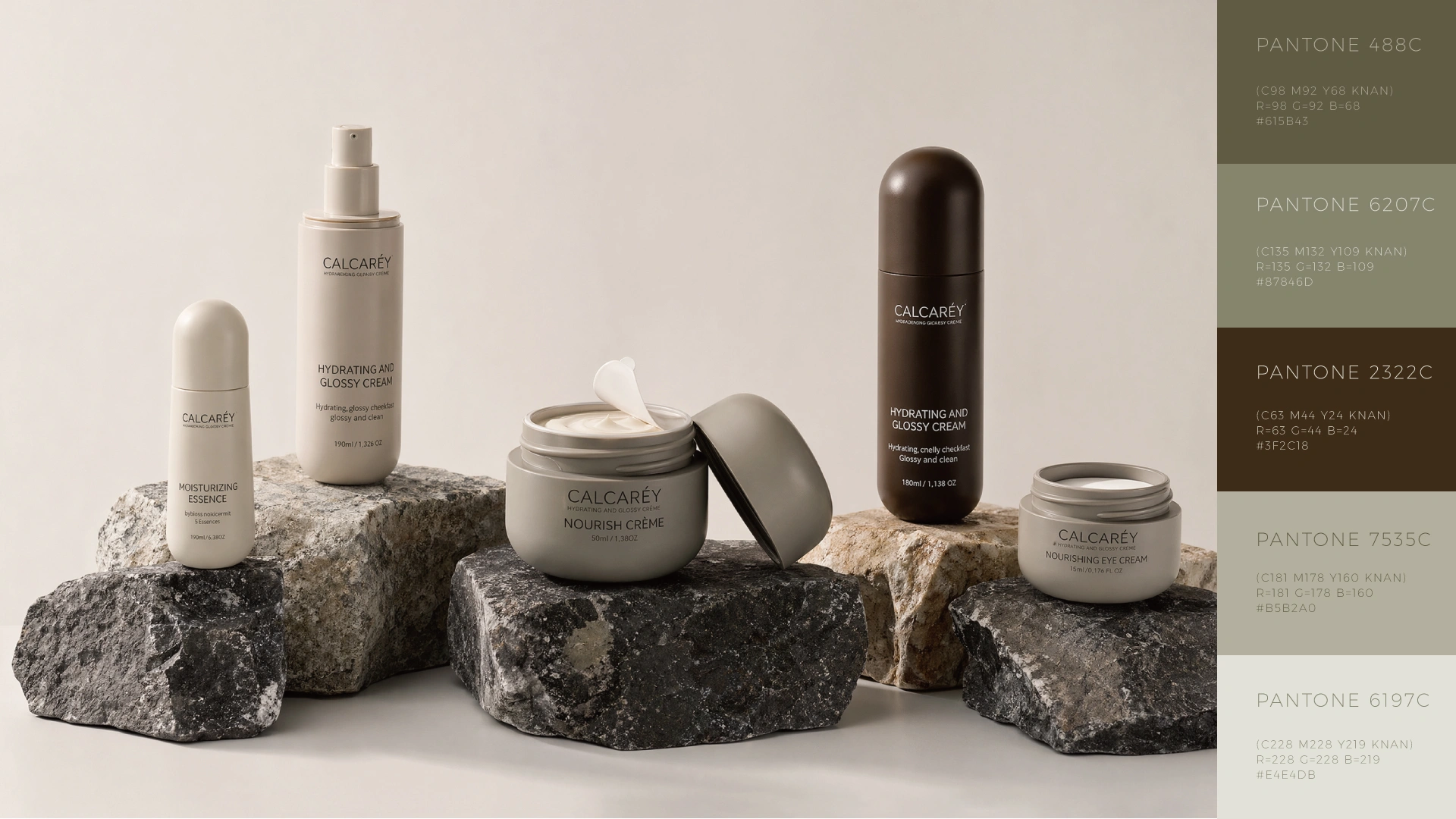
CaCO₃ (calcium carbonate) composite is a packaging material that uses natural mineral filler — sourced from limestone or chalk — to replace a significant proportion of petroleum-derived polymer. The result is a material that carries the visual weight and tactile gravitas of stone, without the high carbon cost or fragility of glass. For prestige brands that have historically relied on heavy glass to signal luxury, mineral composite offers a credible, lower-impact alternative that retains the premium hand-feel consumers expect from high-end skincare.
From a PPWR perspective, the reduced virgin polymer content in CaCO₃ composite supports compliance with the regulation’s recycled and bio-content trajectory, and its single-material construction is significantly more Design for Recycling (DfR)-friendly than multi-material glass-and-metal assemblies.
The moodboard language that points to CaCO₃:
Visual references: geological strata cross-sections, polished travertine slabs, raw limestone quarry faces, Scandinavian stone architecture, ceramic studio surfaces
Color palette: chalk white, warm travertine, slate grey, basalt black, warm sand, fossil cream
Texture direction: matte stone-effect, micro-textured surface, raw mineral, fine grain
Brand archetype: prestige skincare, Scandinavian wellness, luxury indie, earth-luxury apothecary
Key words on the board: mineral, weight, provenance, earthy, tactile, grounded
If your moodboard references sedimentary rock formations and Bauhaus-minimalist stone architecture, CaCO₃ composite is your material. Explore Jarsking’s CaCO₃ Composite Mineral Strata Series — a packaging collection built around natural mineral composites designed for brands building a luxury sustainability story grounded in the earth.
Best suited for: Prestige skincare, luxury indie brands, wellness and spa, high-end moisturisers and treatment creams.
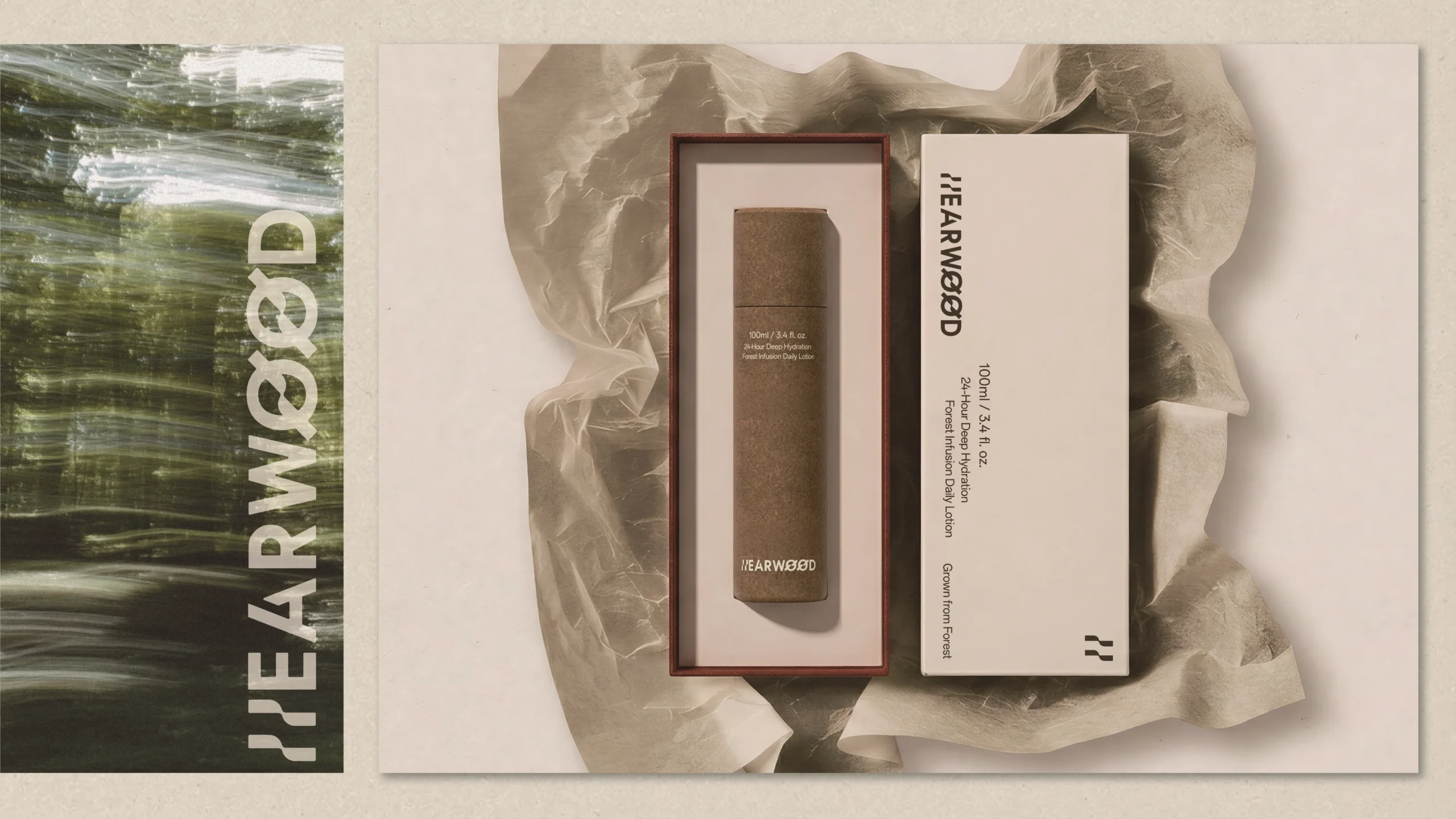
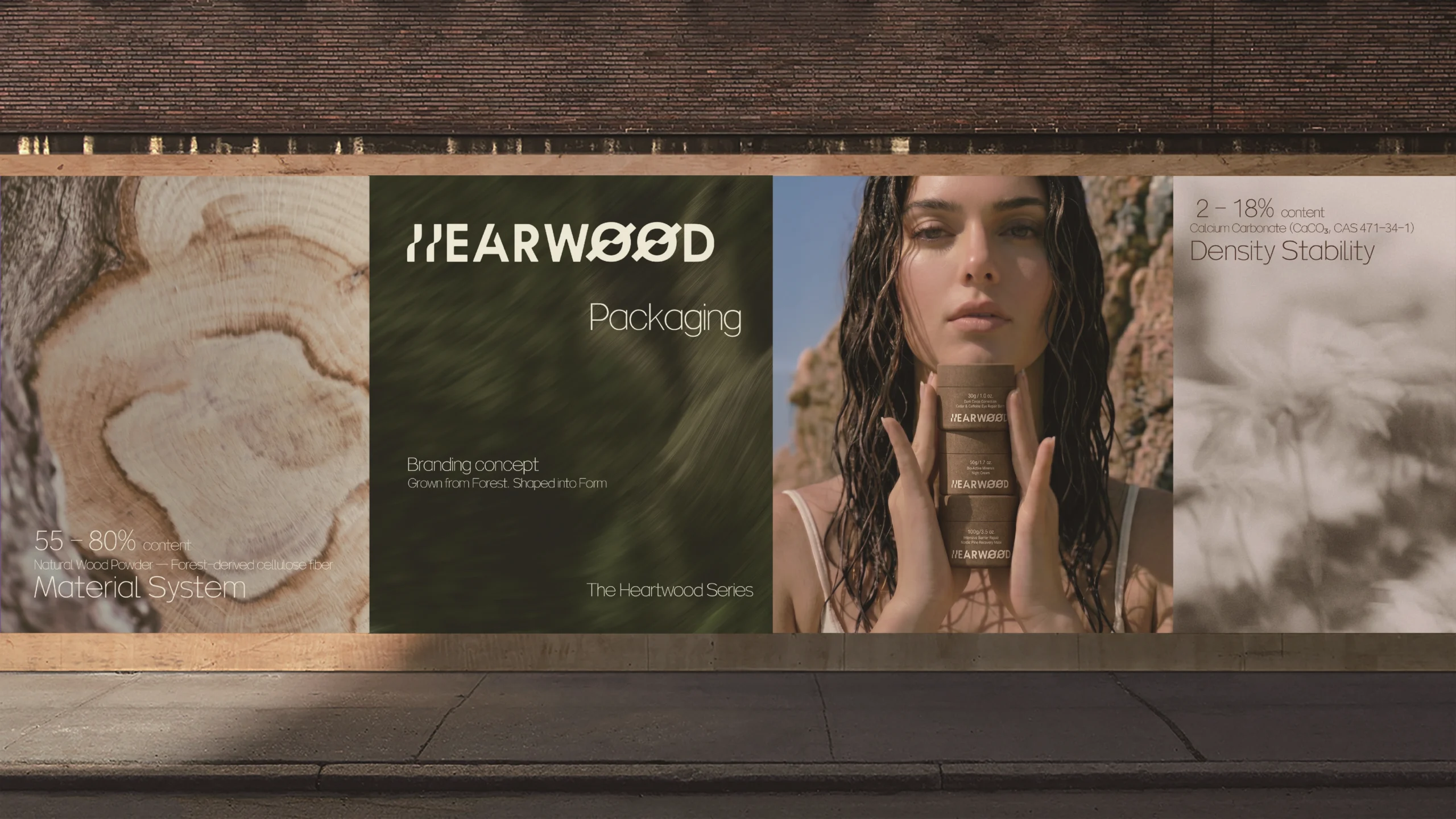
Wood Fiber Composite Hearwood — The Material for Forest Provenance Brands
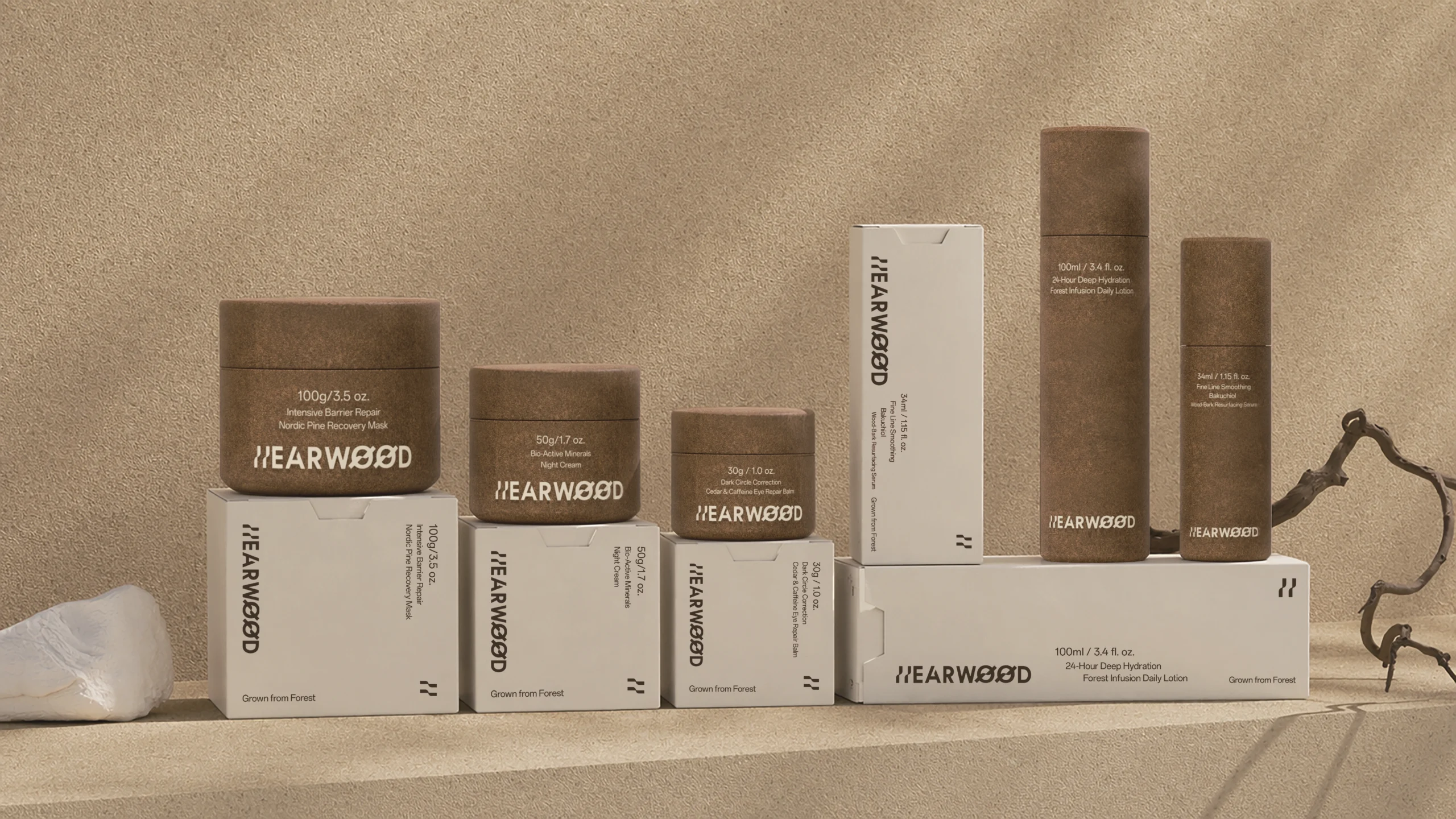
Wood fiber composite incorporates genuine plant-based wood fiber into the material structure, producing a packaging surface with authentic grain texture and warmth that cannot be replicated by a printed finish or a wood-look film. Unlike bamboo-print plastics or kraft paper wraps, the Hearwood series carries the material story of the forest in its actual physical composition — making it a credible, substantiated claim rather than an aesthetic shortcut.
For PPWR compliance, wood fiber composites offer a strong bio-content profile. Their plant-based feedstock, biodegradable material properties, and alignment with FSC-certified sourcing narratives position them well against the regulation’s direction on reducing fossil-derived content and improving end-of-life recyclability.
The moodboard language that points to wood fiber:
Visual references: warm wood grain cross-sections, birch bark close-ups, pressed botanical illustration, forest floor macro photography, artisan craft studio materials
Color palette: warm oak, birch cream, cedar brown, forest green, raw linen, aged parchment
Texture direction: tactile grain surface, matte natural, uncoated woody warmth, hand-craft feel
Brand archetype: slow beauty, forest bathing, clean herbalism, artisan apothecary, craft fragrance
Key words on the board: botanical, grain, provenance, craft, warmth, natural origin
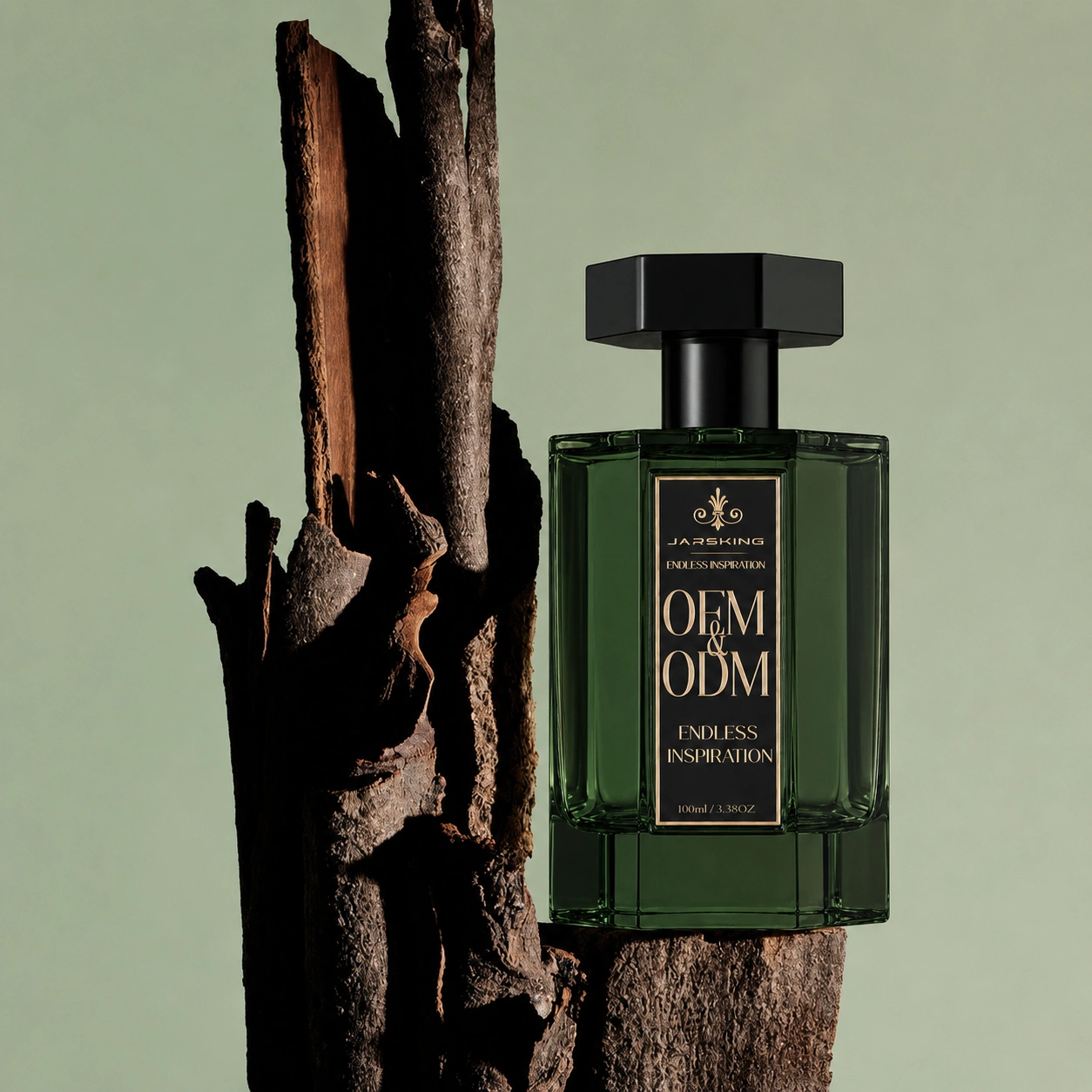
If your moodboard references a Japanese forest walk, a Provençal herb garden, or an artisan woodworker’s studio, wood fiber composite is your material. Explore Jarsking’s Wood Fiber Composite Hearwood Series — packaging built from genuine plant-fiber composites for brands whose sustainability story begins in the forest.
Best suited for: Natural skincare, clean beauty, herbalism and wellness, artisan fragrance, spa and botanical retail.
Material Comparison at a Glance
| PLA Bio-Monolith | CaCO₃ Mineral Strata | Wood Fiber Hearwood | |
|---|---|---|---|
| Base Material | Plant-derived bioplastic | Mineral-filled polymer composite | Plant-fiber composite |
| Aesthetic Language | Clean, precise, translucent | Stone-weight, earthy, tactile | Warm grain, botanical, craft |
| Brand Archetype | Biotech / Clinical Beauty | Prestige / Mineral Wellness | Clean / Forest / Apothecary |
| PPWR Positioning | Bio-derived, fossil-free | Reduced virgin polymer content | Bio-fiber content, biodegradable profile |
| Shelf Context | DTC, clinical skincare, serums | Luxury counter, spa retail | Indie clean beauty, natural retail |
| Best Product Types | Serums, essences, toners | Face creams, premium moisturisers | Balms, oils, artisan fragrance |
How to Build a Moodboard That Points to a Material — Step by Step
Most brands build moodboards by browsing competitor packaging and existing product ranges. This is the single biggest mistake in the process — it leads to derivative outcomes and does nothing to differentiate a brand’s material story. The most effective CMF moodboards are built away from packaging references, drawn from architecture, natural materials, interiors, fashion, and industrial design.
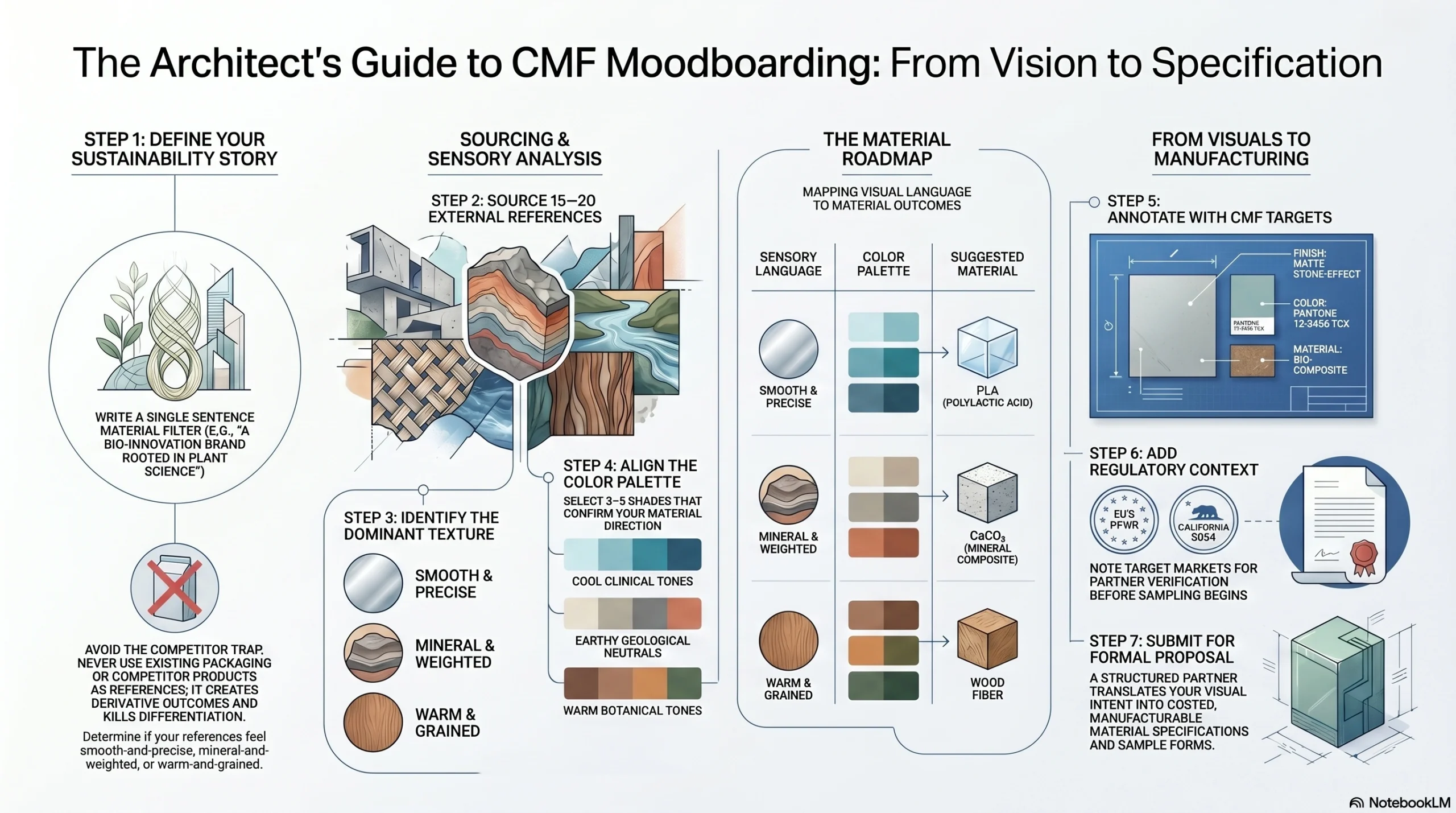
Follow these seven steps to build a moodboard that makes a genuine material decision:
Write your sustainability story in one sentence. “We are a bio-innovation brand rooted in plant science.” Or: “We draw our material language from mineral provenance and geological time.” Or: “We are a slow beauty brand whose packaging belongs to the forest.” This single sentence is your material filter for everything that follows.
Collect 15–20 visual references from outside the beauty industry. Pull from architecture, geology, fashion textiles, industrial materials, and natural environments. The goal is to surface your brand’s material language without being influenced by what competitors have already made.
Identify your dominant texture language. Review your references and ask: is the overwhelming sensation smooth-and-precise, mineral-and-weighted, or warm-and-grained? The answer points to PLA, CaCO₃, or wood fiber respectively.
Define your color palette in three to five shades. Cool, clinical tones align with PLA. Earthy, geological neutrals align with CaCO₃. Warm, botanical tones align with wood fiber. Color and material are deeply linked — let the palette confirm the material direction.
Write your CMF targets directly onto the board. Annotate the moodboard with explicit Color / Material / Finish notes. Example: C: Warm chalk | M: Mineral composite | F: Matte stone-effect. This transforms the moodboard from a visual reference into a manufacturing brief.
Add your regulatory context as a brief annotation. Note whether you are targeting EU markets under PPWR, US markets under California SB54 EPR, or both. This ensures your packaging partner can cross-reference material selection against compliance requirements from the very first conversation, not after sampling.
Submit the moodboard for a formal CMF proposal. A structured design partner will translate your brief into a shortlist of manufacturable materials, sample forms, and finish options — before any tooling investment is made. This is where visual intent becomes a sourced, costed, compliance-aware packaging specification.
From Moodboard Approval to Manufacture — What the Journey Looks Like
Once a moodboard brief is approved, the path from creative direction to production-ready packaging follows a defined sequence. Understanding this process helps brands plan timelines realistically and avoid the delays that come from ad hoc material decisions.
Stage 1 — CMF Proposal. The packaging partner reviews the moodboard and presents a shortlist of material options aligned to the brand’s aesthetic direction, sustainability credentials, and regulatory context. For EU-market brands, this stage includes a preliminary assessment of each material against PPWR’s Design for Recycling criteria and recycled content targets.
Stage 2 — Material Sampling. Selected materials are sampled in the target form factor — jar, bottle, tube, or compact — across a range of finishes. Because the moodboard has already defined the CMF direction, sampling is focused and purposeful rather than exploratory.
Stage 3 — Design Refinement. Surface finishes, cap compatibility, wall thickness, and component assembly are refined based on sample feedback. At this stage, packaging minimisation principles — relevant to PPWR’s 50% empty space rule — are reviewed for secondary packaging.
Stage 4 — Compliance Documentation. For EU-market packaging, the manufacturing partner compiles the technical documentation required for the EU Declaration of Conformity (DoC) — including material composition data, recyclability grade assessment, and heavy metal and PFAS compliance confirmation.
Stage 5 — Production. Tooling is confirmed and production commences against an approved, documented, compliance-ready specification.
The entire process, from a well-structured moodboard brief to approved sample, runs significantly faster than the conventional approach of browsing catalogues and sampling speculatively. Explore the full cosmetic packaging design journey from moodboard to manufacture to understand each stage in detail.
Conclusion
Sustainable packaging that genuinely reflects a brand’s values, performs on the shelf, and holds up to regulatory scrutiny is not found by browsing a catalogue. It is engineered — and the engineering starts with the brief.
A structured CMF moodboard is the single most effective tool available to a beauty brand founder at the packaging decision stage. It forces clarity on brand language before material selection, maps aesthetic direction to substantiated material science, and — critically in 2026 — builds PPWR compliance into the design process from day one rather than retrofitting it onto a finished product.
PLA bio-composite, CaCO₃ mineral composite, and wood fiber composite each carry a distinct brand language, a distinct sustainability story, and a distinct compliance profile. The right choice is not the most “eco” option in the abstract — it is the one that tells your brand’s story, on your brand’s shelf, with material honesty that neither regulators nor consumers can question.
The brands that will lead the next decade of sustainable beauty packaging are not the ones who waited for 2030 to start redesigning. They are the ones who started the conversation with a moodboard.
Ready to turn your brand vision into sustainable packaging designed for 2026 and beyond? Submit your moodboard to Jarsking’s design team and receive a custom CMF proposal — with material options aligned to your aesthetic brief, your sustainability credentials, and your PPWR compliance needs. No commitment required.
FAQs
PPWR — Regulation (EU) 2025/40 — is the EU’s binding Packaging and Packaging Waste Regulation. It entered into force in February 2025, with core obligations applying from August 12, 2026. It applies to all brands placing packaged products on the EU market — including US and Asia-based brands exporting to Europe. Compliance is not optional, and it covers primary, secondary, and e-commerce packaging.
CaCO₃ mineral composite delivers the weight, tactile density, and visual premium traditionally associated with heavy glass — without glass’s carbon cost or fragility. For prestige skincare brands targeting luxury retail, the CaCO₃ Mineral Strata Series is the most direct path to a sustainable material with genuine shelf gravitas.
PLA is a bio-derived material that aligns well with PPWR’s objective of reducing fossil-derived content in packaging. Full compliance also depends on the packaging’s recyclability grade under PPWR’s Design for Recycling criteria, which your packaging supplier should confirm before finalising the specification.
A CMF moodboard should include: 15–20 visual references from outside the beauty industry, a defined three-to-five colour palette, explicit texture and surface direction, written CMF annotations, your brand sustainability narrative, and your target market’s regulatory context (EU PPWR, US EPR, or both).
From the moodboard stage — not after sampling. PPWR compliance is a design-phase requirement. Brands building PPWR context into their CMF brief from the outset arrive at compliant, on-brand packaging faster and with significantly fewer costly revisions.
Wood fiber composite — as used in the Hearwood Series — incorporates genuine plant-fiber material into the physical structure of the packaging, giving it an authentic grain texture and substantiated bio-content claim. Bamboo-print packaging is typically a conventional polymer with a printed or embossed surface treatment — a visual shortcut rather than a material story.