












You can spend a year perfecting a bond-repair formula, dial in the scent, nail the price point — and still lose the sale at the shelf or the product page because the bottle looks like everyone else’s. In a category as crowded as hair, the container is doing a lot of quiet work: it protects the formula, communicates the brand, survives a wet bathroom, and tells a shopper in about three seconds whether this is a $9 mass product or a $49 prestige one.
That is why getting hair care packaging right is a strategic decision, not a procurement afterthought. This guide walks through everything a brand needs to make that decision well in 2026: the main bottle, tube, and jar formats and what each is best for; how to choose between glass, plastic, and more sustainable materials; what separates packaging that sells from packaging that just contains; lead time of different cooperative models; and how to vet a supplier so you do not get burned on your first production run.
Whether you are launching a single hero serum or a full eight-SKU regimen, the goal is the same — packaging that protects what is inside and earns the purchase outside.
Why Hair Care Packaging Is a Category of Its Own
It is tempting to treat hair packaging like skincare packaging with a bigger bottle. In practice, hair products place demands that skincare rarely does, and the best packaging decisions start by respecting those differences.
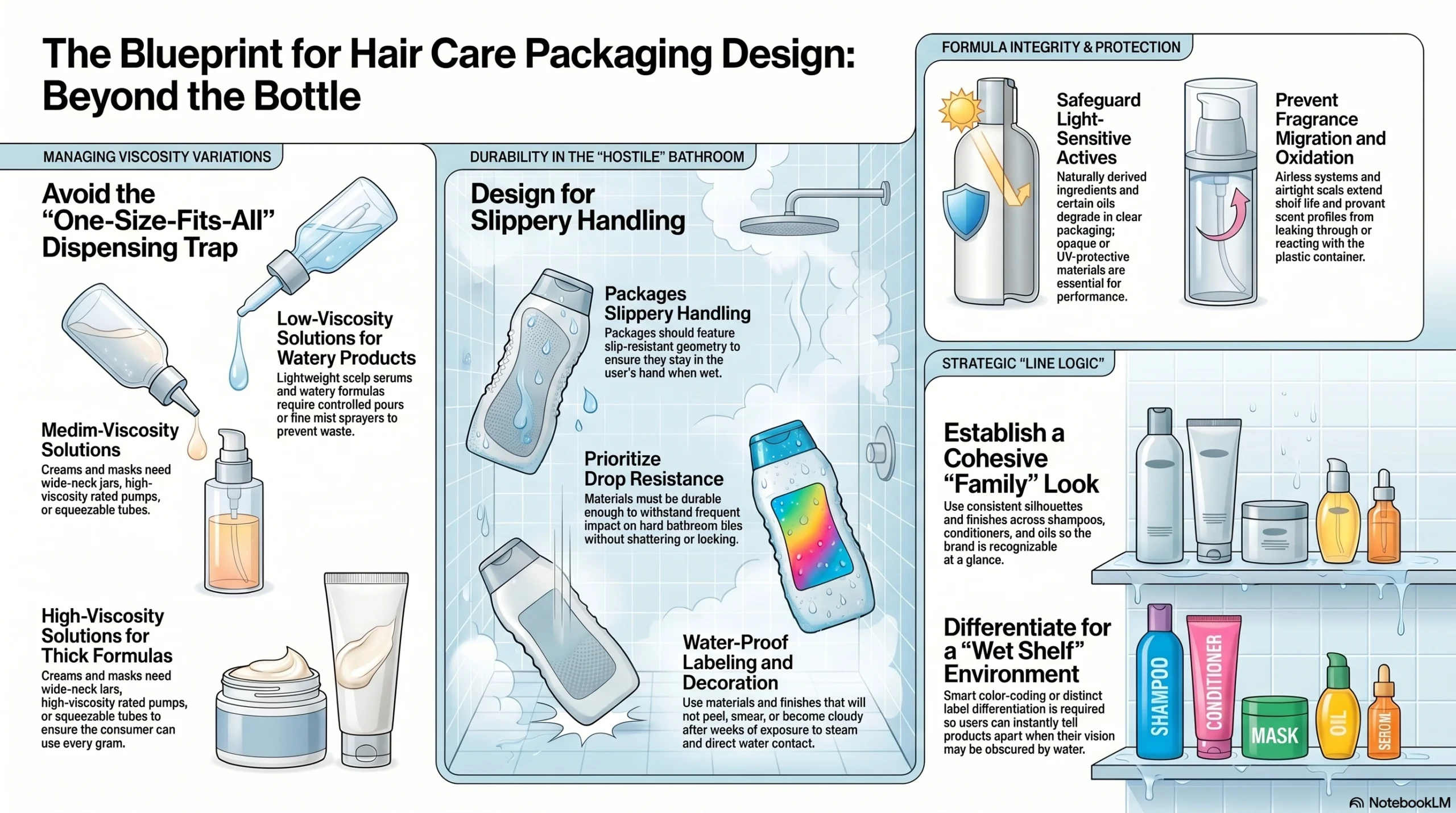
Viscosity swings wildly across a single line. A lightweight scalp serum behaves nothing like a thick mask or a creamy leave-in. Watery products need a controlled pour or a fine sprayer; thick products need a wide neck, a pump rated for high viscosity, or a tube you can squeeze to the last gram. A one-size dispensing choice across a regimen is one of the most common — and most expensive — mistakes we see.
The bathroom is a hostile environment. Hair products live wet, get handled with slippery hands, and frequently get dropped on hard tile. That puts a premium on drop resistance, slip-resistant geometry, and labels or decoration that will not peel, smear, or cloud after weeks of steam and water contact.
Formulas need protection. Oils oxidize, naturally derived actives degrade, and fragrance can migrate into or through the wrong plastic. Light-sensitive ingredients fade in clear packaging. Airless and well-sealed systems extend shelf life and keep the last application performing like the first.
A regimen has to look like a family. Shampoo, conditioner, mask, oil, and styling product should read as one brand at a glance while still being instantly distinguishable on a wet shelf. That “line logic” — consistent silhouette and finish with smart color or label differentiation — is what makes a collection feel premium and shoppable.
Get these fundamentals right and every later decision becomes easier. Ignore them and you end up paying for re-tooling, re-labeling, or returns.
The Main Types of Hair Care Packaging
Most hair lines are built from a small set of proven formats — but the difference between a package that performs and one that frustrates customers lives in the specifics: the exact material, neck finish, wall thickness, and closure. Here is how to think about each format in real detail, with examples of how brands put them to work.
Bottles (shampoo, conditioner, wash, and rinse)
Bottles are the backbone of hair care, and the material choice is rarely arbitrary.
HDPE is the default for shampoo and conditioner because it is opaque (hiding the formula and blocking light), naturally squeezable, chemical-resistant against surfactants and sulfates, and forgiving when dropped on tile.
PET is the pick when you want clarity — to show a translucent gel, a layered oil, or a colored formula — and it takes a high-gloss finish well, though it is more rigid and less squeezable.
PP tends to appear in caps and premium rigid bottles where stiffness and a quality “knock” matter more than squeeze.
The numbers that actually go on a spec sheet:
- Sizes: shower SKUs typically run 250–500 ml; salon back-bar and value sizes reach 750 ml–1 L; travel and discovery sizes sit at 50–100 ml.
- Neck finishes decide which closures fit. A 24/410 or 24/415 neck is common for pump-dispensed conditioners; 28/410 suits flip-top shampoos; wider 33/400 and 38/400 necks pair with disc-top caps for thick washes.
- Closures: disc-top and flip-top caps for everyday lather products (one-handed use with wet hands), and lotion pumps for thicker conditioners, masks, and treatments.
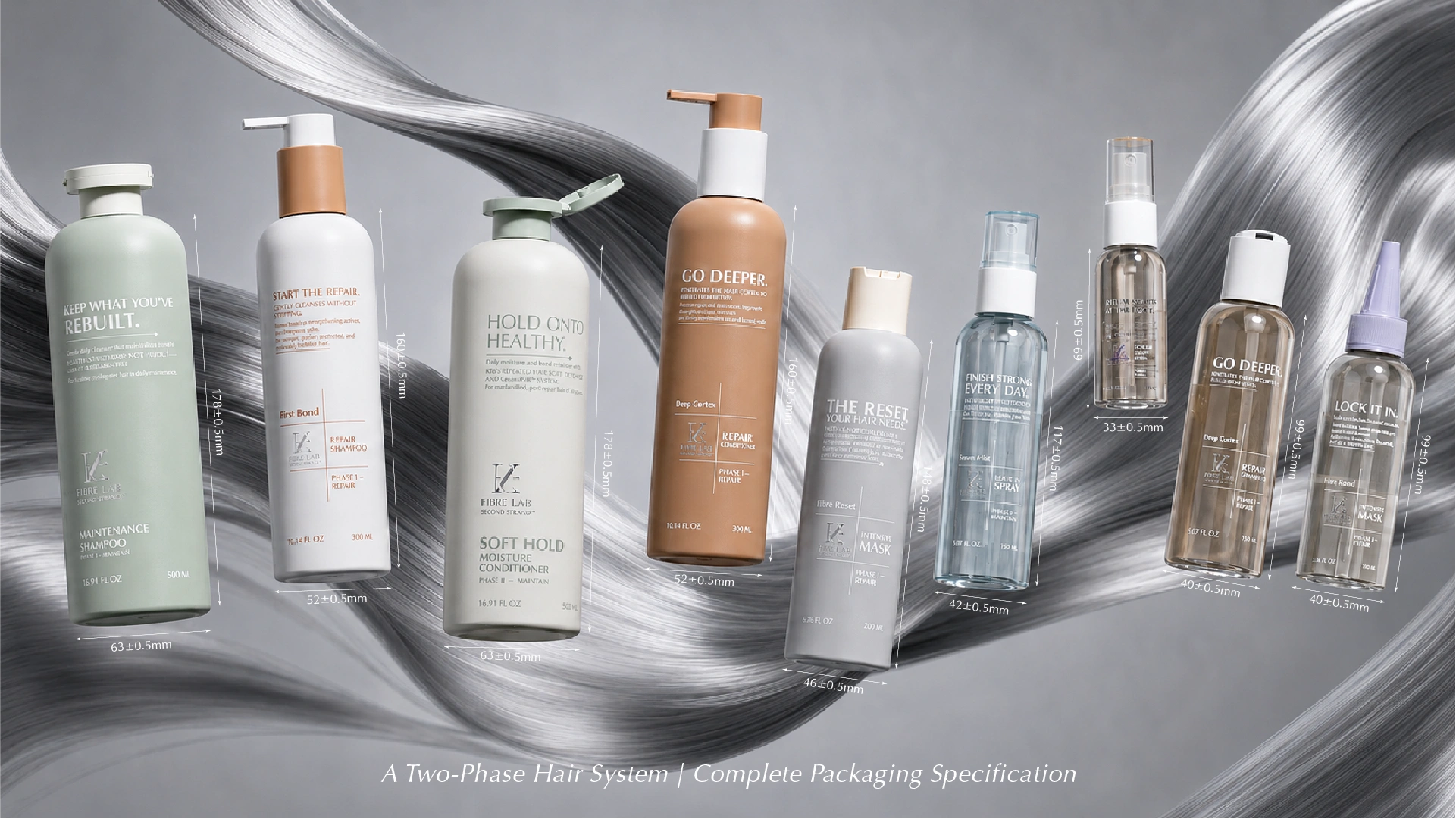
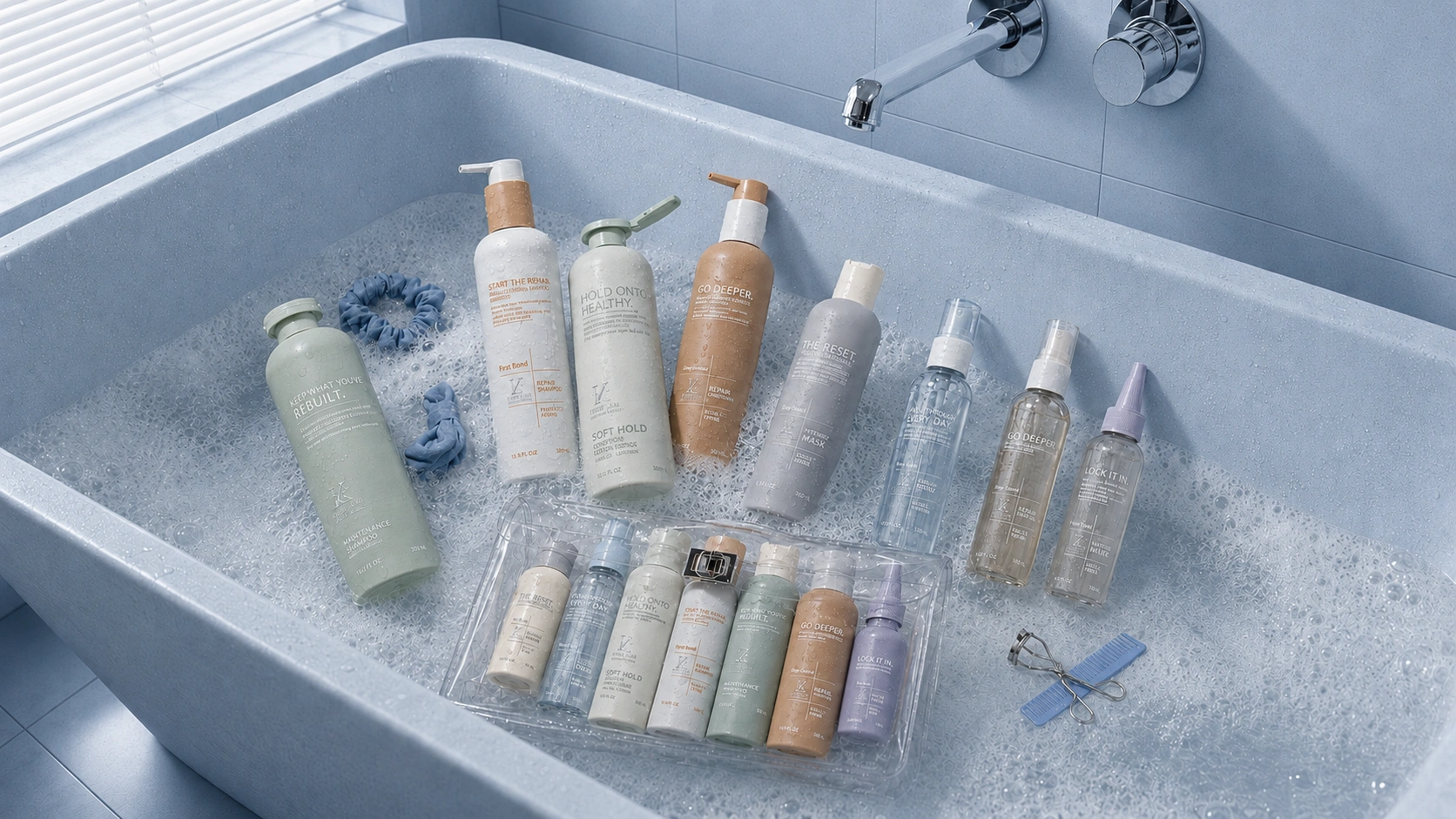
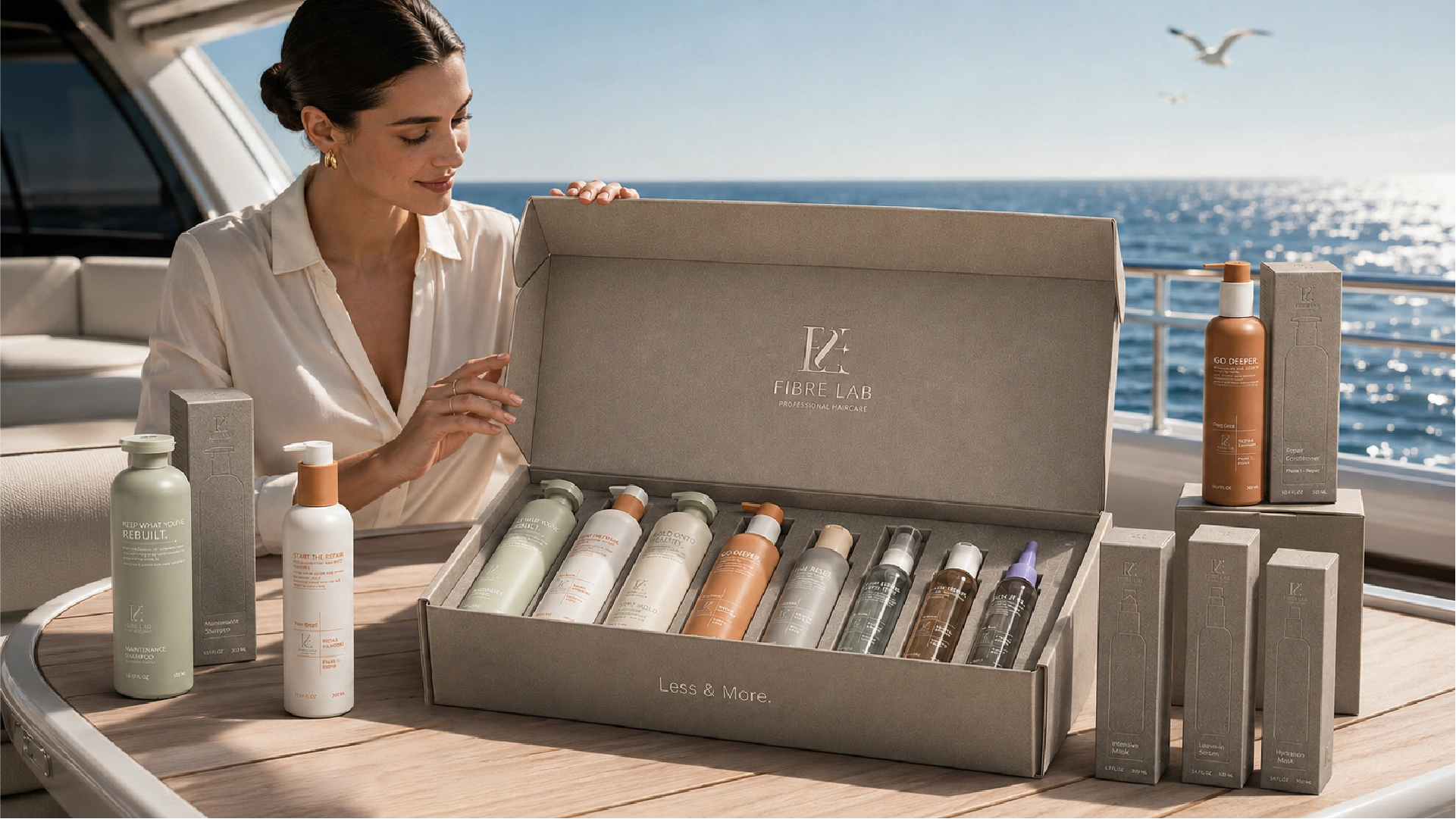
A practical illustration of bottle-platform thinking is Jarsking’s Second Strand™ Fibre Lab system — a luxury hair-repair line spanning eight SKUs built on a single customizable HDPE bottle platform. The strategic move there is reusing one engineered base across the whole regimen, then differentiating SKUs through size, color, and decoration. That keeps tooling cost and lead time down while the line still reads as a cohesive, premium family on the shelf.
If shampoo and conditioner are your core SKUs, our shampoo and conditioner bottle range is a useful starting point for stock platforms you can brand rather than tooling from zero.
Tubes shine for masks, treatments, color-care creams, and travel sizes — anywhere customers want to squeeze out a controlled amount and the product is too thick to pour. They empty cleanly, lie flat in a travel bag, and offer a large, uninterrupted surface for decoration.
The construction matters more than most brands realize:
- Standard PE tubes are cost-effective and fully squeezable — fine for masks and conditioners without aggressive actives.
- ABL (aluminum barrier laminate) adds a metal layer that blocks oxygen and light migration, protecting fragile actives, fragrance, and color-treatment chemistry from degrading over a long shelf life.
- PBL (plastic barrier laminate) offers a middle ground — better barrier than plain PE, more recyclable-friendly than ABL.
- Paper-based and PCR tubes are the fastest-growing option for sustainability-led brands.
Diameter (commonly 35 mm, 45 mm, or 50 mm) and fill volume (typically 50–250 ml) are the key spec choices, along with the nozzle and cap style — a directional nozzle for precise mask application, or a flip-top for everyday creams.

Jars are home to hair masks, butters, pomades, clays, and waxes — anything thick enough to scoop rather than pour. A wide mouth (typically 50–250 ml capacity) makes finger or spatula application easy, which is exactly why customers reach for a jar with a styling clay.
The trade-off is exposure: an open-mouth jar lets in air and fingers, accelerating oxidation and contamination. Two fixes are worth knowing — airless jars (a piston pushes product up so it never sits open to air) for oxidation-prone treatment masks, and sealed inner liners or shive seals plus tamper bands for everyday products. Material runs from PP and PET for cost and durability up to glass for prestige treatment masks where weight signals luxury.

Pumps, sprayers, and airless systems
Dispensing is where function meets perceived quality — and where a cheap component can undermine an expensive formula in one pump.
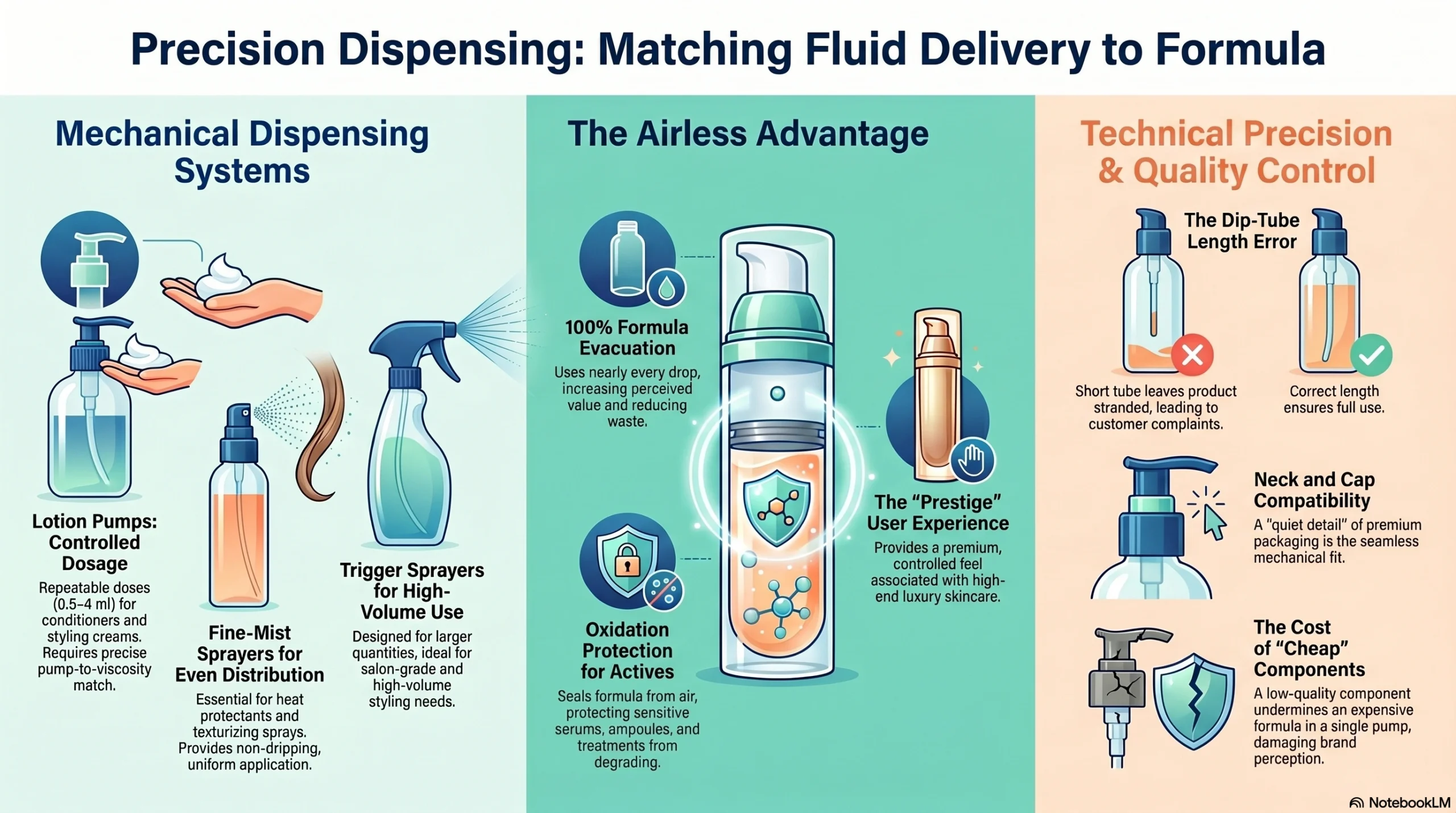
- Lotion pumps deliver controlled, repeatable doses of conditioner, leave-in cream, and styling cream. Output is measured in dosage per stroke (commonly 0.5–4 ml); match it to viscosity, since an under-rated pump will clog or stutter on a thick formula.
- Fine-mist sprayers suit heat protectants, texturizing sprays, sea-salt sprays, and detanglers, where even, non-dripping distribution is the whole point.
- Trigger sprayers handle higher-volume styling and salon products.
- Airless systems protect serums, ampoules, and active-rich treatments from oxidation, dispense nearly 100% of the formula, and deliver the premium, controlled feel customers associate with prestige skincare.
A quiet detail that separates premium from average: pump and cap compatibility with the formula and the bottle neck. A dip-tube length that is a few millimeters off leaves product stranded at the bottom — a small spec error that generates outsized customer complaints.

Droppers
Calibrated droppers are ideal for scalp serums, growth treatments, hair-oil ampoules, and concentrated hair serum formulas where dosing precision and a clinical, premium cue both matter. The pipette communicates “potent, use sparingly” before the customer reads a word of copy. Bottle sizes are usually small and intentional — 15–50 ml — and amber, frosted, or externally coated glass adds UV protection for light-sensitive actives like certain oils and vitamins. Dropper assemblies come with rubber bulbs (standard) or press-button “teat” tops (a more premium, controlled draw).
For the luxury end of dispensing and material, Jarsking’s MIRROIR Glass Hair System is a telling example — a seven-SKU luxury hair care system built around the Korean “glass hair” aesthetic, where the glass containers and finishing are designed to mirror the high-shine, polished result the products promise. It shows how, at the prestige tier, format and material become part of the brand message rather than a neutral vessel.
Use this quick reference to match format to need:
| Format | Best for | Typical material | Dispensing |
|---|---|---|---|
| Bottle | Shampoo, conditioner, wash | HDPE, PET, PP | Disc/flip cap, pump |
| Tube | Masks, treatments, travel | PE, ABL/PBL, paper/PCR | Squeeze, nozzle |
| Jar | Masks, butters, pomades | PP, PET, glass | Open scoop, spatula |
| Airless | Serums, leave-in treatments | PP/PE | Airless pump |
| Dropper | Scalp & hair oils, serums | Glass, PET | Calibrated pipette |
Choosing the Right Material: Plastic, Glass, and Sustainable Options
Material drives cost, weight, recyclability, shelf appeal, and how well your formula holds up. There is no universally “best” material — only the right one for a given product, position, and channel.
Plastic dominates hair care for good reasons: it is lightweight, shatterproof in a wet bathroom, design-flexible, and cost-efficient at volume. HDPE is the standard for shampoo and conditioner; PET offers glass-like clarity for gels, oils, and serums; PP handles caps and rigid premium parts. The growing story here is PCR — post-consumer recycled resin — which lets brands cut virgin plastic, often at 25–100% recycled content, without redesigning the whole package.

Sustainable options worth knowing
Sustainable hair care packaging has moved from nice-to-have to table stakes in many channels. The practical levers brands are pulling in 2026 include PCR plastics, refillable and recharge systems, mono-material constructions designed for recycling, aluminum (which is endlessly recyclable), and paper-based tubes and secondary cartons.
This matters at scale. According to the U.S. Environmental Protection Agency, containers and packaging make up the single largest category of municipal solid waste generated in the United States — which is exactly why retailers and regulators are scrutinizing it. The caution we always share: a sustainability claim is only as good as the supply chain behind it. Mono-material designs that are theoretically recyclable but not accepted by real curbside programs can do more brand harm than good, so design for the recycling system your customers actually have.
One regulatory note many founders miss: in the United States, most hair products are regulated as cosmetics, and your labeling has to comply accordingly. The FDA’s cosmetics labeling guidance covers required elements such as the ingredient declaration and net quantity of contents — and certain products (an anti-dandruff shampoo with an active drug ingredient, for example) carry additional over-the-counter drug requirements. Your packaging artwork and panel space need to account for this from day one, not at the proof stage.
Hair Care Packaging Design: How Brands Win on the Shelf
This is where good packaging becomes a growth lever. Material and format keep the product safe; hair care packaging design is what makes someone choose it.
Three things do most of the heavy lifting:
- CMF — color, material, and finish. A soft-touch matte coating, a hot-stamped logo, a metallized cap, or a frosted glass body changes perceived value far more than the formula label ever will.
- Haptics. Weight, grip, and the click of a closure all register as quality cues before a customer reads a single word.
- Line logic. A repeatable design system across the range so a shopper recognizes SKU four as the same family as SKU one — critical for regimens.
The right design language depends entirely on where you sit in the market, and the two ends look very different.
The clinical, treatment-led look
Science-forward hair repair and scalp-health brands lean into a medical-grade aesthetic: clean lines, restrained color, a “lab” feel, and dosing cues that imply precision. The challenge is doing this across an entire regimen without it feeling sterile or generic.
The Second Strand™ Fibre Lab system referenced earlier is a good example of solving this: across its eight repair SKUs, a full brand identity — typography, color coding, and a consistent clinical finish — turns a shared HDPE platform into a credible, premium “fibre lab” story rather than eight bottles that merely match.
The luxury, glass-led look
At the prestige end, the bottle is the experience. Heavier glass, refined silhouettes, premium caps, and surface treatments turn a product into something that earns a place on the vanity rather than the shower caddy.
The MIRROIR Glass Hair System shows how this comes together at the prestige tier: a seven-SKU luxury line developed from concept through moodboard, where positioning and visual story were defined first and the glass structure and finish followed from that brief. It is a useful illustration of design-led development — the brand decision drives the engineering, not the other way around.
Whichever direction fits, one principle holds: design intent has to survive manufacturing. A beautiful render that cannot be molded at tolerance, filled on an automated line, or held to color batch-to-batch is not a design — it is a future production problem. Bridging that gap between concept and mass production is where experienced design and engineering earn their keep.

Don't Overlook Secondary Packaging and the Unboxing Moment
Primary containers get the attention, but the carton, sleeve, or gift box around them carries more weight than most brands plan for — especially in direct-to-consumer and prestige.
For e-commerce, the secondary package is the first physical brand impression a customer ever touches, and it has to survive the journey. Drop-tested folding cartons and right-sized shippers reduce damage, returns, and the “arrived dented” reviews that quietly erode trust. For gifting and prestige lines, a rigid box with a magnetic closure, a satin-lined interior, or a custom foam insert transforms a routine purchase into something worth photographing — the kind of unboxing that earns organic social reach you would otherwise pay for.
There is a practical sourcing reason to keep secondary packaging in mind early, too. When your bottle, label, and outer carton are produced and color-matched under one roof, you avoid the print-mismatch and fit problems that appear when cartons come from a separate printer. Coordinating primary and secondary together is one of the simplest ways to protect both your timeline and your finish.
Sustainable Hair Care Packaging That Actually Works
Because sustainability is now a buying criterion for both retailers and consumers, it deserves its own playbook rather than a single recycled-material swap.
The most effective, supply-chain-ready moves include:
- Refill and recharge systems — a durable primary container plus low-impact refills, which cut material per use and build repeat purchase.
- Lightweighting — trimming gram weight in bottles and caps reduces both material and shipping emissions, often with no visible change to the customer.
- Design for Recycling (DfR) — mono-material construction and easily separable components so the package is recyclable in practice, not just on paper.
- PCR content — specifying a target recycled percentage and documenting it.
- Waterless and solid formats — shampoo bars and concentrated formats that shrink packaging dramatically, paired with paper or minimal secondary packaging.
The discipline is matching ambition to capability. Commit to a recyclable mono-material structure only if your supplier can actually source and mold it consistently, and verify your claims against the markets where you sell, since recyclability and labeling rules differ by region. Sustainability that collapses at the production stage is worse than a modest claim you can fully back up.
Jarsking's Lead Time
Lead time depends on the path you take:
- OEM (you supply finished designs and specs): roughly 33–65 days from sampling to production-ready, excluding shipping
- ODM (you customize a proven existing structure): roughly 40–60 days
- OBM (full custom development including new molds): roughly 84–110 days, since steel mold production alone often runs 35–40 days
Add approximately 35–40 days for sea freight on international orders, and confirm color via Pantone codes or physical samples — screen captures are not reliable for matching.
Which path is right comes down to your timeline, budget, and how distinctive you need to be. If you have a hard launch date and limited budget, customizing a proven platform (ODM) usually wins. If a bespoke silhouette is core to your brand story — as with a prestige glass line — the longer OBM route is the investment that pays back in differentiation. A capable partner can also blend approaches across a single regimen: stock platforms for the wash SKUs, custom for the hero.
How to Choose a Hair Care Packaging Supplier
The supplier decision is really a risk decision. Use this checklist:
- Format and material breadth — can they cover your whole regimen (bottles, tubes, jars, droppers, plus secondary cartons) so you are not stitching together five vendors?
- Compliance and documentation — relevant certifications (ISO quality systems, BSCI for ethical manufacturing, REACH/RoHS for material safety) and the paperwork to back them.
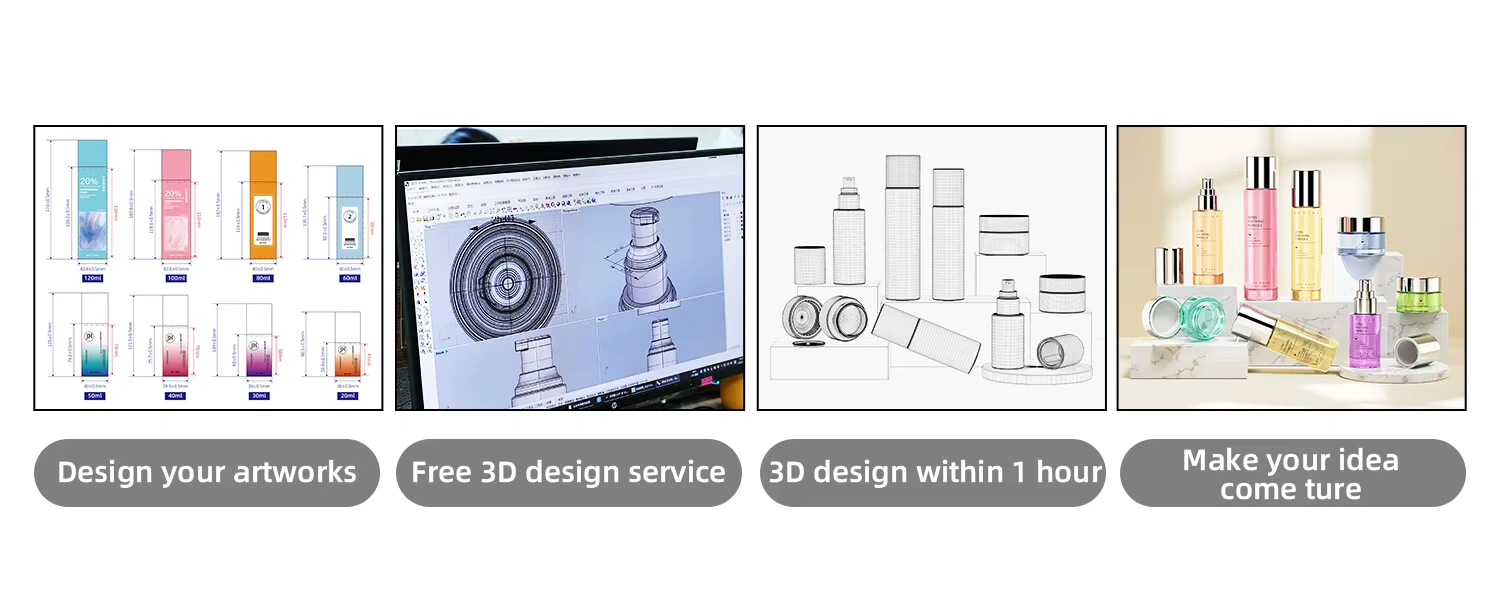
- Design and R&D support — a partner who can take you from brief to manufacturable spec, not just quote against your drawings.
- Single-source coordination — bottle, pump, cap, label, and box arriving together, on one timeline, eliminates the cascade failures that happen when components ship from four countries.
- Quality control and traceability — defined inspection protocols (AQL sampling), batch lot numbers, and consistency you can audit run to run.
- Export and market experience — proven shipping into your target market and familiarity with its labeling rules.
The brands that scale smoothly tend to consolidate around one accountable partner with in-house tooling and decoration, because that is what protects color consistency, timelines, and intellectual property as volumes grow.
FAQs
HDPE is the most common choice — opaque, durable, chemical-resistant, and cost-effective at volume. PET is preferred when you want clarity to show a gel or oil, and PCR versions of both let you reduce virgin plastic. For thicker conditioners and treatments, pair the bottle with a pump rated for higher viscosity.
Plastic wins for everyday wash products: it is lightweight, shatterproof in a wet bathroom, and lower cost. Glass wins for prestige hair oils, serums, and treatment “ritual” products where weight, inertness, and a luxury feel justify the added cost and care in shipping.
The highest-impact levers are refillable systems, lightweighting, mono-material designs built for recycling, PCR content, and waterless or solid formats. Make sure each choice is recyclable in the markets you actually sell into rather than only in theory.
Customizing an existing structure typically takes about 40–60 days from sampling to production; full custom development with new molds runs roughly 84–110 days, largely because steel mold production alone takes 35–40 days. Add about 35–40 days for sea freight on international orders.
Yes — compatibility testing is one of the most important and most skipped steps. Some formulas react with certain plastics or closures: fragrance and essential oils can be absorbed by or migrate through the wrong resin, active ingredients can degrade, and high-pH or solvent-based products can stress-crack a bottle or corrode a pump spring. Before committing to mass production, fill samples with your actual formula and run a stability check over several weeks (ideally including elevated-temperature conditions) to confirm the material, liner, and pump all hold up. A good supplier will provide samples specifically for this purpose.
Absolutely, and most well-built regimens do. A single line might use opaque HDPE bottles for shampoo and conditioner, a laminate tube for the mask, a glass dropper for the scalp serum, and an airless pump for the leave-in treatment — each chosen for its formula and price point. The key to keeping it cohesive is a consistent design system: shared color coding, typography, and finish so the SKUs still read as one family despite different shapes and materials. Sourcing them through a single partner also keeps color, decoration, and timelines aligned across the mixed formats.