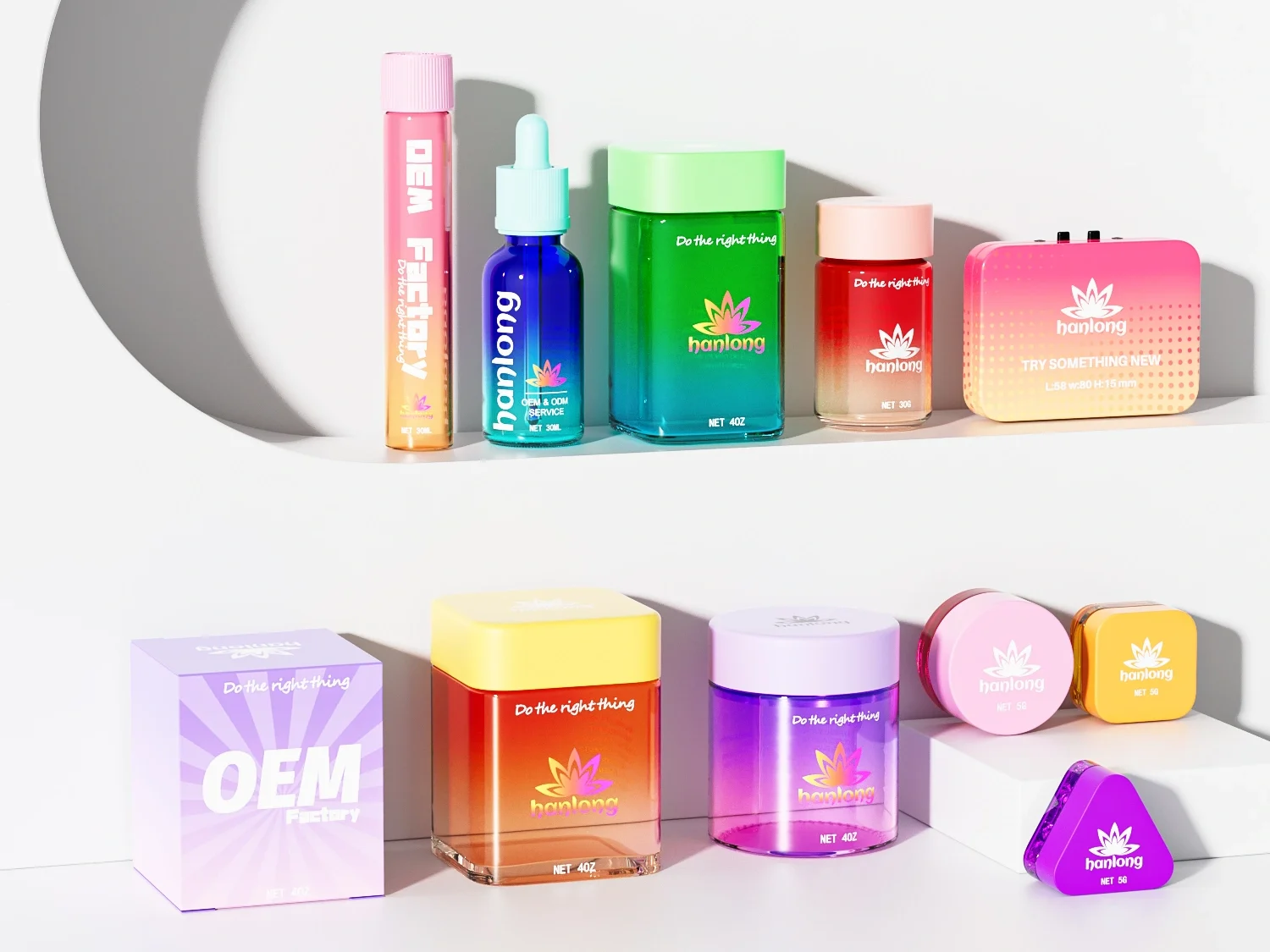


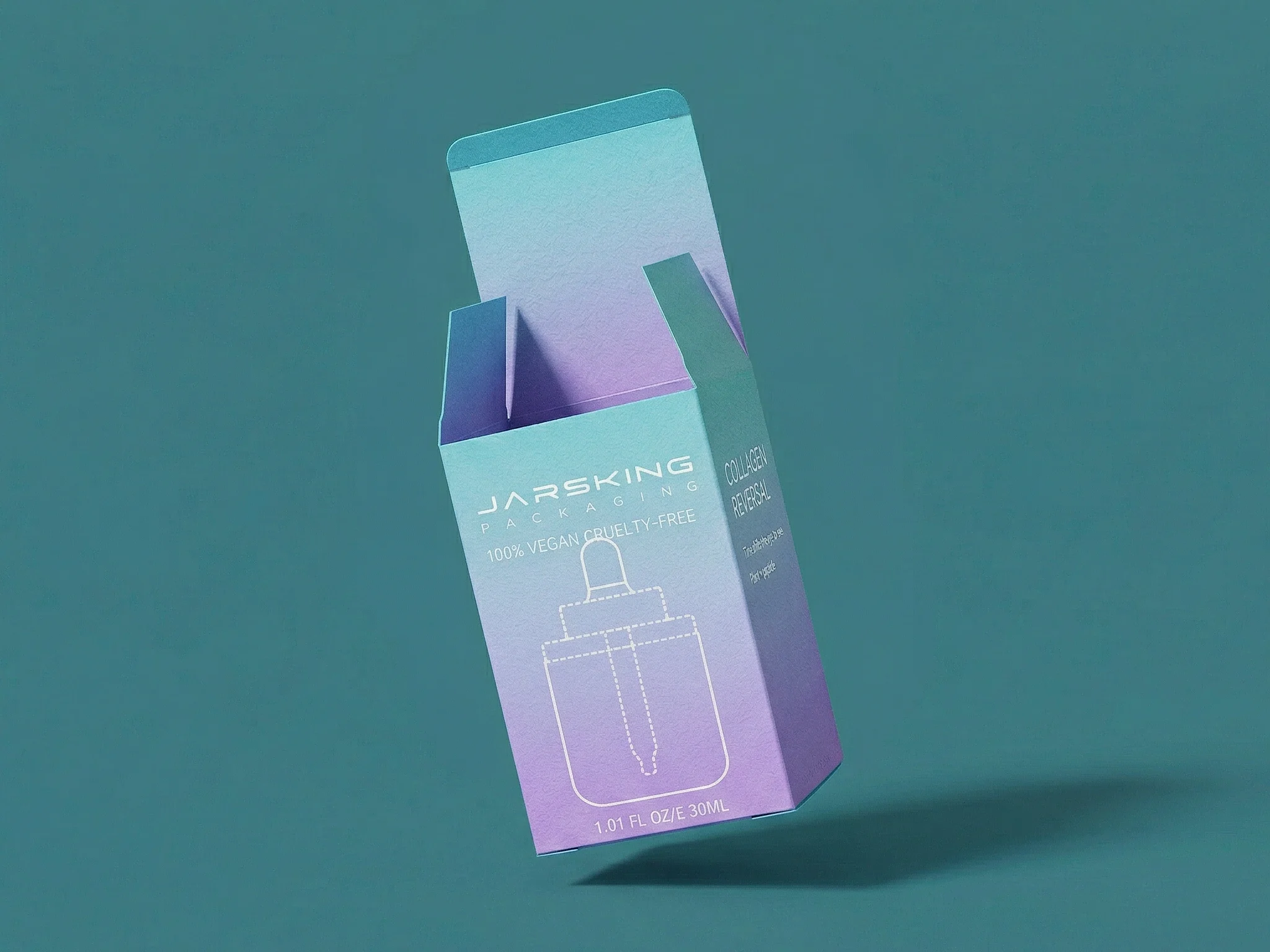





You’ve spent decades perfecting your craft. Your production line is flawless. Your defect rate is under 1%. You’ve supplied some of the most recognizable brands in the world, and you know — with complete confidence — that your formulas and materials rival anything on the market.
So you decided it was time. You launched your own brand.
And then… nothing happened.
No buzz. No sales. Just inventory sitting in a warehouse and a growing suspicion that the market is broken — or unfair — or simply doesn’t appreciate quality anymore.
Here’s the truth no one told you: the market isn’t broken. Your approach to it is.
The B2B-to-B2C transition is one of the most treacherous moves a manufacturer can make — not because your product isn’t good enough, but because the skills, logic, and instincts that made you exceptional in contract manufacturing are actively working against you in the consumer marketplace. At Jarsking, we’ve partnered with hundreds of brands across skincare, beauty, fragrance, and personal care — from first-time indie founders to influencer-led labels to factory owners making exactly this leap. We’ve seen this story end well, and we’ve seen it end in expensive silence.
In this article, we’ll break down the three structural traps that kill manufacturer-turned-brand-owner ventures, and exactly what it takes to escape them. If you’re planning a B2B-to-B2C transition — or you’re already in one and wondering why it isn’t working — this is the most important thing you’ll read today.
The Invisible Wall Between Manufacturing and Branding
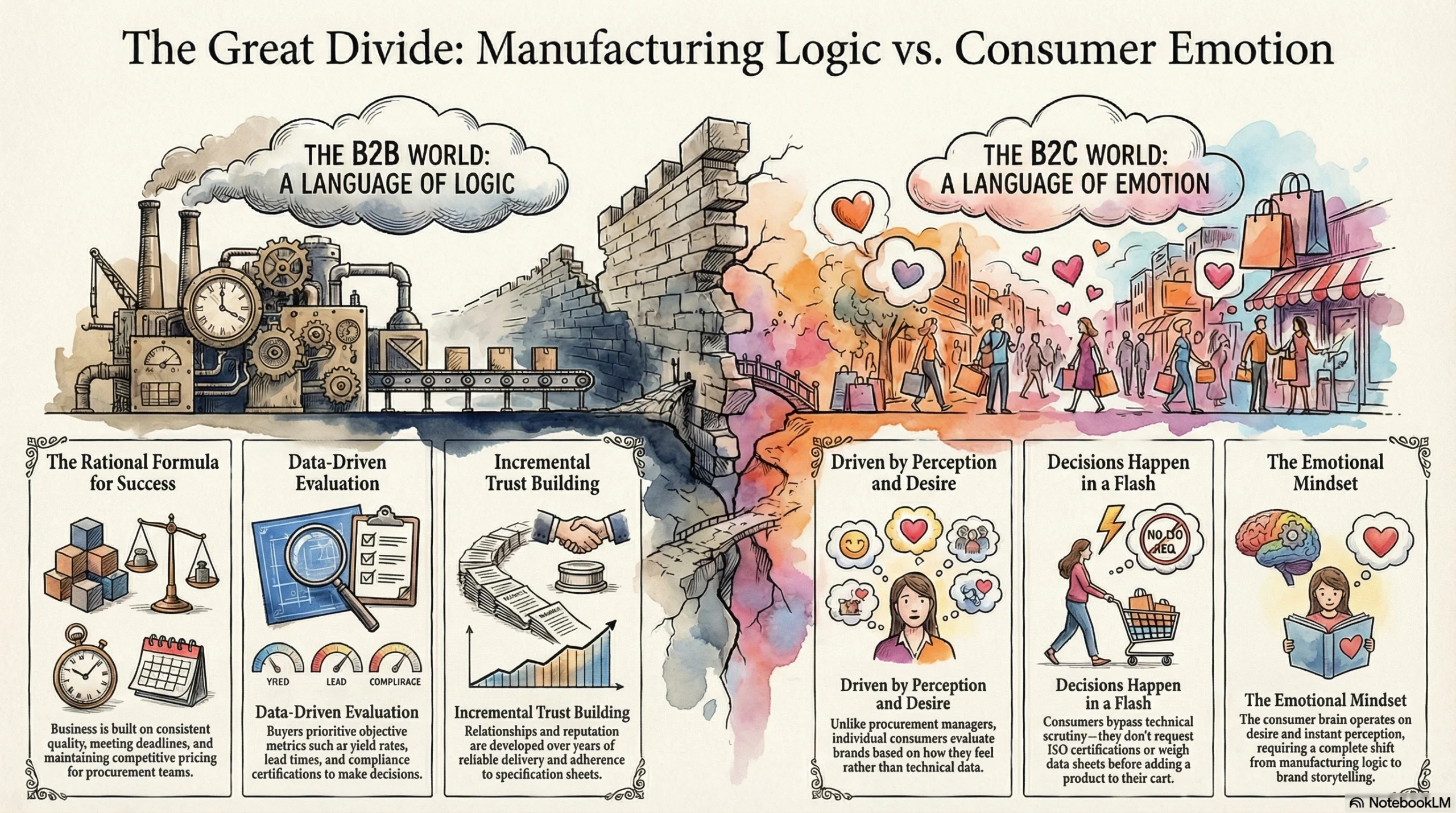
Before we get into the traps, we need to establish the foundational problem: B2B and B2C operate in completely different languages.
In B2B manufacturing, success is built on a clear and rational formula: deliver consistent quality, hit your deadlines, maintain competitive pricing, and build relationships with procurement teams who evaluate you on data. The better your numbers — yield rate, lead time, compliance certifications — the better your business. This is a world of logic, specification sheets, and incremental trust built over years of reliable delivery.
The consumer market does not work this way. Not even slightly.
B2C is driven by emotion, perception, and desire. Consumers don’t evaluate your brand the way a procurement manager evaluates a supplier. They don’t request your ISO certifications before adding a serum to their cart. They don’t weigh your material data sheets before choosing one moisturizer over another. They feel their way to a decision — and that decision happens faster than you think.
The wall between these two worlds isn’t made of skill or effort. It’s made of mindset. And until you genuinely understand how differently the consumer brain operates compared to a B2B buyer, every investment you make in your brand will underperform.
Let’s look at the three specific ways this plays out — and what to do about each one.
Death Trap #1 — You're Still Pitching to a Procurement Manager Who Isn't There
What Consumers Actually Buy
Here’s a scenario that plays out constantly in the beauty and personal care industry: a manufacturer with a world-class formula, a pristine production facility, and a proven track record launches their own product. They build their brand story around quality. They highlight their certifications. They publish their ingredient lists with pride. They invest in professional lab testing and feature the results prominently.
And consumers scroll right past it.
This is not ingratitude. It’s human psychology. Research into consumer purchase behavior consistently shows that packaging and visual presentation influence buying decisions before any other factor — including price. Shoppers in physical retail spend an average of 7 seconds evaluating a product on shelf. Online, that window is even shorter. In that window, they are not reading your spec sheet. They are forming an emotional impression based entirely on what they see.
The procurement manager you’ve spent 20 years negotiating with is a professional evaluator. They are paid to look past surface presentation and assess underlying value. Your end consumer is not. They are making an intuitive, emotional judgment call — and your product’s visual presentation is the only evidence they have to go on.
This is the first trap: you’ve been optimizing for an audience that doesn’t exist in your new market.
Emotion Is the Real Purchase Driver
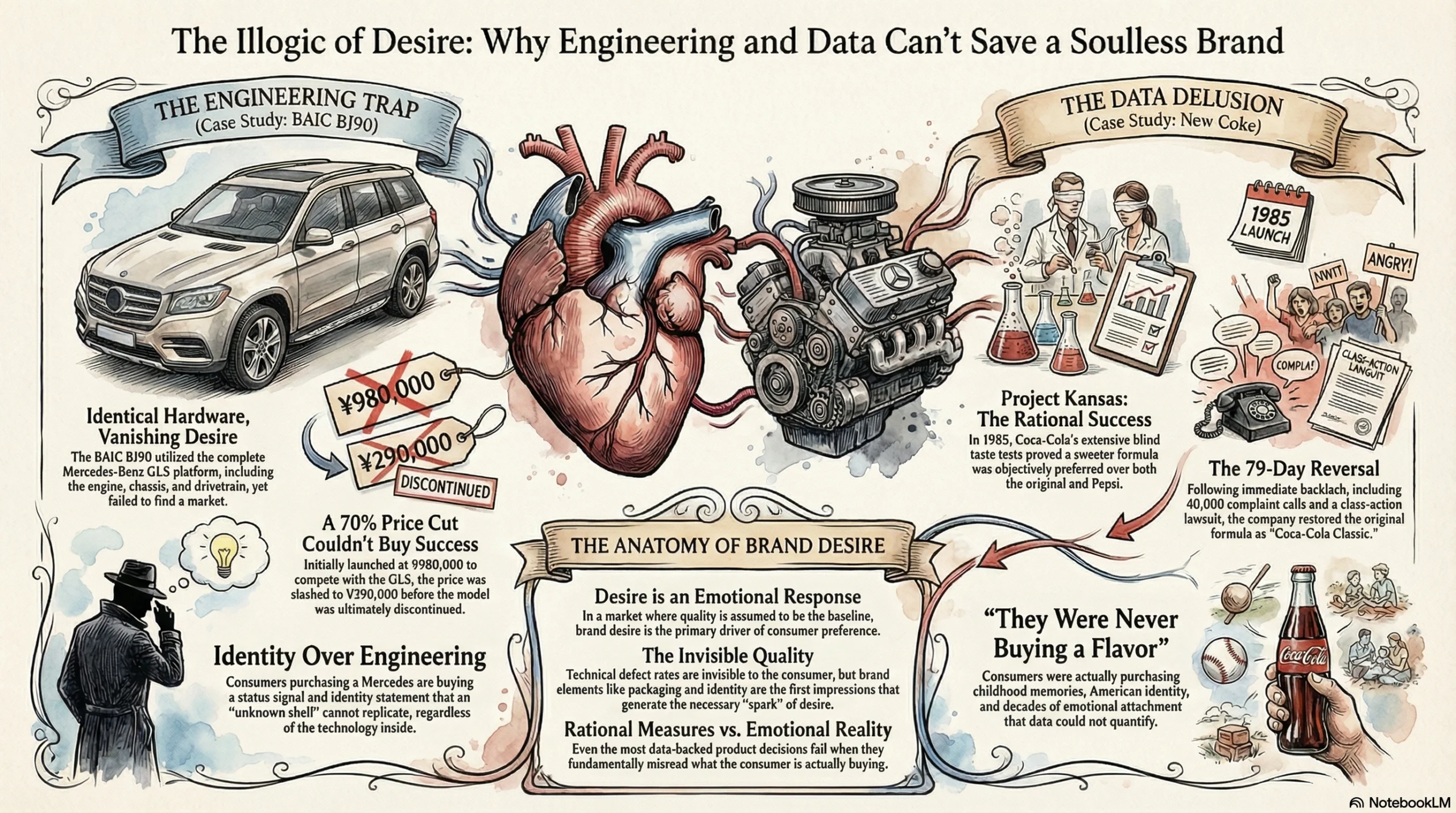
Consider the case of BAIC’s BJ90 — a vehicle that borrowed the complete Mercedes-Benz GLS platform, including the engine, chassis, and drivetrain. On paper, it was an extraordinary product. It launched at ¥980,000, directly competing with the GLS it was built upon. It didn’t sell. The price was cut again and again, eventually reaching ¥290,000 — less than a third of its original asking price. It still didn’t sell. The model was eventually discontinued.
The engineering was world-class. The brand was not. Consumers buying a Mercedes-Benz aren’t simply purchasing German engineering — they’re purchasing the emotional value, the status signal, and the identity statement that the Mercedes brand carries. Strip away the brand and put identical technology in an unknown shell, and the desire evaporates.
This is your product without brand investment. No matter how good it is underneath, if the first impression doesn’t generate desire, the consumer moves on.
Your 99% defect rate is invisible to the consumer. Your packaging is not. In a market where quality is assumed to be baseline, brand desire is what creates preference — and desire is an emotional response, not a rational one.
This isn’t just a story about one Chinese automaker. In 1985, Coca-Cola — armed with the most tested product reformulation in history — made the same mistake. The result became a Harvard Business School case study in what happens when you optimize for the product and forget about the brand.
In 1985, Coca-Cola did something that seemed, by every rational measure, like the right business decision. They conducted extensive blind taste tests — internally codenamed Project Kansas — and discovered that consumers consistently preferred a sweeter, reformulated version of Coke over the original. They also preferred it over Pepsi. The science was clear. The new formula was objectively better received.
So in April 1985, Coca-Cola retired their 99-year-old original formula and launched New Coke.
The backlash was immediate and ferocious. Coca-Cola’s phone lines were flooded with over 40,000 complaint calls and letters within the first month. Consumers stockpiled cases of the old formula. Protest groups formed. A man in Seattle filed a class-action lawsuit. Bottlers were furious. Within 79 days, Coca-Cola reversed one of the most data-backed product decisions in their history and relaunched the original as “Coca-Cola Classic” — an admission, in front of the entire world, that they had fundamentally misread what their consumers were actually buying.
They were never buying a flavor. They were buying childhood memories, family gatherings, American identity, and decades of emotional attachment that no taste test could quantify. When the formula changed, all of that disappeared — and no amount of superior product performance could replace it.
The lesson is identical to the BAIC story: the best product, proven in controlled conditions, lost catastrophically to an emotional reality that the data never captured.
Death Trap #2 — Your B2B Network Is Worthless in a Consumer Market
The Trust Deficit
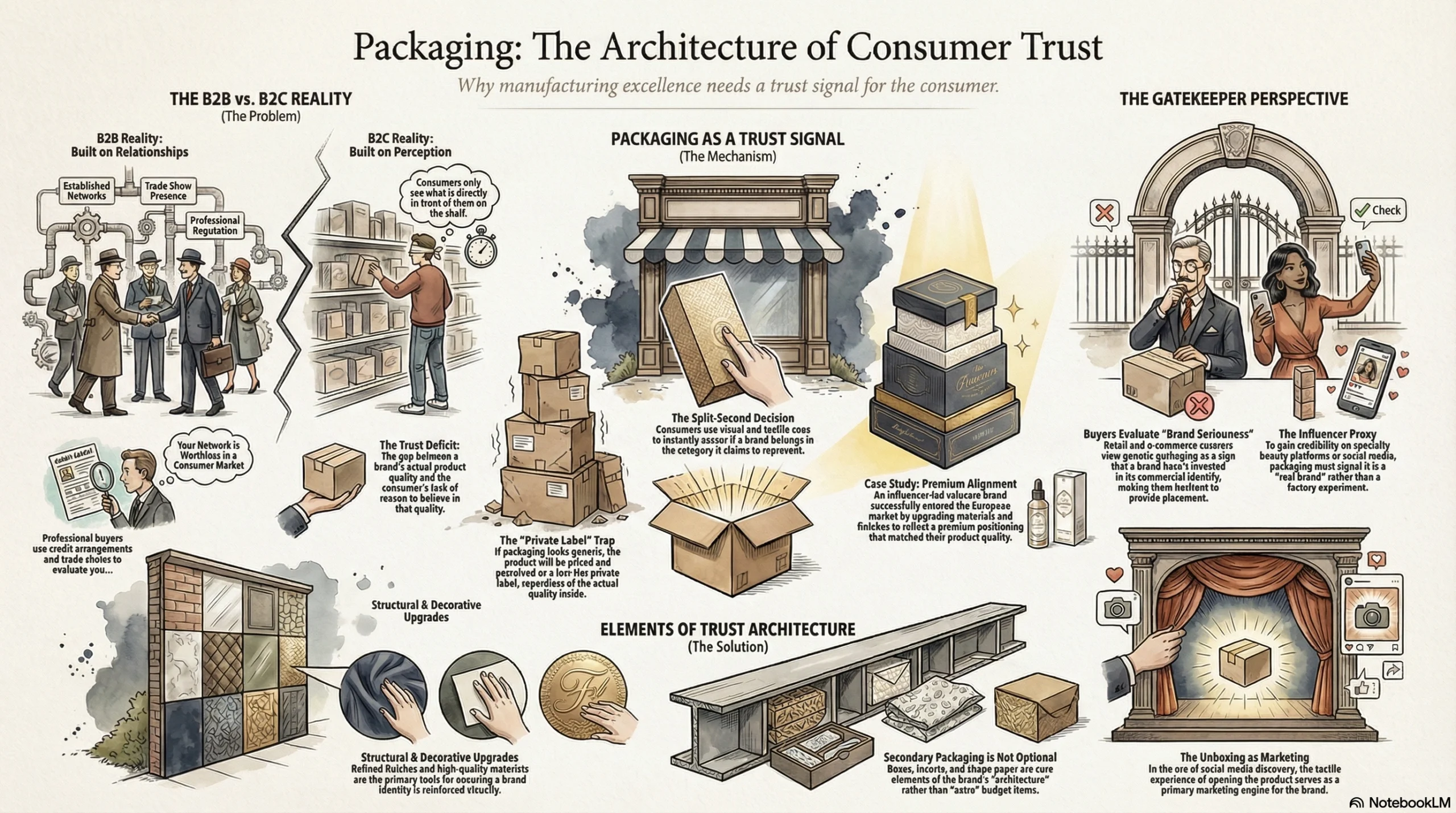
Over the course of your manufacturing career, you built something genuinely valuable: a network. Distributor relationships. Buyer contacts. Trade show presence. Credit arrangements. Referral pipelines. In B2B, this network is the engine of your business — new contracts flow through it, and your reputation spreads through word of mouth among professionals who know how to evaluate you.
In B2C, none of this transfers.
The end consumer doesn’t know your name. They have no reason to. They haven’t heard of you from a trusted colleague. They haven’t seen you at an industry event. They stumbled across your product on a shelf or a screen, with zero prior context, and they are deciding in seconds whether to engage or move on.
Trust is the currency of the consumer market. And trust, in B2C, is not built through relationships — it’s built through perception. It’s built through the signals your brand sends before a single word is read or a single product is used. The most powerful of those signals is your packaging.
Packaging as a Trust Signal
This is something Jarsking’s team sees play out repeatedly: a brand with genuinely excellent product quality fails to gain traction because its packaging communicates the wrong tier. Consumers use visual and tactile cues to assess whether a brand belongs in the category it’s claiming. If your packaging looks like a generic private label, your product will be perceived and priced like one — regardless of what’s inside.
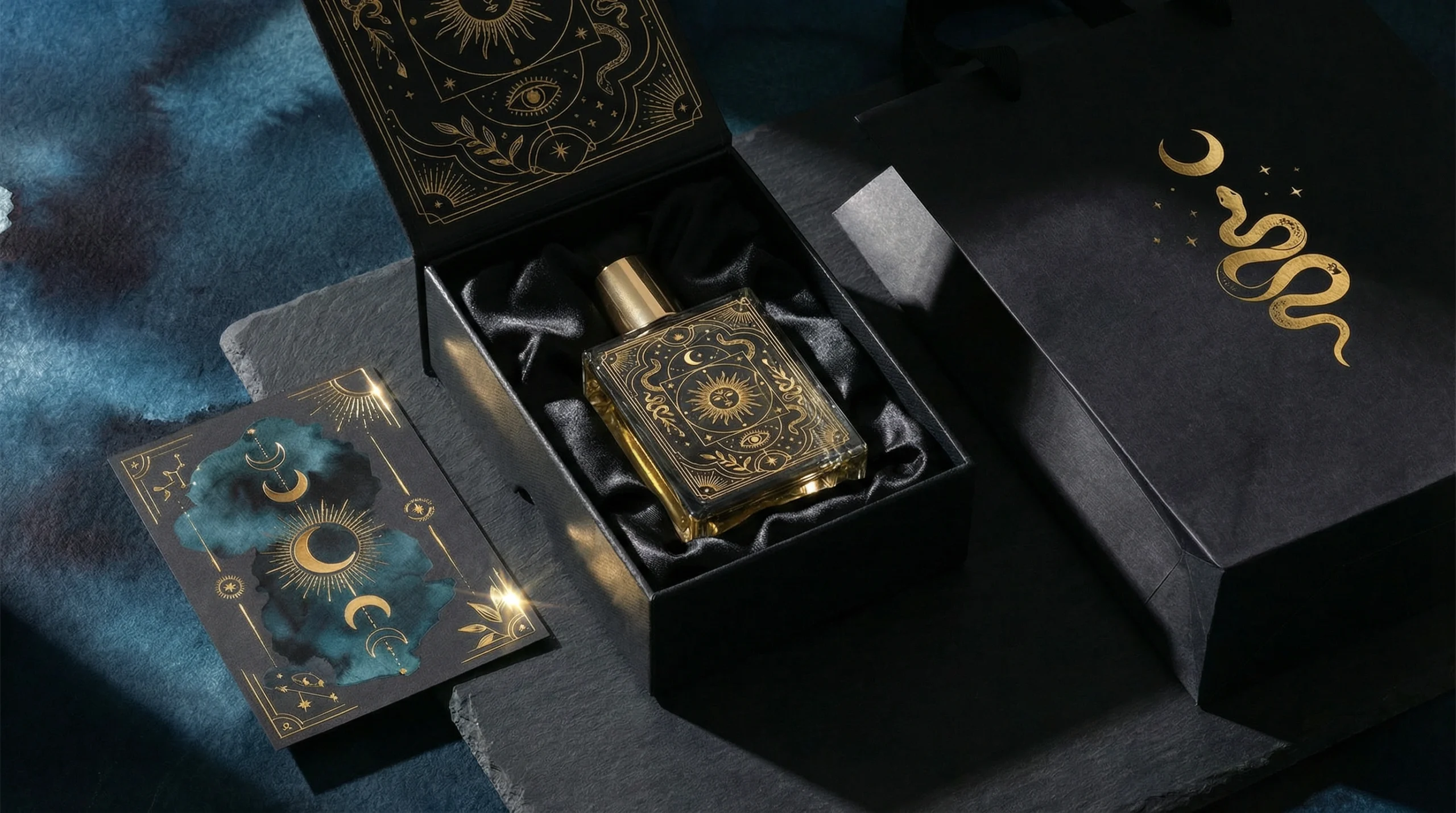
Conversely, when a brand invests in packaging that communicates its positioning clearly and confidently, trust follows. We worked with an influencer-led skincare brand entering the competitive European market that had strong products but packaging that wasn’t reflecting their premium positioning. By redesigning their structural and decorative packaging — upgrading materials, refining finishes, and ensuring every visual element reinforced their brand identity — they went from a brand that looked out of place on premium shelves to one that belonged there.
What Retail and E-Commerce Buyers Are Really Evaluating
It’s worth noting that the trust signal challenge extends beyond end consumers. Retail buyers and e-commerce platform curators — the gatekeepers between your brand and mass distribution — also evaluate packaging as a proxy for brand seriousness. A brand that shows up with generic packaging signals that it hasn’t invested in its commercial identity. That makes buyers nervous.
If you want placement in premium retail, if you want credibility on specialty beauty platforms, if you want influencers to genuinely want to feature your product, your packaging needs to communicate that you are a real brand — not a factory experiment.
Secondary packaging is part of this equation. The box, the insert, the tissue, the unboxing moment — these are not optional extras for brands with extra budget. They are core elements of your trust architecture. In an era of social-media-driven discovery, the unboxing is the marketing.
Death Trap #3 — You're Treating Design Like a Cost Center, Not a Revenue Engine
Why Design Is Life or Death in B2C
Of the three traps, this one is the most consistently underestimated by manufacturers making the B2C transition — and it’s the one that does the most damage.
In OEM manufacturing, design is largely irrelevant to your commercial success. Your clients bring their own specifications, their own brand guidelines, their own packaging concepts. Your job is to execute to spec, not to create visual identity. As a result, most experienced factory owners have never had to develop design intuition, never had to think about what makes packaging desirable rather than functional, and never had to consider how a color palette or a structural form communicates brand personality.
This isn’t a criticism — it’s simply the nature of the work. But it creates a profound blind spot when the same founder steps into the B2C world.
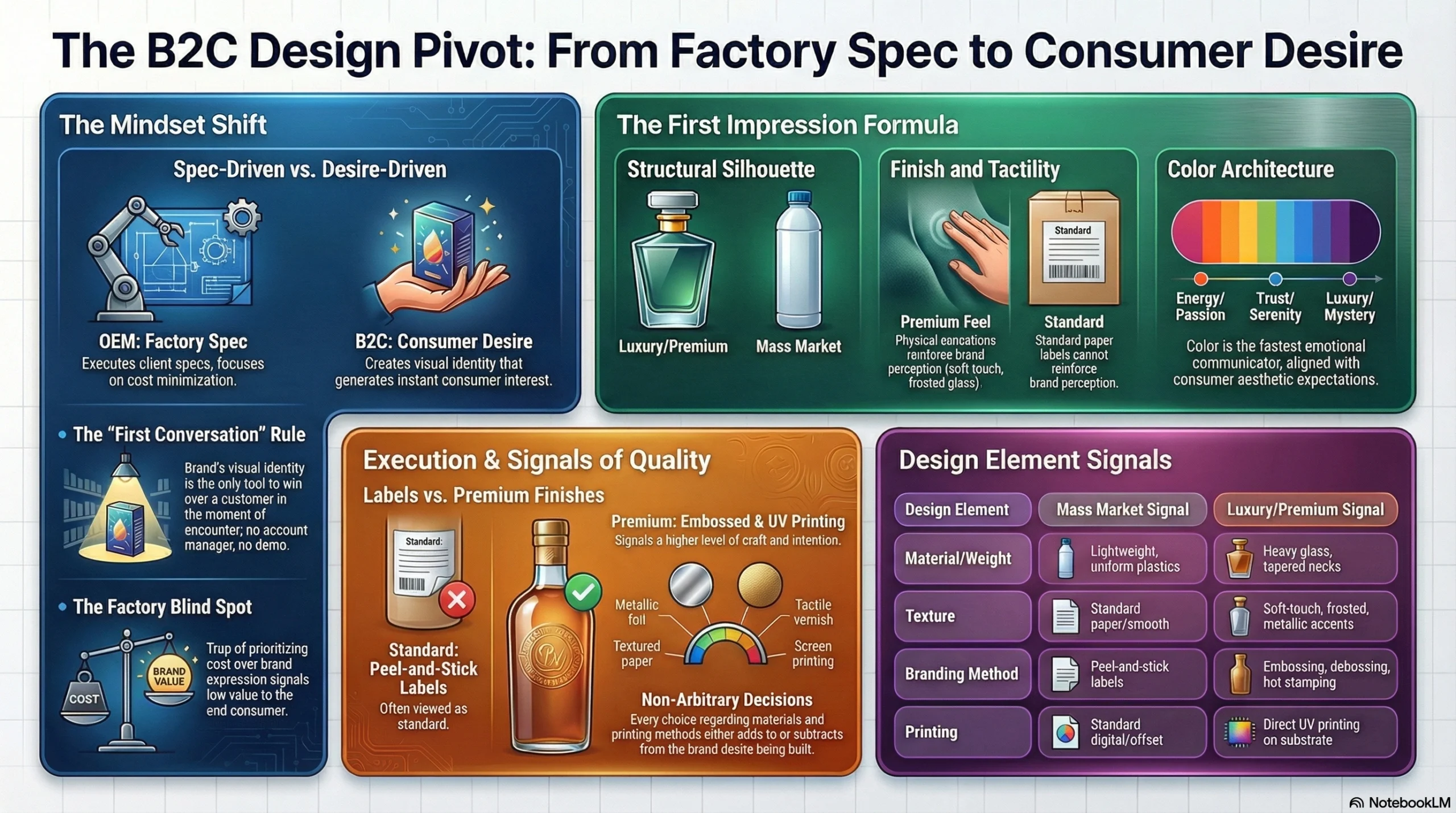
In B2C, design is not a department. It’s the first conversation your brand has with every potential customer. There is no account manager to build a relationship, no product demo to win someone over, no reputation to precede you. There is only what the consumer sees in the moment they encounter your product. If that moment doesn’t generate interest, curiosity, or desire, the conversation is over before it began.
If you are still approaching your brand’s visual identity with a factory mindset — prioritizing cost minimization over brand expression, choosing standard molds over custom structures, settling for generic labels rather than investing in premium finishes — you are communicating to consumers that your brand is not worth their attention.
The First Impression Formula
What actually makes packaging perform in B2C — whether on a physical shelf or an e-commerce product page — comes down to a handful of critical design decisions:
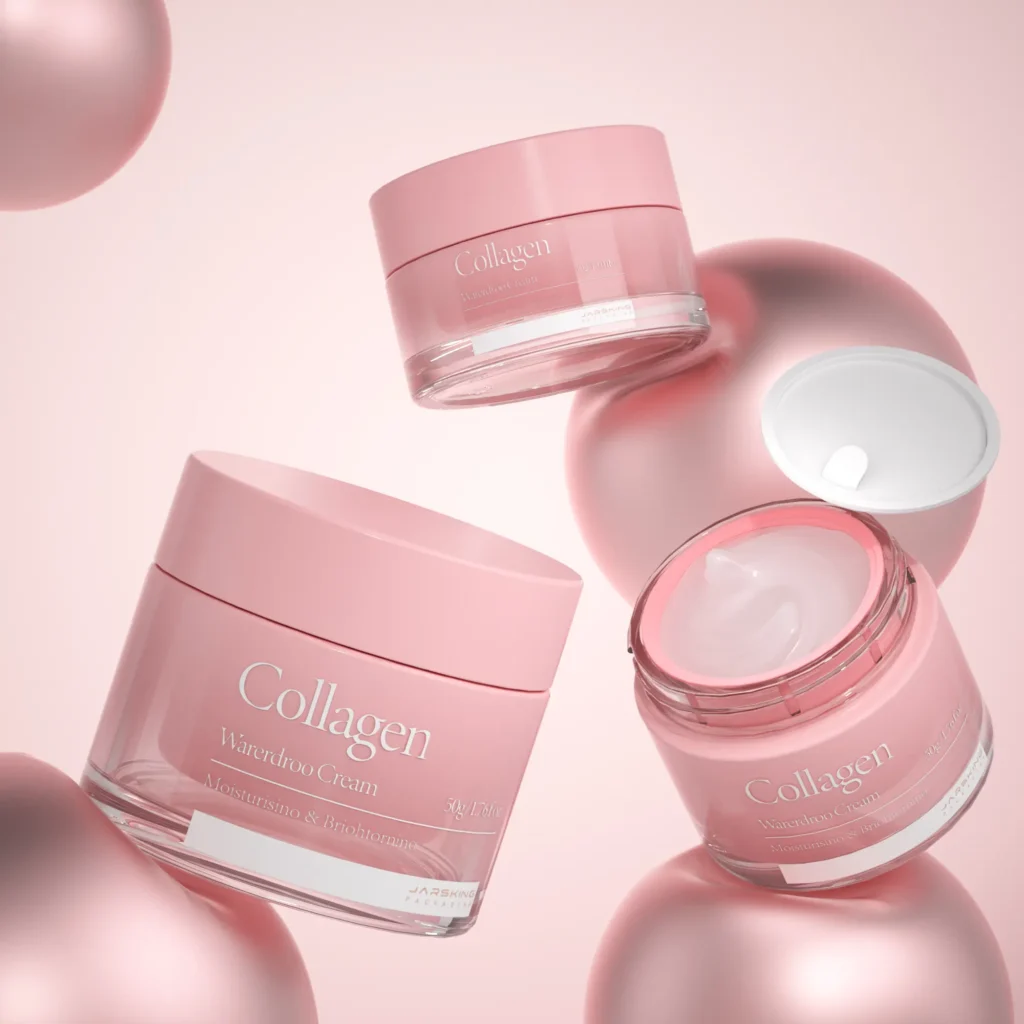
Structural silhouette: The shape of your container communicates before any other element. A distinctive form creates instant recognition and signals category positioning. Consumers associate specific shapes with specific tiers of product — a heavy glass bottle with a tapered neck reads as luxury; a lightweight, uniform cylinder reads as mass market.
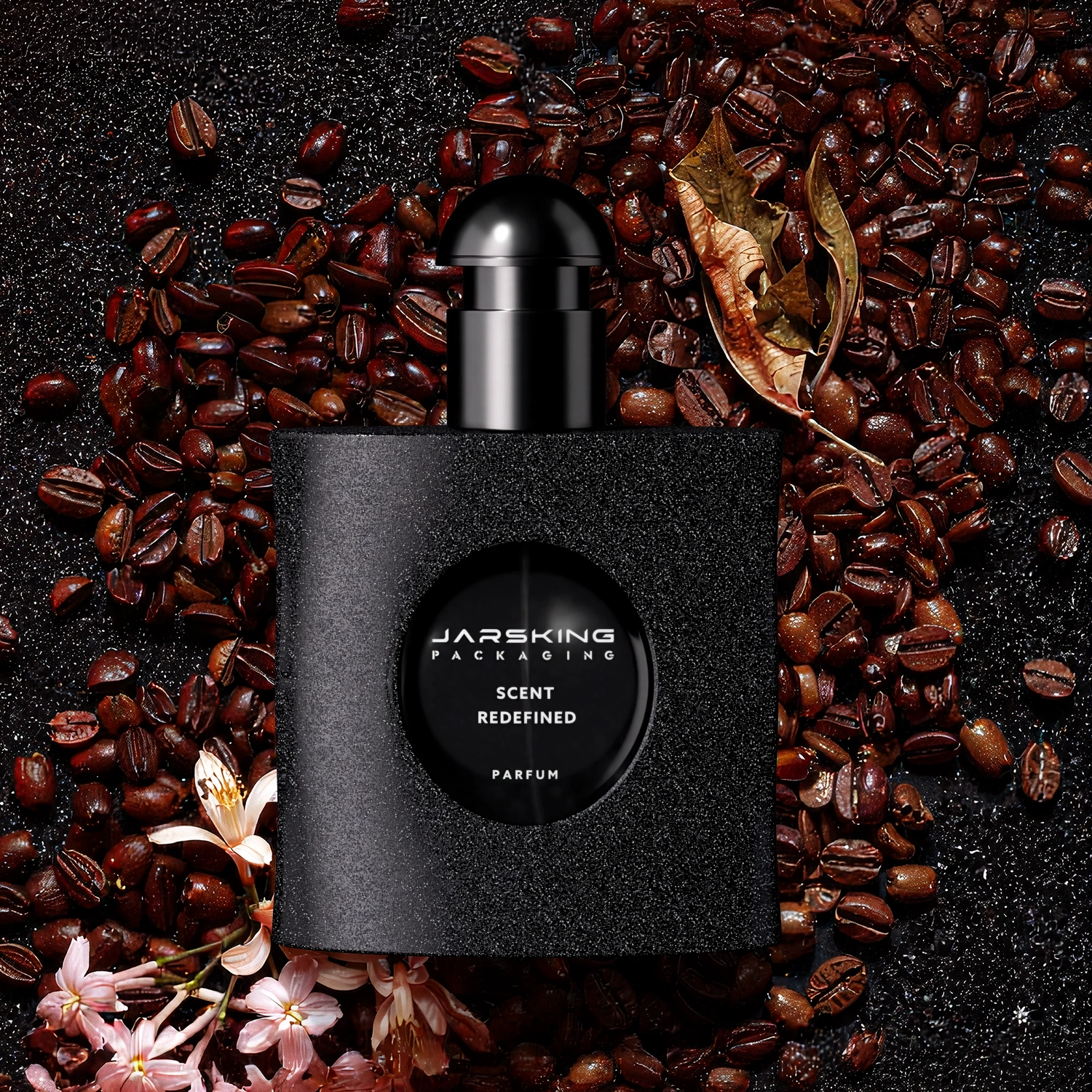
Finish and tactility: How packaging feels in the hand reinforces how the brand is perceived. Soft-touch lamination, frosted glass, and metallic accents communicate premium quality in ways that printed paper labels cannot.
Color architecture: Color is the fastest emotional communicator in brand design. Your palette needs to be intentional, consistent, and aligned with both your target consumer’s aesthetic expectations and your positioning tier.
Label vs. direct print vs. embossed decisions: Each execution method sends a different signal about investment and quality. Embossed or debossed branding, direct UV printing on glass, and hot stamping all communicate a level of craft and intention that peel-and-stick labels do not.
None of these decisions are arbitrary. Each one is a deliberate signal to a specific type of consumer, and each one either adds to or subtracts from the brand desire you’re trying to build.
Premium Finishes That Signal Luxury Without Luxury Price Tags
One of the most persistent misconceptions among manufacturers entering B2C is that premium-looking packaging requires premium budgets. It doesn’t — but it does require premium expertise and the right manufacturing partner.
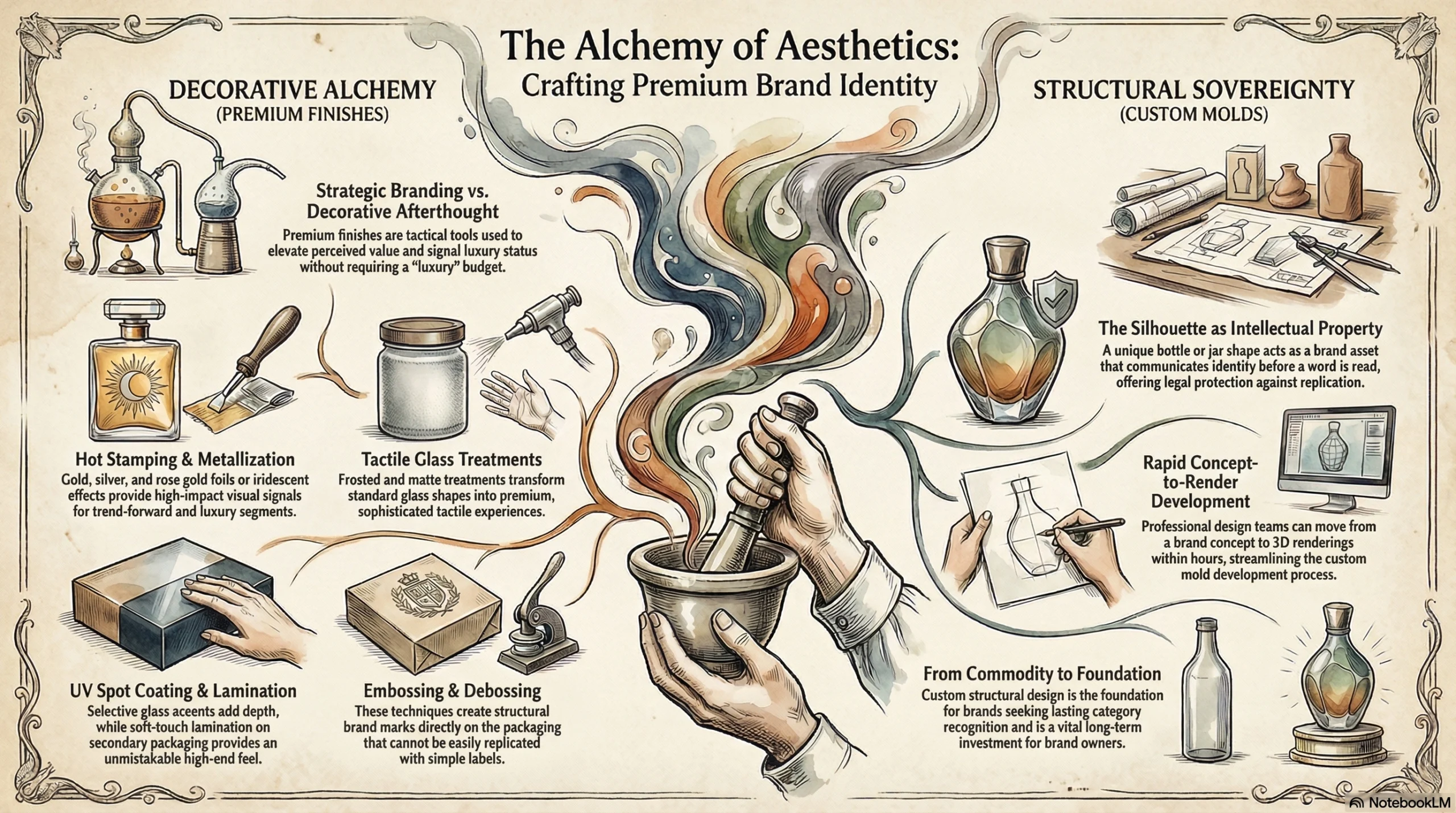
At Jarsking, our decorative capabilities exist specifically to give brands access to luxury-tier visual signals at commercially viable price points. Our finish options include:
Hot stamping in gold, silver, rose gold, and custom foil colors
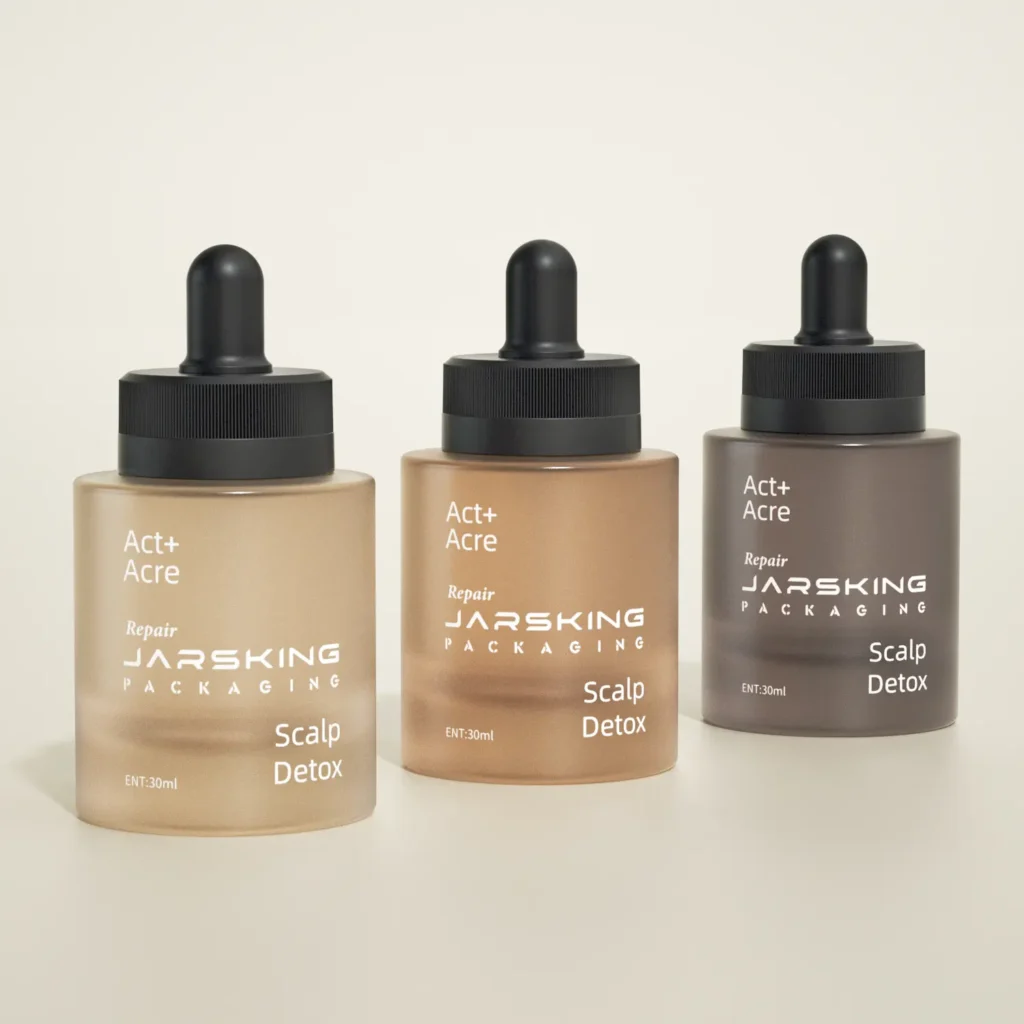
Frosted and matte glass treatments that transform standard shapes into premium tactile experiences
UV spot coating for selective gloss accents that add depth and sophistication
Metallization and iridescent effects for brands targeting the luxury and trend-forward segments
Soft-touch lamination on secondary packaging that delivers an unmistakable premium feel
Embossing and debossing for structural brand marks that cannot be replicated with labels
These aren’t decorative afterthoughts — they are strategic brand tools. When used intentionally and consistently, they elevate the perceived value of your product significantly beyond the cost of the finish itself.
Custom Mold Design — The Structural Brand Advantage
Beyond finish, the single most powerful long-term brand investment a manufacturer-turned-brand-owner can make is a custom structural mold.
A unique bottle or jar silhouette becomes a brand asset. Think of the most recognizable fragrance bottles in the world — the shape alone communicates the brand before a single word is read. That structural identity is owned, protected, and impossible to replicate without legal consequence. It transforms your packaging from a commodity into intellectual property.
Jarsking’s in-house design team works with brands to develop custom structural concepts from scratch, delivering 3D renderings within hours of initial consultation and guiding the mold development process from concept through production. For brands serious about building lasting recognition in their category, this is not a luxury — it is the foundation.
The Language Gap — And How to Close It
Let’s bring the three traps together into their underlying cause — because at their root, they are all the same problem.
The factory language is built on one operating principle: deliver maximum quality at minimum cost within agreed timelines. Every decision in a manufacturing environment flows from this logic. It is rational, measurable, and extraordinarily effective for the business it was designed to serve.
The consumer market language is built on a completely different principle: make someone believe that your product will make their life better. It is emotional, perceptual, and fundamentally about desire rather than specification.
The distance between those two sentences is where brands die.
A Tale of Two Launches
Consider a real scenario Jarsking worked through with a European-market skincare brand — one that illustrates this gap more clearly than any theory can.
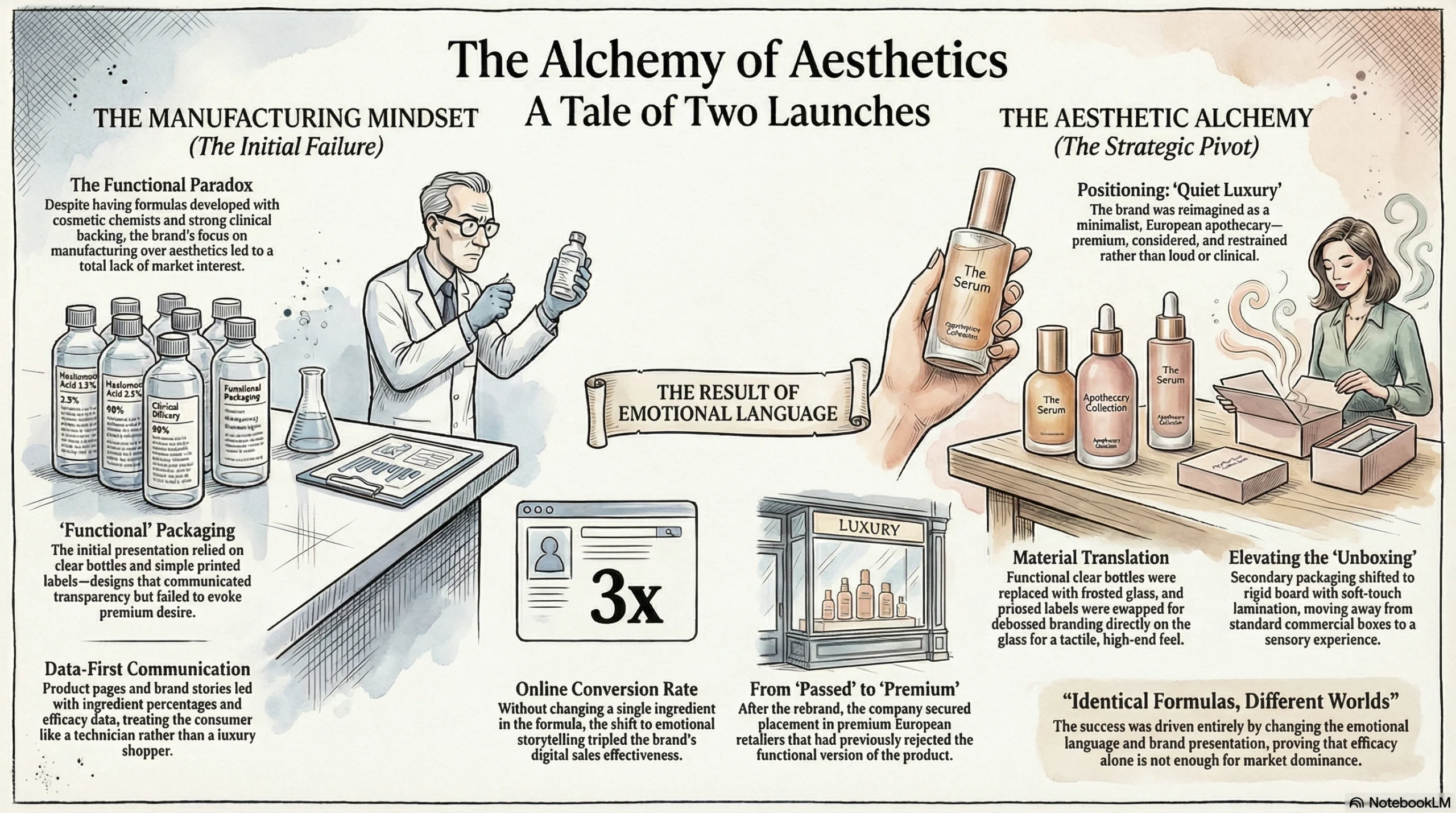
The founder had a manufacturing background. Her formulas were genuinely exceptional — developed with cosmetic chemists, tested rigorously, and built around a hero ingredient with strong clinical backing. She understood ingredients better than most brand founders ever will. She launched with confidence.
Her packaging was functional. Clear bottles, printed labels, clean enough. Her product pages led with ingredient percentages and efficacy data. Her brand story was rooted in what the formulas did — which, in her manufacturing mind, was the only story that mattered.
Sales were almost nonexistent. The products sat. Retailers passed. Influencers who received samples posted nothing.
She came to Jarsking not because her products had failed — but because her brand presentation had. The two things are not the same, and she had never been forced to treat them differently before.
What Changed — And What It Tells Us
The work began not with production, but with positioning. What emotional world did this brand belong to? What did the target consumer want to feel when they used it — and crucially, when they first saw it? The answers pointed toward quiet luxury: minimalist, considered, European apothecary in spirit, premium without being loud.
From there, every packaging decision became a translation exercise. Clear bottles became frosted glass — communicating purity and restraint rather than transparency-for-its-own-sake. Printed labels were replaced with debossed branding directly on the glass — no label, just form and texture. The palette was stripped back to two tones. Secondary packaging shifted to rigid board with soft-touch lamination and a single foil detail. The product pages stopped leading with percentages and started leading with the feeling the product was designed to create. The clinical data moved to a supporting role — present, credible, but no longer the headline.
The formula hadn’t changed by a single ingredient. The emotional language had changed completely.
Within two seasons, the brand had secured placement in a premium European retailer and tripled its online conversion rate. The products were identical. The brand presentation was not.
The Translation Partner You Actually Need
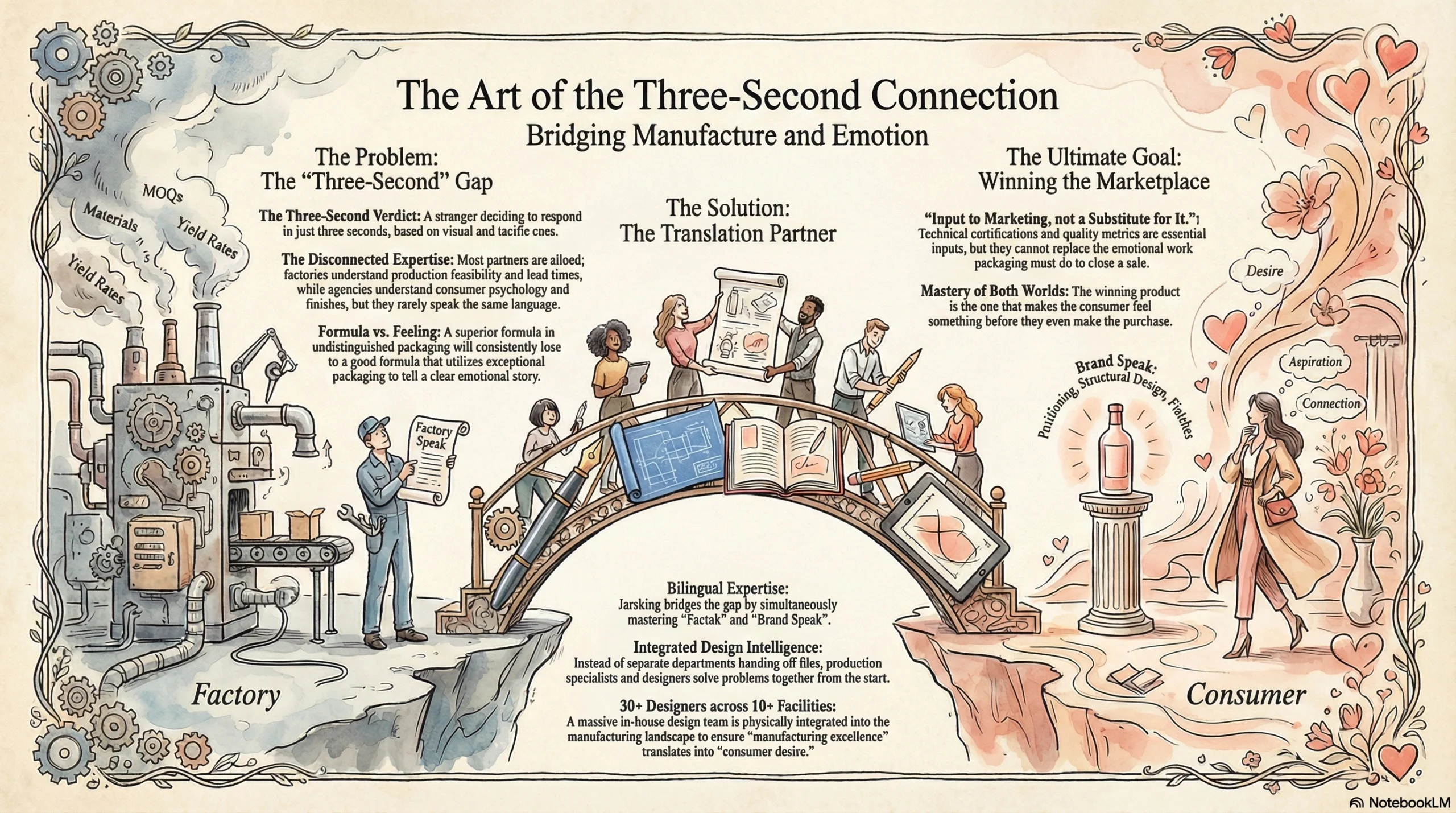
This is the gap Jarsking was built to close. Not to manufacture packaging — any factory can do that — but to translate manufacturing excellence into consumer desire. To take what a founder knows about their product and render it in a visual and tactile language that a stranger, encountering the brand for the first time on a shelf or a screen, can feel and respond to in three seconds.
That requires holding two very different kinds of expertise at the same time. It requires understanding production feasibility, material behavior, MOQ economics, and lead time reality — while simultaneously understanding brand positioning, consumer psychology, finish selection, and structural design. These are not naturally adjacent skills. Most manufacturers have the first. Most brand agencies have the second. Very few partners have both.
Jarsking’s team of 30+ in-house designers works directly alongside our production specialists across 10+ manufacturing facilities — not as separate departments handing off files, but as integrated partners solving the same problem: how do we make this brand’s packaging do the emotional work that closes the gap between great product and chosen brand?
Technology matters. Quality matters. Your formula, your yield rate, your certifications — they all matter. But in the consumer marketplace, these are inputs to marketing, not substitutes for it. A superior formula in undistinguished packaging will lose, every time, to a good formula in exceptional packaging with a clear emotional story. The product that makes people feel something before they buy it is the product that wins.
You already have the factory side of this equation mastered. What you need now is the brand side — and a partner who can speak both languages without losing either one in translation.
Your First Entry Ticket to the Consumer Market
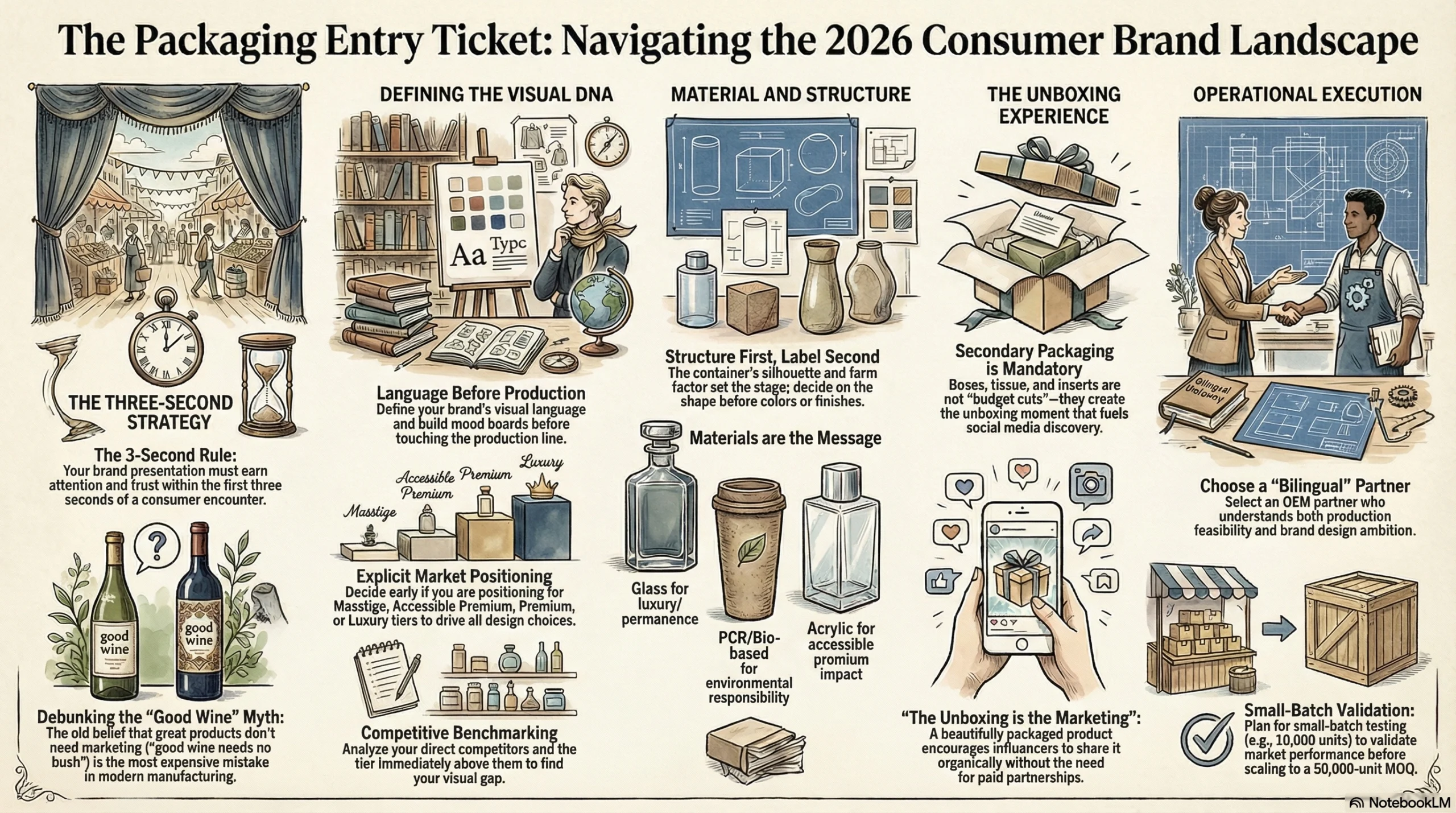
The old saying “good wine needs no bush” — the idea that great products sell themselves — is the most expensive myth in modern business. It has quietly ended the ambitions of countless manufacturers who had every right to succeed.
In 2026, your packaging speaks before your product does. The entry ticket to the consumer market is not a better formula or a lower price — it is a brand presentation that earns the consumer’s attention and trust in the first three seconds of encounter.
If you’re planning your B2C launch — or re-evaluating one that hasn’t performed — here is the practical checklist that our experience shows separates brands that break through from brands that quietly fade:
Define your brand visual language before touching production. Build a mood board. Benchmark your direct competitors and the tier above them. Decide explicitly where you are positioning — masstige, accessible premium, premium, or luxury — and let that decision drive every subsequent choice.
Invest in structural packaging design first. Your container’s form factor sets the stage for everything else. Before you decide on labels, colors, or finishes, decide on shape. Ask yourself: does this silhouette communicate the brand I want to build?
Match your material to your brand positioning. Glass signals luxury and permanence. PCR and bio-based materials signal environmental responsibility and attract the conscious consumer. Acrylic bridges accessible premium with visual impact. The material is not neutral — it is part of your brand message.
Never launch without secondary packaging. The box, the inner tissue, the insert card — these are not budget items to cut when margins get tight. They are the unboxing moment, and in a social-media-driven discovery environment, the unboxing is often the marketing. An influencer who receives a beautifully packaged product doesn’t need to be paid to share it.
Choose a manufacturing partner who speaks both languages. OEM expertise without brand design capability is only half of what you need. You need a partner who can hold the complexity of production feasibility and brand desire simultaneously — who won’t let manufacturing constraints silently undermine your brand vision, and who won’t let brand ambition run ahead of commercial reality.
Plan for small-batch testing before scaling MOQ. Validate your brand presentation in market before committing to large production runs. The cost of discovering your packaging isn’t performing at 10,000 units is very different from discovering it at 50,000.
Conclusion: Stop Making Great Products Nobody Knows About
The three traps are clear. Your procurement manager instincts are working against you in a consumer market. Your B2B network doesn’t transfer. And your treatment of design as a cost rather than a revenue driver is costing you far more than any design investment would.
The gap isn’t in your product. The gap is in the language you’re using to present it.
You have something genuinely valuable: real manufacturing knowledge, real quality control, and real capability that most brand founders are trying to fake. The brands that are beating you on the shelf don’t have better products — they have better brand presentation. That is a fixable problem.
Ready to stop making great products that no one knows about?
Jarsking’s team of 30+ in-house designers and manufacturing specialists exists for exactly this transition. We’ll help you translate your production expertise into a brand that consumers trust, desire, and choose — starting with packaging that speaks the right language from the very first impression.
Request your free consultation and 3D packaging concept today — and let’s build the brand your factory has always deserved.
FAQs
Unfortunately, no — and this is the most common misconception we encounter. Your OEM track record is a powerful internal confidence builder, but the end consumer has no visibility into it and no framework for valuing it. They have never heard your factory’s name, and they have no reason to trust it yet. Consumer credibility is built through brand presentation, visual consistency, and emotional resonance — not manufacturing credentials. Your OEM history is a foundation to build from, not a shortcut to skip the brand-building process entirely. The good news: that foundation gives you a real quality advantage — but only once your packaging gives consumers a reason to pick up the product in the first place.
Both matter, but they operate at different stages of the consumer journey. Product quality drives repeat purchase and loyalty — but packaging design drives the first purchase. If your packaging doesn’t generate enough interest for a consumer to pick up your product and try it, your product quality never gets the chance to prove itself. Studies in consumer behavior consistently show that packaging is the primary decision driver at the point of sale, with purchase decisions in physical retail forming in under 7 seconds. In e-commerce, product photography — which is entirely a function of packaging — determines click-through rates before a single word of copy is read. Quality keeps customers. Packaging gets them.
This is a false choice — but if you are genuinely resource-constrained, the order of operations matters more than the budget split. A common and costly mistake is spending heavily on formula development and then treating packaging as a budget line to minimize. The result is a world-class product in forgettable packaging that never reaches enough consumers to justify the formula investment.
A smarter approach: develop a solid, efficacious formula, then invest proportionally in packaging that makes your brand credible in your target tier. At Jarsking, we work with brands across a wide range of budget profiles to find packaging solutions that communicate premium positioning without requiring luxury-level spend. Custom doesn’t always mean expensive — it means intentional.
OEM (Original Equipment Manufacturing) means you provide the design and specifications, and the manufacturer produces to your brief. ODM (Original Design Manufacturing) means the manufacturer contributes to the design itself — bringing structural, aesthetic, and material expertise to the development process alongside you.
For a manufacturer making the B2C transition, ODM is almost always the stronger path. You bring deep knowledge of what’s inside the product; an ODM partner like Jarsking brings the brand design language that makes the outside perform in a consumer market. The collaboration fills the gap between factory expertise and brand presentation — which is precisely the gap this article has described.
Custom structural mold development typically takes 45 to 75 days from concept approval to production-ready tooling, depending on complexity. However, the design phase — structural concepting, 3D rendering, material and finish selection — can move much faster when you work with a team that has an integrated design and production process.
At Jarsking, our team delivers initial 3D concept renderings within hours of consultation, which means the creative direction can be locked quickly and the timeline is driven by production rather than design iteration. For brands working within tight launch windows, we also offer solutions using existing molds with custom finishes and decoration — a faster path to a distinctive brand presentation without the lead time of full custom tooling.
It is never too late — and a strategic packaging refresh is often far less disruptive than founders fear. Some of the strongest brand transformations happen not at launch but at a second-edition refresh, when real market feedback informs the creative direction. If your current packaging isn’t generating the traction you need, the question isn’t whether to evolve it, but how to do so in a way that retains any existing customer recognition while dramatically improving your brand’s ability to attract new ones.
Jarsking’s team regularly works with brands at this stage — auditing what is and isn’t working, identifying the specific signals their packaging is sending versus the signals their brand positioning requires, and developing a new direction that closes the gap. A rebrand done well doesn’t signal failure. It signals a brand that is serious about getting it right.