






Imagine walking into a luxury mall in Dubai or a specialty fragrance boutique on Riyadh’s Tahlia Street. Before a single spritz reaches a customer’s wrist, something else has already happened: they’ve picked up the bottle. They’ve turned the cap in their hand. They’ve weighed the box. They’ve felt the emboss trace under their thumb. That is packaging doing its job — and in the GCC, it is one of the most commercially consequential jobs in consumer goods.
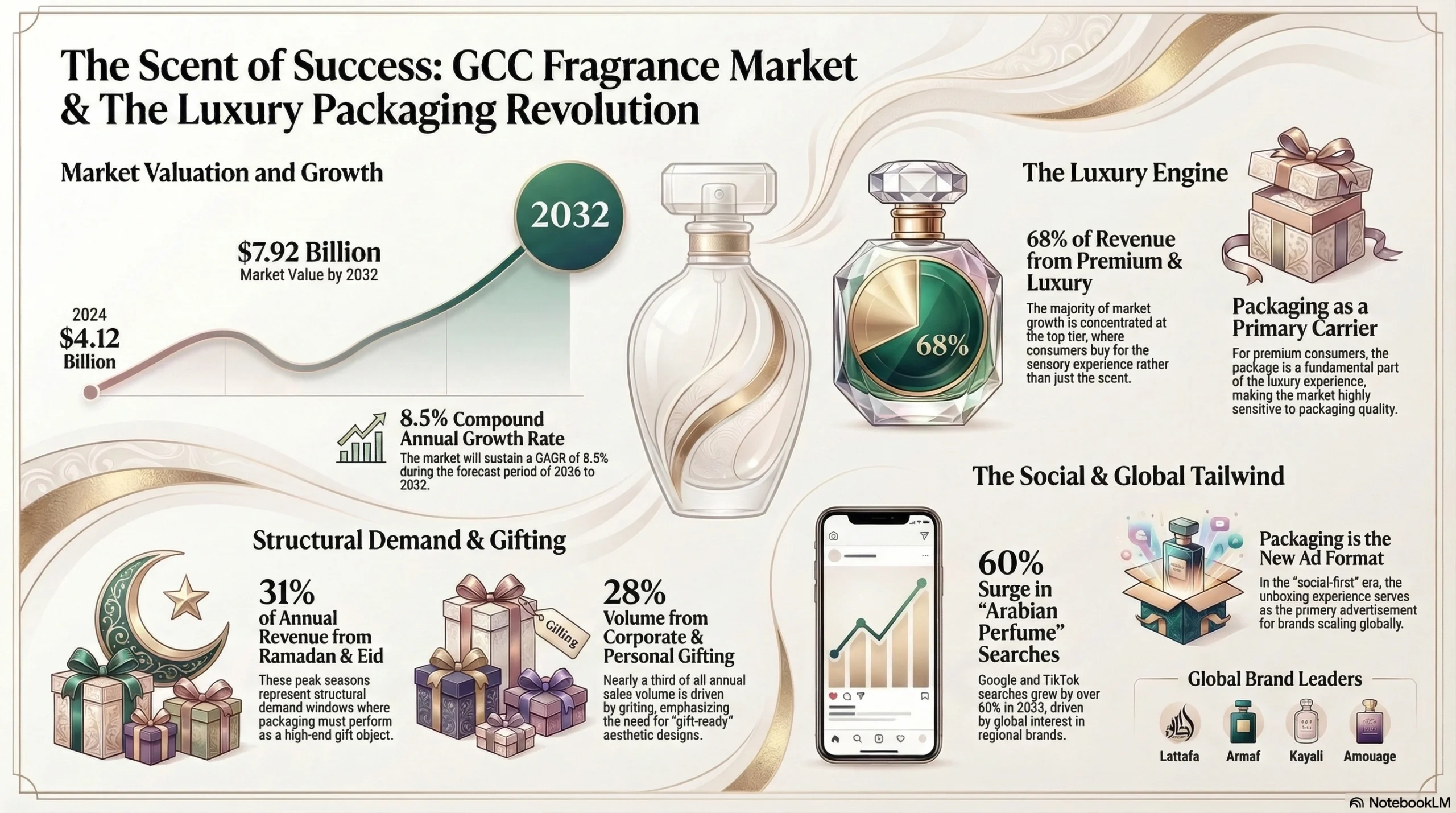
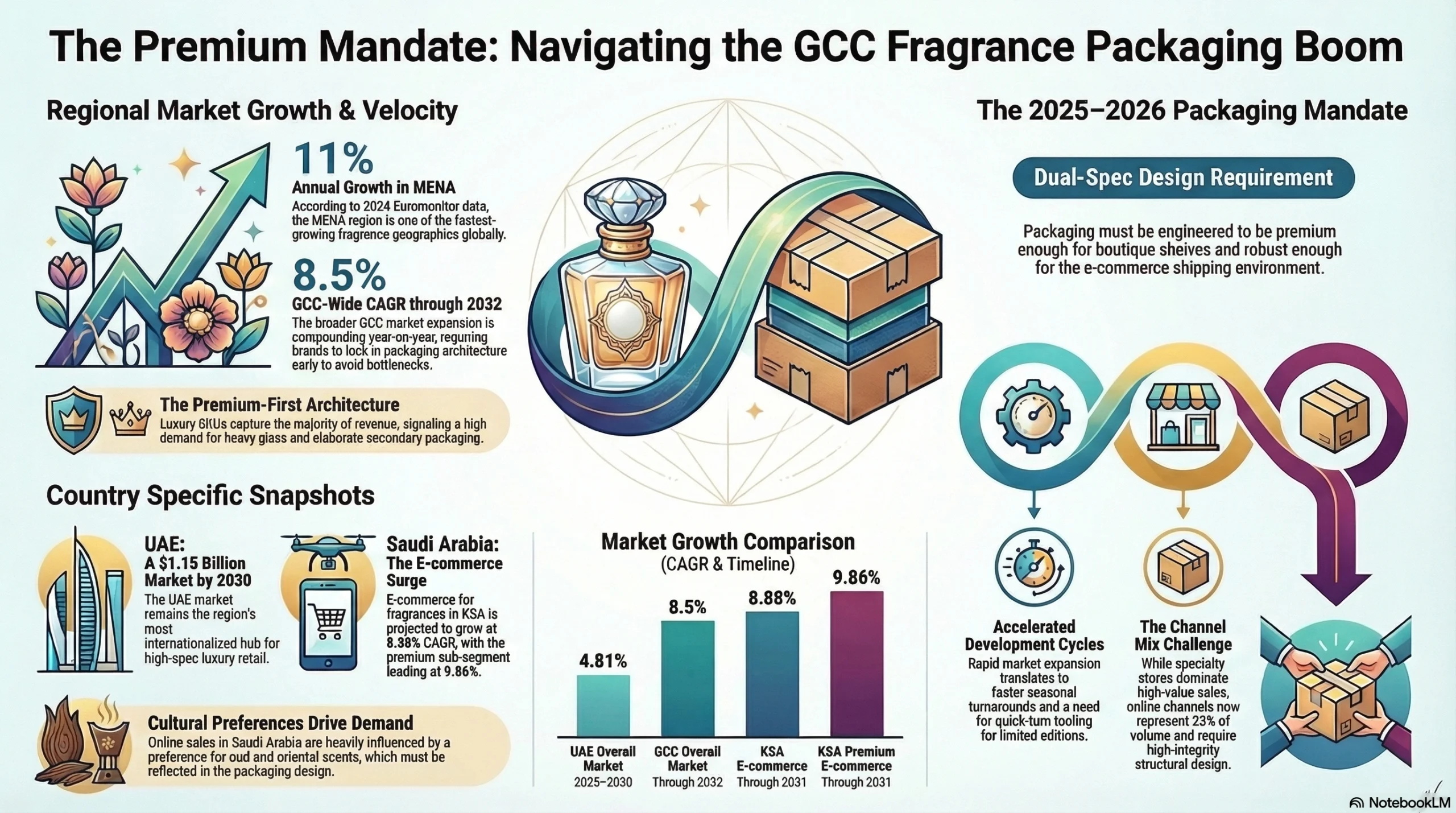
The numbers validate the stakes. The GCC perfume and fragrance market was valued at $4.12 billion in 2024 and is projected to reach $7.92 billion by 2032, growing at a CAGR of 8.5% from 2026 to 2032. This isn’t diffuse, democratic growth — it’s concentrated at the top. Premium and luxury fragrances account for approximately 68% of total market revenue, which means most of the growth engine is also packaging-sensitive. Consumers spending at the premium tier are, by definition, buying a sensory experience — and the package is a primary carrier of that experience.
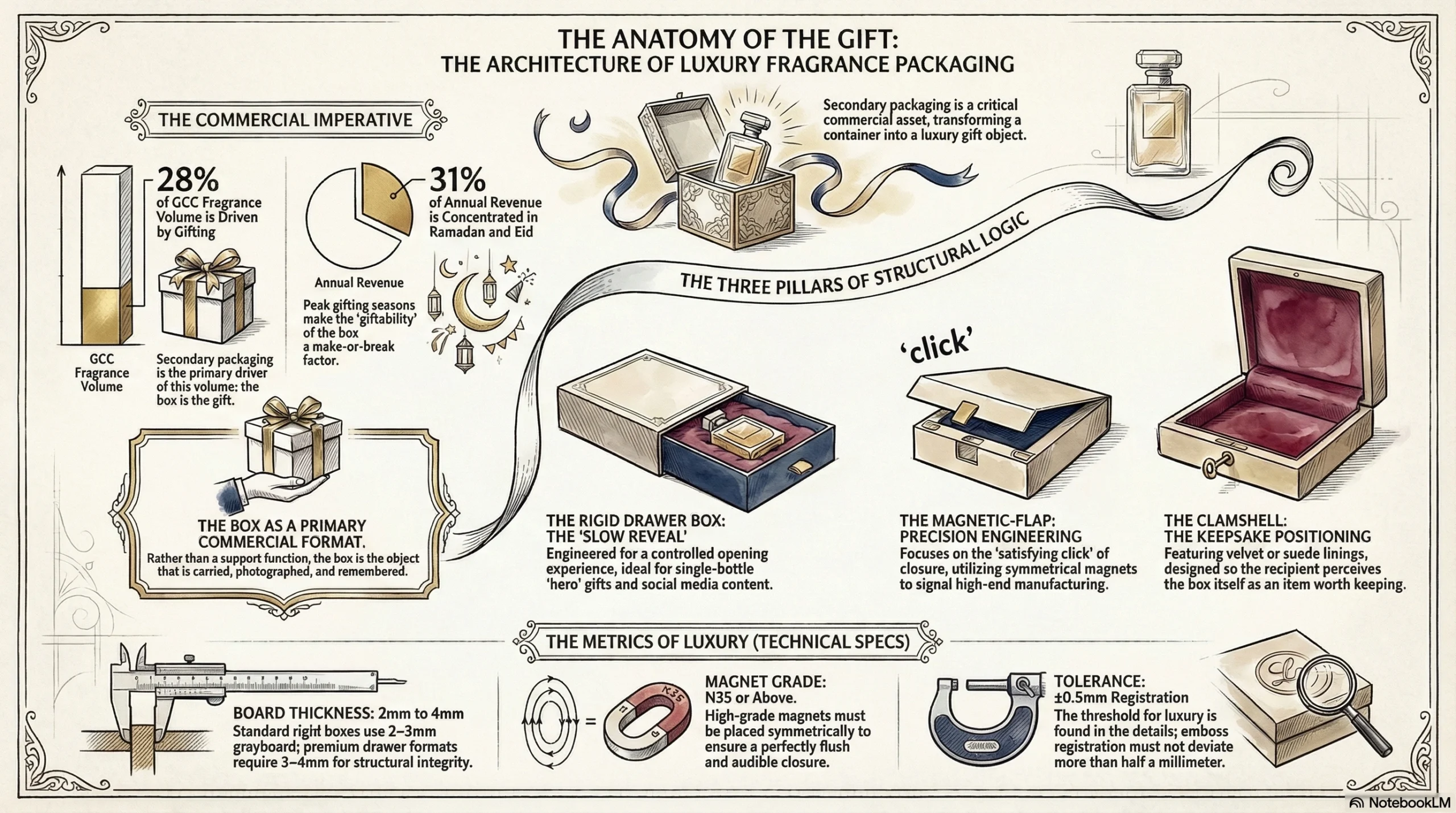
The gifting dimension deepens the opportunity. Corporate and personal gifting accounts for 28% of annual sales volume, and peak season sales during Ramadan and Eid represent 31% of annual revenue. These are not micro-occasions — they are structural demand windows that require packaging built to perform as a gift object, not just a container.
Then there’s the social tailwind. TikTok and Google searches for “Arabian perfume” grew by more than 60% in 2025, as regional brands like Lattafa, Armaf, Kayali, and Amouage scaled globally through social-first strategies and bold visual identity. Packaging is no longer just a retail asset — it is a content format. The unboxing is the ad.
This guide is a practical 2025–2026 packaging blueprint for GCC fragrance brand owners, product teams, and procurement leads. It covers six core design and engineering disciplines: luxury design language, cultural authenticity, omnichannel specification, gifting engineering, sustainability, and anti-counterfeit technology. Each section is built around verifiable market data and actionable specification guidance.
Market Reality Check: What GCC Growth Means for Packaging
The Premium-First Architecture
The GCC fragrance market does not behave like a mass-consumer market. With premium and luxury SKUs capturing the overwhelming majority of revenue, the demand signal flowing to packaging suppliers is clear: more bottles, heavier glass, more elaborate secondary packaging, more limited editions, and faster seasonal turnarounds. Every new fragrance launch in Riyadh, Doha, or Jeddah requires packaging that communicates premium before the cap is removed.
The MENA region as a whole is experiencing 11% annual fragrance growth according to Euromonitor’s 2024 data, making it one of the fastest-growing fragrance geographies in the world. That rate of expansion translates directly into new product development cycles, more gifting sets, and more limited-edition seasonal formats — all of which require accelerated packaging production and tooling. The brands that win will be those whose supply chains can match the pace.
Country Snapshots
UAE: The UAE fragrance market is estimated at $0.91 billion in 2025, growing to $1.15 billion by 2030 at a CAGR of 4.81%. Dubai remains the GCC’s most internationalized fragrance retail hub, with duty-free, luxury malls, and specialty stores all operating at the highest spec tier.
Saudi Arabia: The e-commerce channel for cosmetics and fragrances in the Kingdom is projected to grow at a CAGR of 8.88% through 2031, with the premium/luxury sub-segment accelerating even faster at 9.86% CAGR. Online fragrance sales in Saudi Arabia are driven by oud and oriental scent preferences, and packaging must hold up to a shipping environment, not just a shelf.
GCC-wide: The broader market growth trajectory (8.5% CAGR through 2032) means packaging demand compounds year-on-year. Brands that lock in their packaging architecture now — bottle molds, box die-lines, cultural motif libraries — will move faster than competitors scrambling to design at peak.
Channel Mix Drives Packaging Specs
Specialty fragrance stores dominate the GCC’s high-value channel landscape, meaning packaging must earn shelf space through tactile finish, structural integrity, and visual weight. At the same time, online channels now represent 23% of total market volume and are growing rapidly. A bottle designed only for shelf presence — glossy, unprotected, fragile — will fail in e-commerce. A box designed only for shipping economics — compact, plain — will fail in gifting. The 2025–2026 mandate is dual-spec design: premium enough for the boutique, robust enough for the shipper.
The 2025–2026 GCC Consumer: Bold Scent, Bold Packaging
No packaging brief can be written without first understanding who it is designed for. In the GCC, the fragrance consumer is shaped by cultural heritage, climate demands, generational shifts, and a growing conviction that the region now leads global luxury perfumery rather than follows it. Each of these forces carries direct implications for what packaging must look, feel, and do.
Fragrance as Identity, Not Accessory
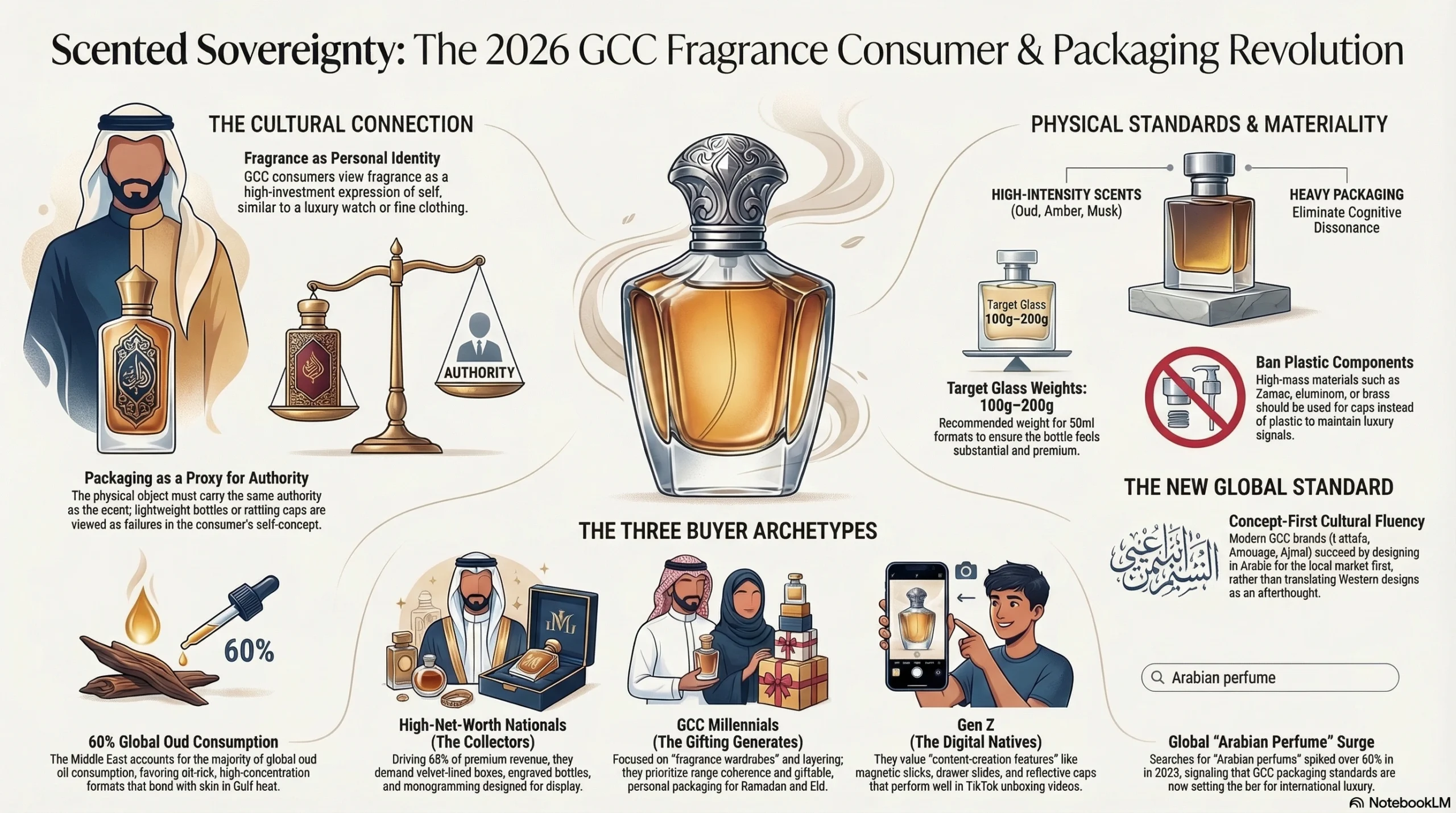
Across Dubai, Riyadh, Doha, and Kuwait City, fragrance occupies a cultural position that has no direct equivalent in Western markets. Scent is present at every significant life moment — in prayer, in greeting, in business, in celebration. GCC consumers invest in fragrance the way they invest in watches or fine clothing: as an expression of personal identity, not a seasonal whim.
This elevates what the consumer expects before they smell anything. The physical object must carry the same authority as the scent it contains. A bottle that feels lightweight, a cap that rattles, a box that flexes — these are not minor quality failures. They are fundamental mismatches with the consumer’s self-concept. In a market where packaging is a proxy for identity, those signals are deal-breakers.
Bold, Complex, Longevity-First
Middle Eastern consumers prefer bold, complex scents — fragrances built around oud, amber, rose, saffron, and musk that are intense and long-lasting. This is culturally rooted and climatically reinforced. Light, aqueous compositions evaporate quickly in Gulf heat; oil-rich, high-concentration formats bond with skin and last. The Middle East accounts for over 60% of global oud oil consumption, and Beautyworld Middle East 2025 confirmed that consumer appetite for “faceted, complex, rich and opulent scents” is only deepening.
The packaging implication is direct: if the fragrance is heavy, the bottle must feel heavy. Cognitive dissonance between scent character and packaging weight is one of the most common conversion killers in the GCC premium channel. Target glass weights of 100–200g for 50ml formats, and use high-mass cap materials — zamac, aluminum, or brass — not plastic.
Three Buyer Segments, Three Packaging Briefs
The GCC fragrance consumer in 2025–2026 is not a single archetype:
High-net-worth nationals drive the 68% premium revenue concentration. They buy Amouage, Roja Parfums, and top regional houses — and expect packaging designed to be displayed and kept. Engraved bottles, velvet-lined boxes, limited editions, and monogramming are baseline expectations at this tier.
Millennials (25–40) are the primary gifting buyers for Ramadan and Eid, and they are driving the “fragrance wardrobe” concept — building collections of complementary scents. Their packaging priority is range coherence: bottles that display together, sets that offer layering guidance, boxes that feel personal and giftable simultaneously.
Gen Z (18–27) is the TikTok-native entry tier — and the engine behind the 60%+ surge in “Arabian perfume” searches in 2025. They favor intense, authentic fragrances with oud, leather, and amber, and they discovered them through unboxing content. For this segment, the magnetic click, the drawer slide, the reflective cap are not luxury indulgences — they are content-creation features that drive organic discovery.
Craft + Heritage + Global Ambition
Brands like Lattafa, Kayali, Ajmal, and Amouage are not aspiring to match French heritage houses — they are setting their own standards and watching those standards be adopted internationally. Their lavish packaging was central to the global attention they commanded at Beautyworld Middle East 2025. For any GCC brand in 2025–2026, this means one thing: packaging must be conceived in Arabic and happen to speak to the world — not designed for Paris and translated into Arabic as an afterthought. Cultural fluency is the category’s defining premium signal, and consumers can instantly tell the difference.
The GCC Packaging Stack: Bottle + Cap + Box + Experience
Winning GCC fragrance packaging is never a single component decision. It is a four-part system — bottle, cap, secondary packaging, and experience layer — where every tier must be specified in concert. A spectacular bottle in a forgettable box sends a confused signal. A beautifully printed box concealing a lightweight, rattling bottle destroys trust at the moment of unboxing. In the GCC premium channel, where consumers are paying for the totality of the sensory experience, the system must hold together from first touch to last.
The Bottle: Your Most Permanent Brand Asset
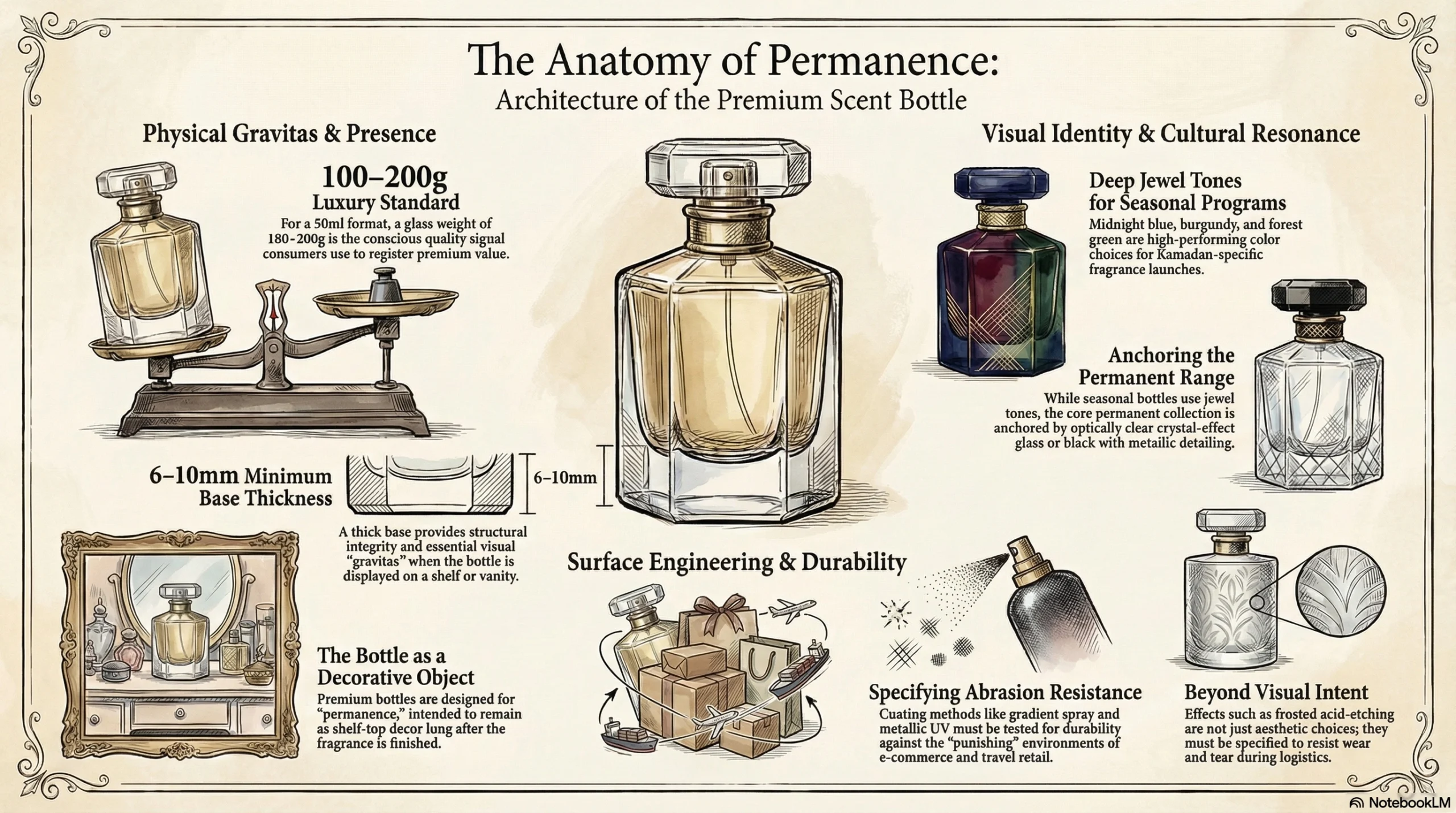
The bottle is the object that stays. Long after the fragrance is finished, a well-designed GCC perfume bottle remains on a vanity, a shelf, or a display cabinet — which means it must be designed with the permanence of a decorative object, not the disposability of a container.
In the GCC premium tier, glass weight is a quality signal consumers consciously register. Target weights of 100–200g for 50ml formats are standard at the luxury end; anything lighter risks undermining the perceived value of the formulation inside. Base thickness — 6–10mm minimum — adds both structural integrity and visual gravitas when the bottle is viewed from the front.
Color and coating choices should be made with durability and cultural resonance in mind simultaneously. Deep jewel tones (midnight blue, burgundy, forest green) perform strongly for Ramadan seasonal programs, while optically clear crystal-effect glass or black with metallic detailing anchors the permanent range. Coating methods — gradient spray, metallic UV, frosted acid-etch effect — must be specified with abrasion resistance standards, not just visual intent. Travel retail environments and e-commerce logistics are both punishing to poorly specified coatings.
The Cap: The Jewelry of the Package
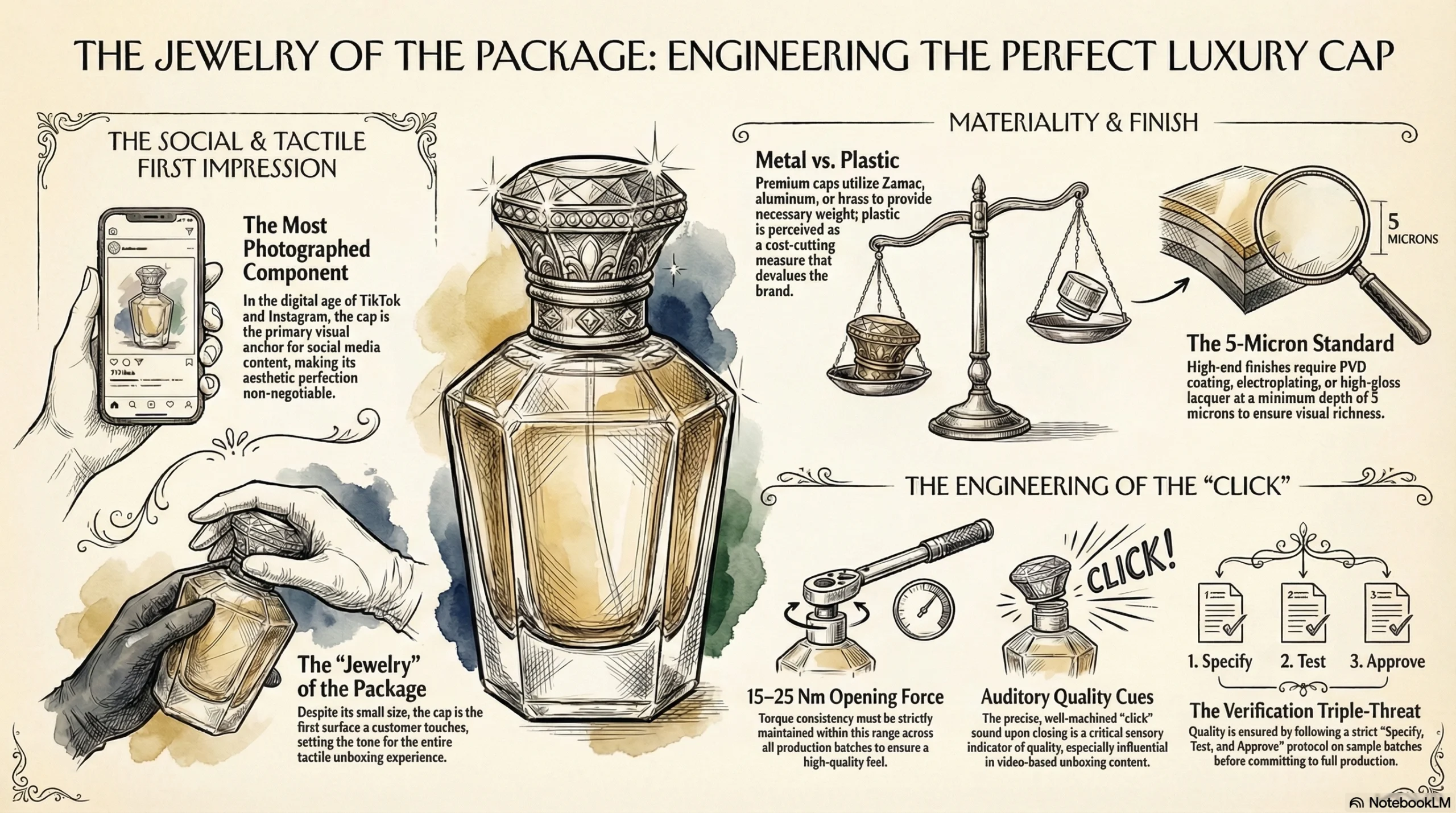
In the GCC context, the cap is disproportionately important relative to its size. It is the first surface handled at point of sale, the most tactile element in the unboxing moment, and — critically — the most photographed component in TikTok and Instagram content. A cap that fails aesthetically or mechanically undermines the entire packaging investment.
Material selection is non-negotiable at the premium tier. Zamac, aluminum, and brass caps — finished with PVD coating, electroplating, or high-gloss lacquer at a minimum 5-micron depth — deliver the weight and visual richness that GCC consumers associate with quality. Plastic caps, regardless of how well they are finished, read as a cost decision and communicate accordingly.
Beyond material, closure mechanics matter. Torque consistency (15–25 Nm opening force) should be specified and tested across production batches, not just prototypes. The closure sound — that precise, well-machined click when the cap seats — is an auditory quality cue that is particularly powerful in video content. A loose, hollow, or imprecise closure sound is one of the fastest triggers for a negative unboxing reaction. Specify it, test it, approve it on a sample batch before committing to production.
Secondary Packaging: Where Gifting Revenue Is Made or Lost
With gifting accounting for 28% of annual GCC fragrance sales volume and Ramadan and Eid driving 31% of annual revenue, secondary packaging is not a support function — it is a primary commercial format. The box is what gets wrapped, carried, photographed, and remembered. It must perform as a gift object in its own right.
The dominant premium gifting structures in the GCC channel are rigid drawer boxes, magnetic-flap presentation boxes, and clamshell formats with velvet or suede interior linings. Each has a structural logic:
Drawer boxes deliver a slow, controlled reveal — ideal for single-bottle hero gifts and social content moments
Magnetic-flap boxes offer the satisfying click that performs on video and signals precision engineering to the recipient
Clamshells with velvet lining anchor the keepsake positioning — the box itself is worth keeping
Board thickness (2–3mm greyboard for standard rigid; 3–4mm for drawer formats), magnet grade (N35 or above, placed symmetrically for flush closure), foil coverage, and emboss registration tolerances (±0.5mm) all require tight supplier specifications and pre-production sample approval. These are not details — they are the difference between a box that feels like a gift and a box that feels like packaging.
The Experience Layer: Where 2025–2026 Packaging Separates from the Past
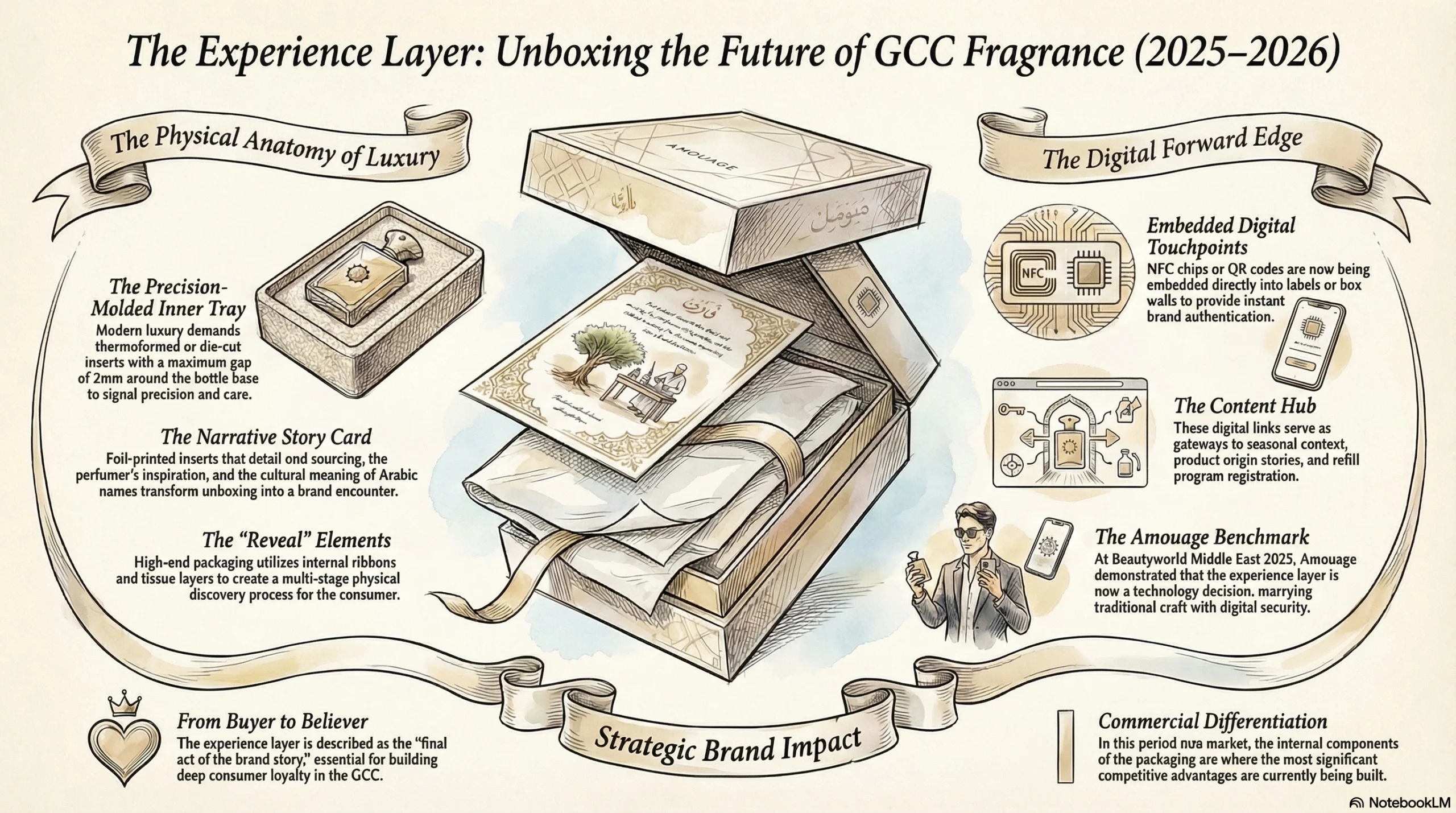
The fourth tier is where the most significant commercial differentiation is being built right now. The experience layer encompasses everything inside the box that is not the bottle: the insert, the message card, the tissue or ribbon reveal, and — increasingly — the digital touchpoint.
A molded inner tray (thermoformed or die-cut, with ≤2mm gap around the bottle base) protects the bottle in transit while telegraphing precision and care when the box is opened. A foil-printed insert card telling the scent story — the oud sourcing, the perfumer’s inspiration, the Arabic name’s meaning — transforms an unboxing into a brand encounter.
The forward edge for 2025–2026 is the QR or NFC chip embedded in the label or box wall, linking to a brand authentication page that doubles as content: the product’s origin story, the seasonal context, the refill program, the loyalty registration. Brands like Amouage debuted packaging at Beautyworld Middle East 2025 that married traditional Arabian luxury craftsmanship with digital authentication — demonstrating that the experience layer is now a technology decision as much as a design one.
The brands that will define GCC fragrance packaging in 2026 are those that treat the experience layer not as an add-on, but as the final act of the brand story — the moment the consumer moves from buyer to believer.
Ramadan + Eid: Your Packaging High Season
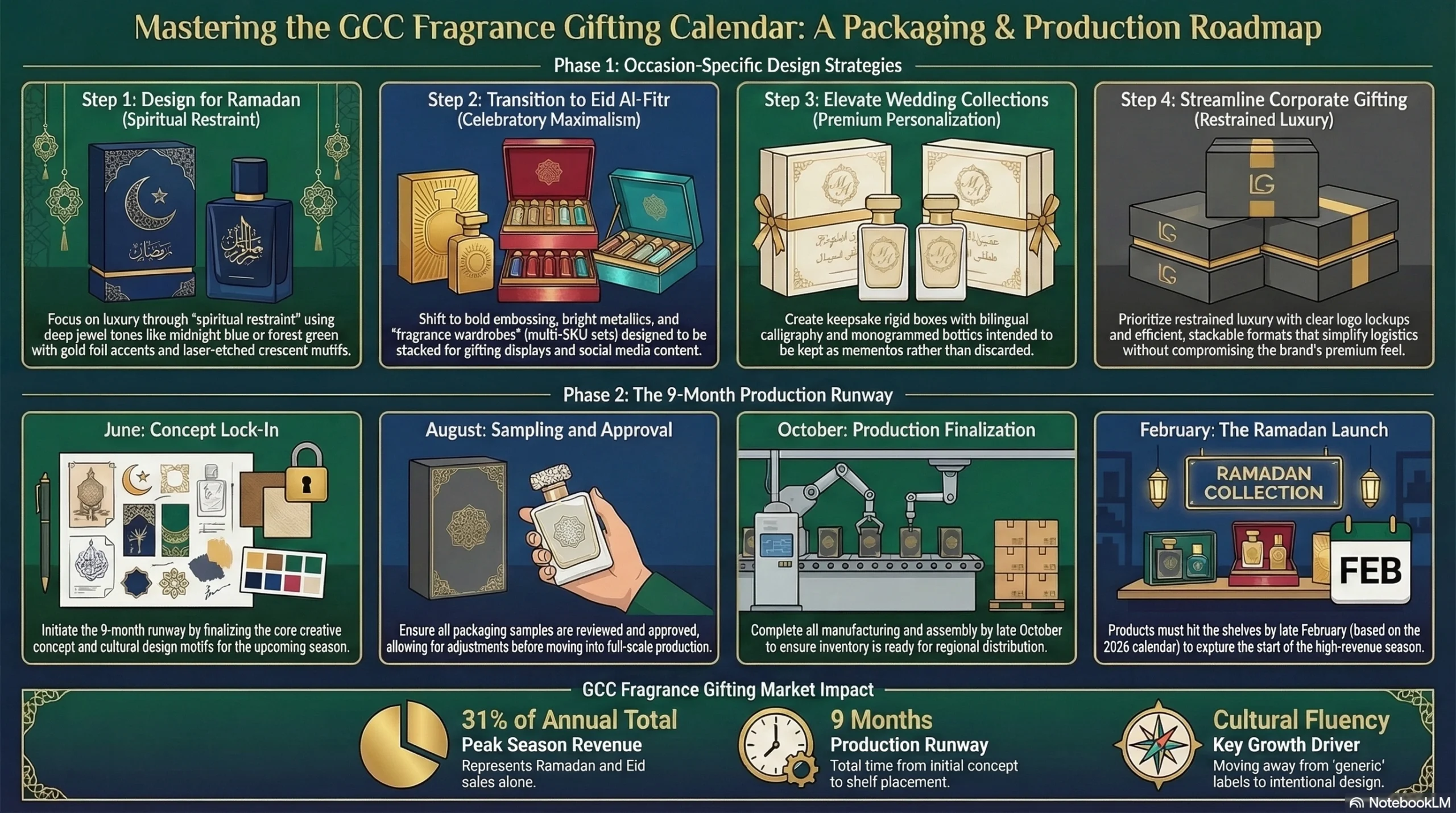
The data is unambiguous: peak season sales during Ramadan and Eid represent 31% of annual revenue in the GCC fragrance market. This is not a seasonal bump — it is a structural commercial event that demands dedicated packaging programs. Brands that treat Ramadan as an afterthought, scrambling to add a crescent label to existing packaging in Q1, leave significant revenue on the table.
Packaging Playbook by Occasion
Ramadan: The aesthetic brief calls for spiritual restraint within luxury. Deep jewel tones (midnight blue, dark burgundy, forest green) with gold foil accents. Crescent and star motifs applied with precision — embossed or laser-etched, not printed as clip art. Typography that honors Arabic script. Packaging that feels intentional and culturally fluent, not festive in a generic sense.
Eid Al-Fitr: The mood shifts to celebratory maximalism. Collector-worthy limited editions. Multi-SKU sets with coordinated visual identity. Bright metallics and bold embossing. Formats that stack beautifully for gifting displays and photograph dramatically for social content. The “fragrance wardrobe” concept — championed by brands like Ajmal Perfumes — works particularly well here, with layering formats and gifting sets designed for diverse gifting occasions.
Weddings: Personalization is the premium signal. Monogrammed bottles, keepsake rigid boxes with custom liners, bilingual calligraphy inserts. The packaging should be designed to be kept, not discarded.
Corporate Gifting: Restrained luxury with clear logo lockup. Formats that stack and ship efficiently. Single-SKU or simple dual-SKU configurations. Easy distribution logistics without sacrificing brand quality.
Limited Editions and Speed-to-Market
Working backwards from a Ramadan launch: with Ramadan 2026 beginning in late February, production needs to be finalized by October 2025, sampling approved by August, and concept locked by June. That is a 9-month runway from concept to shelf — shorter for brands with established packaging partnerships, longer for those starting supplier relationships from scratch. Brands that invest in pre-approved structural tooling and a library of cultural design motifs can compress this timeline significantly.
Cultural Design That Converts: Arabic Calligraphy, Geometry, and Authenticity
In the GCC fragrance market, cultural design is not decoration — it is a commercial argument. It signals to the consumer that the brand understands them, respects their heritage, and has earned the right to charge a premium. Done well, it converts on shelf, in social content, and in global export markets simultaneously. Done poorly, it signals a shortcut — and in a market where consumers are cultural authorities, that signal is immediately legible and commercially damaging.
Why "Cultural Fluency" Is Now a Commercial Requirement
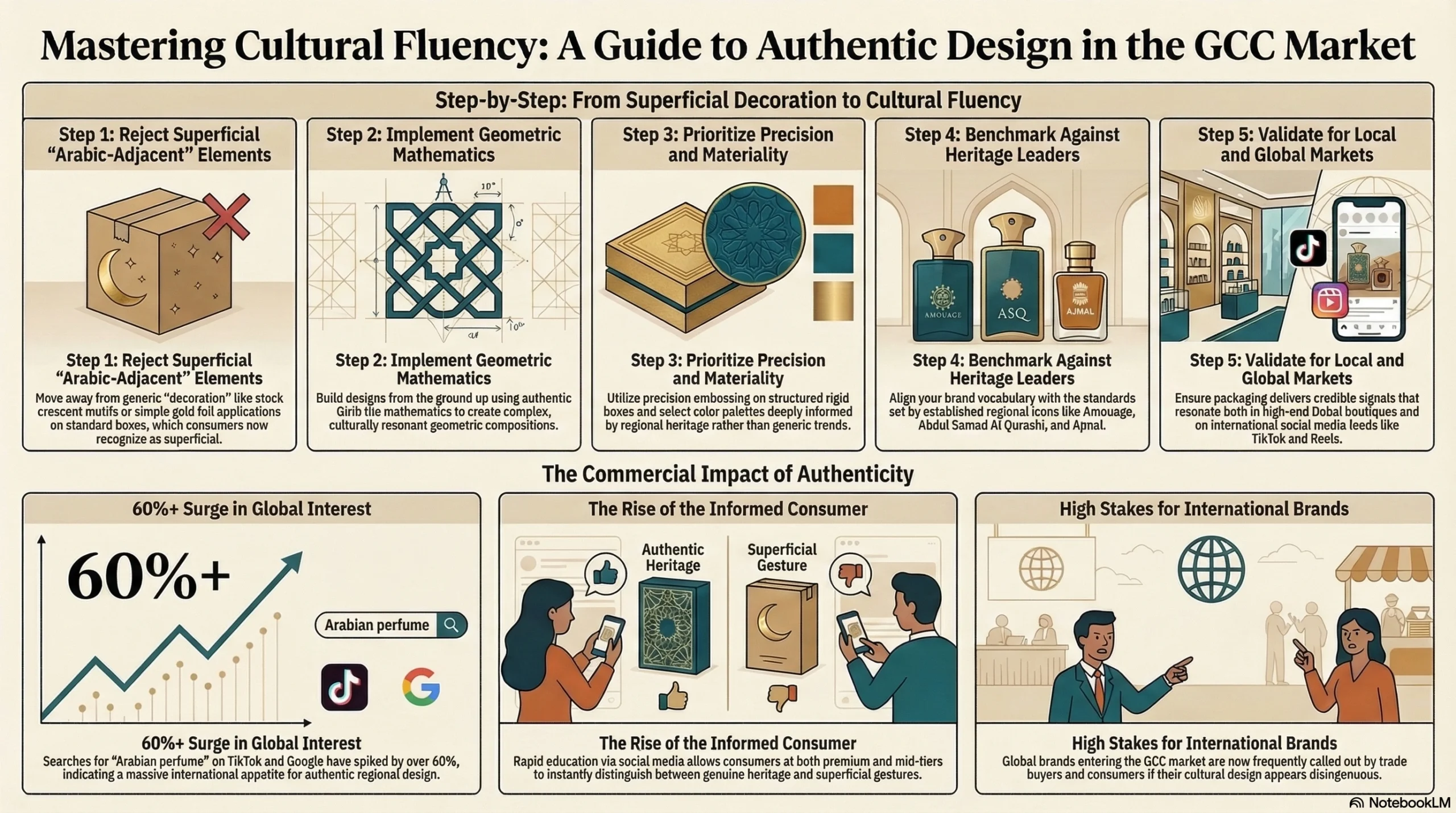
There is a meaningful distinction between packaging that has been designed with Arabic design tradition and packaging that has been decorated with Arabic-adjacent elements. A stock crescent motif applied in gold foil to an otherwise generic box is the latter. A geometric composition derived from Girih tile mathematics, applied through precision emboss to a structured rigid box with culturally informed color choices, is the former. Consumers at the premium tier — and increasingly at the mid-tier, as education through social media accelerates — can tell the difference instantly.
The commercial stakes of that distinction are rising. Regional brands like Amouage, Abdul Samad Al Qurashi, and Ajmal have spent decades building packaging vocabularies rooted in genuine design heritage. International brands entering the GCC market with superficial cultural gestures are increasingly being called out by consumers and trade buyers alike. For a GCC brand designing for 2025–2026, cultural fluency is not a creative choice — it is a baseline expectation.
It is also an export advantage. The 60%+ surge in “Arabian perfume” searches on TikTok and Google in 2025 reflects an international audience actively seeking authentic regional design signals. Packaging that delivers those signals credibly — in Dubai boutiques and on Reels scrolls viewed in London or Los Angeles — converts in both contexts.
The Design Language: What to Commission and How to Specify It
Arabic and Islamic design tradition offers a deep, precise, and geometrically sophisticated vocabulary. The key is knowing which elements to use, and specifying them correctly for the production finish that will carry them.
Arabic Calligraphy
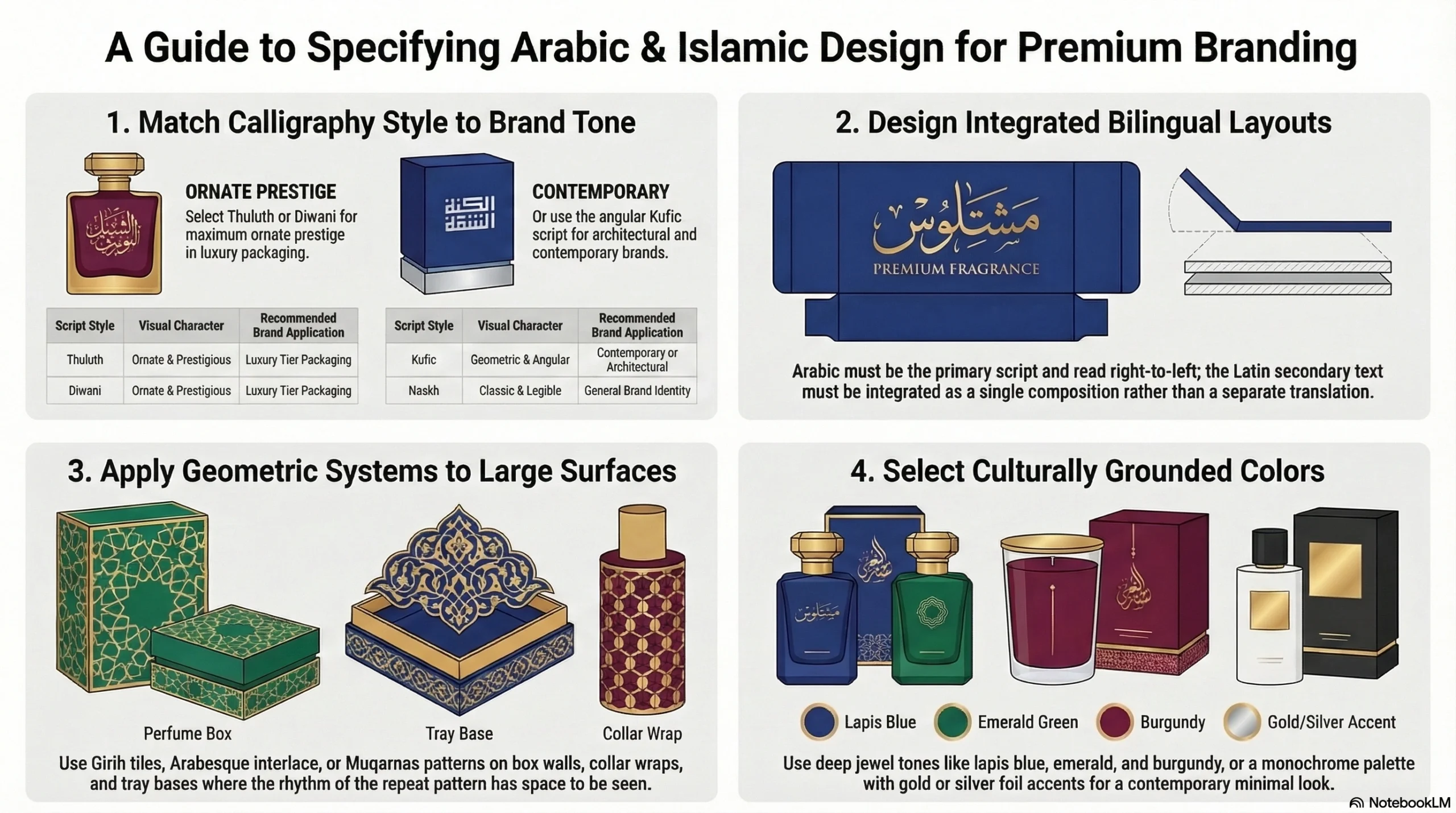
Calligraphy is the most emotionally resonant design element available to a GCC fragrance brand — it carries centuries of cultural weight and is immediately legible as both art and identity. However, it must be commissioned with care. The script style (Naskh, Thuluth, Diwani, Kufic) should match the brand’s tone: Thuluth and Diwani carry maximum ornate prestige and suit luxury tier packaging; Kufic’s geometric, angular character suits architectural or contemporary brands.
Typography placement matters as much as letterform. Arabic script reads right to left and has vertical visual weight distributions that differ from Latin type. Bilingual layouts — Arabic primary, Latin secondary — must be designed as integrated compositions, not translations sitting awkwardly beside each other. The Arabic should feel like it was there first.
Geometric Patterns
Islamic geometric art — Girih tile compositions, Arabesque interlace, Muqarnas-inspired three-dimensional patterning — offers an extensive vocabulary for surface design. These are not ornamental flourishes; they are mathematically precise systems developed over centuries, and their visual sophistication is immediately apparent to informed audiences. For packaging application, geometric repeat patterns work best on box wall surfaces, collar wraps, and inner tray bases — surfaces large enough to carry the rhythm of the pattern.
Color System
Culturally grounded color choices amplify the design signal. Deep jewel tones — lapis blue, emerald, burgundy — reference both the material richness of traditional Islamic art and the luxury codes of the GCC premium channel. Gold (foil or metallic print) is the expected accent in the premium tier. For contemporary or minimal brands, a monochrome palette with a single gold or silver detail allows cultural reference without maximalism.
Finish Methods: Matching Technique to Motif
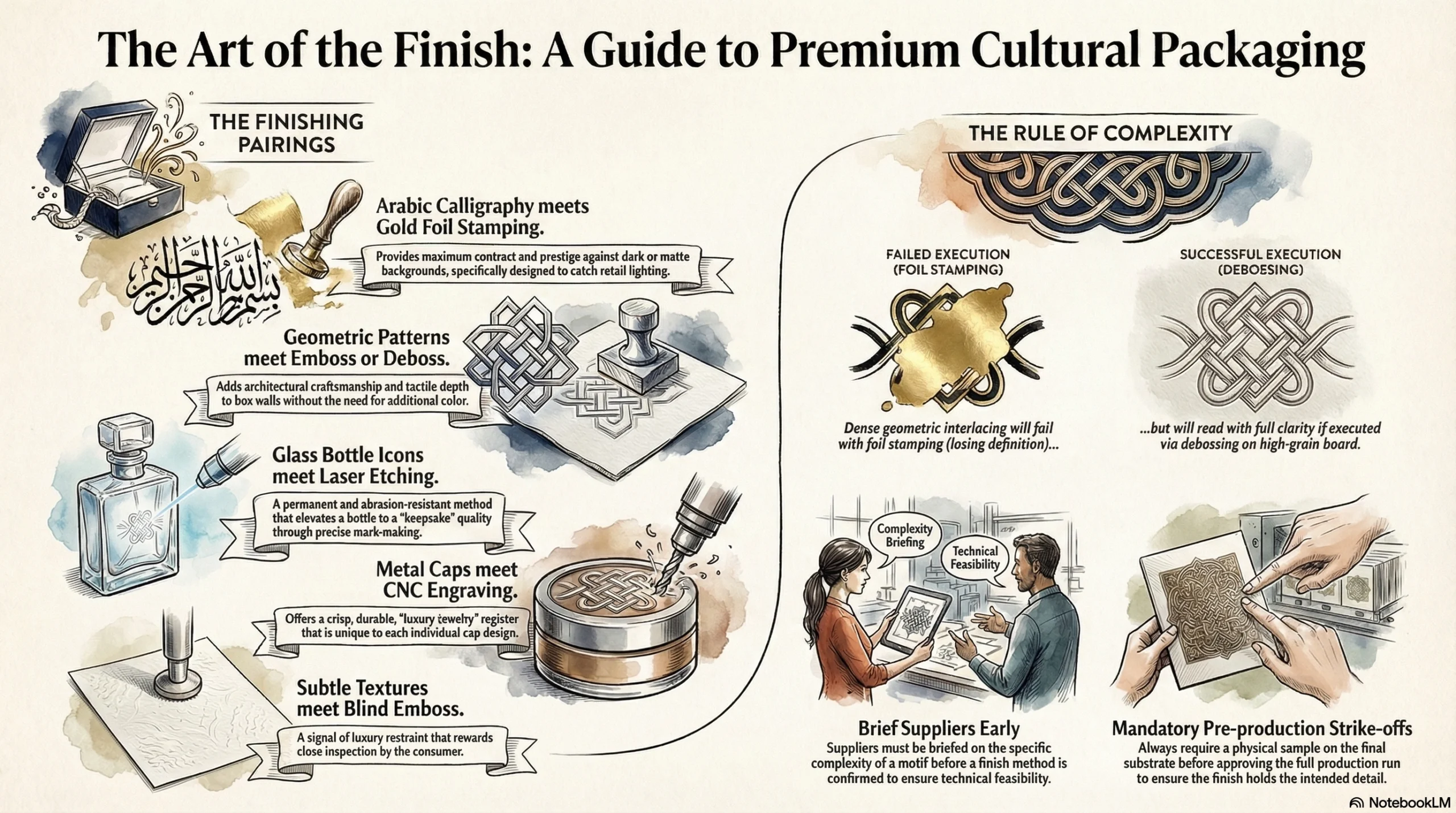
The right cultural design applied with the wrong finish technique loses most of its impact. These pairings represent the current best-practice standard for GCC premium packaging:
| Design Element | Recommended Finish | Why It Works |
|---|---|---|
| Arabic calligraphy on box | Gold foil stamping | Maximum contrast and prestige on dark or matte backgrounds; catches retail lighting |
| Geometric repeat pattern on box wall | Emboss / deboss | Tactile depth without additional color; reads as architectural craftsmanship |
| Brand icon or motif on bottle | Laser etching on glass | Permanent, precise, abrasion-resistant; elevates the bottle’s keepsake quality |
| Pattern or script on metal cap | CNC engraving | Crisp, durable, luxury-jewelry register; unique to each cap design |
| Subtle texture across box surface | Blind emboss | Restraint as a luxury signal; rewards close inspection |
Authenticity in Practice: What to Avoid
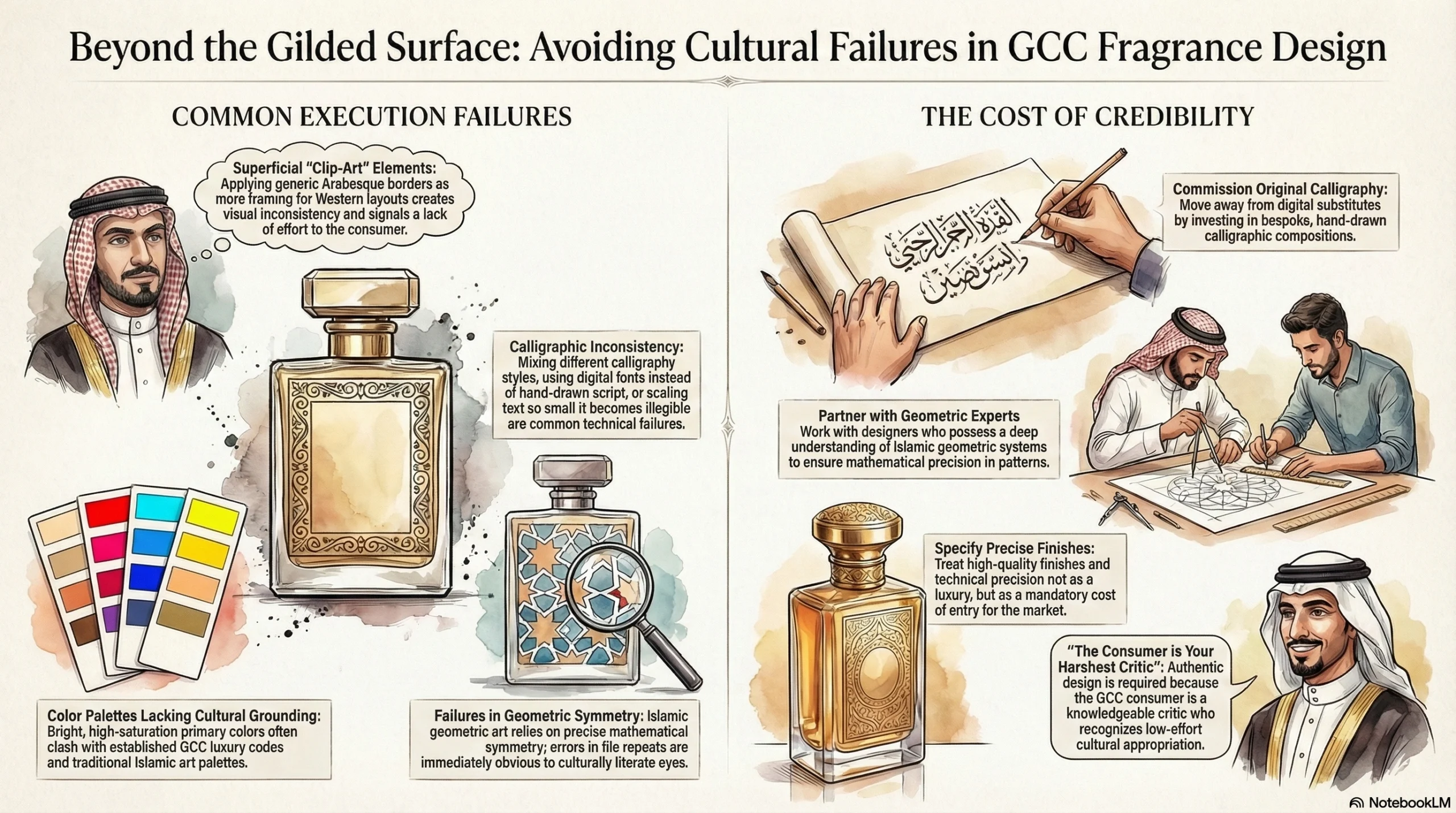
Several common execution failures undermine cultural design in GCC fragrance packaging:
Clip-art Arabesque borders applied as framing elements around otherwise Western packaging layouts — these are visually inconsistent and signal low effort
Inconsistent script quality — mixing calligraphy styles, using digital font substitutes for hand-drawn calligraphy, or applying script at sizes too small for the letterform to read correctly
Colour combinations without cultural grounding — using bright, high-saturation primaries that reference neither Islamic art tradition nor GCC luxury codes
Symmetry failures in geometric patterns — geometric Islamic art is governed by precise mathematical symmetry; errors in tile repeat are immediately visible to culturally literate eyes
The investment in getting this right — commissioning an original calligraphy composition, working with a designer who understands Islamic geometric systems, specifying finishes with precision — is not a creative luxury. It is the cost of participating credibly in a market where your consumer is also your harshest and most knowledgeable design critic.
Sustainability That Still Feels Expensive
At Beautyworld Middle East 2025, “Sustainability Becomes Sexy” was one of the top six trends identified across the show floor. Luxury brands including Amouage, Kayali, and Ghawali debuted collections integrating vegan fixatives, recyclable packaging, and artfully designed refillable amphorae — demonstrating that luxury and sustainability are not mutually exclusive. In the GCC premium context, the sustainability story must be told through material quality and design intention, not just on an eco-label.
Eco-Luxury Material Swaps
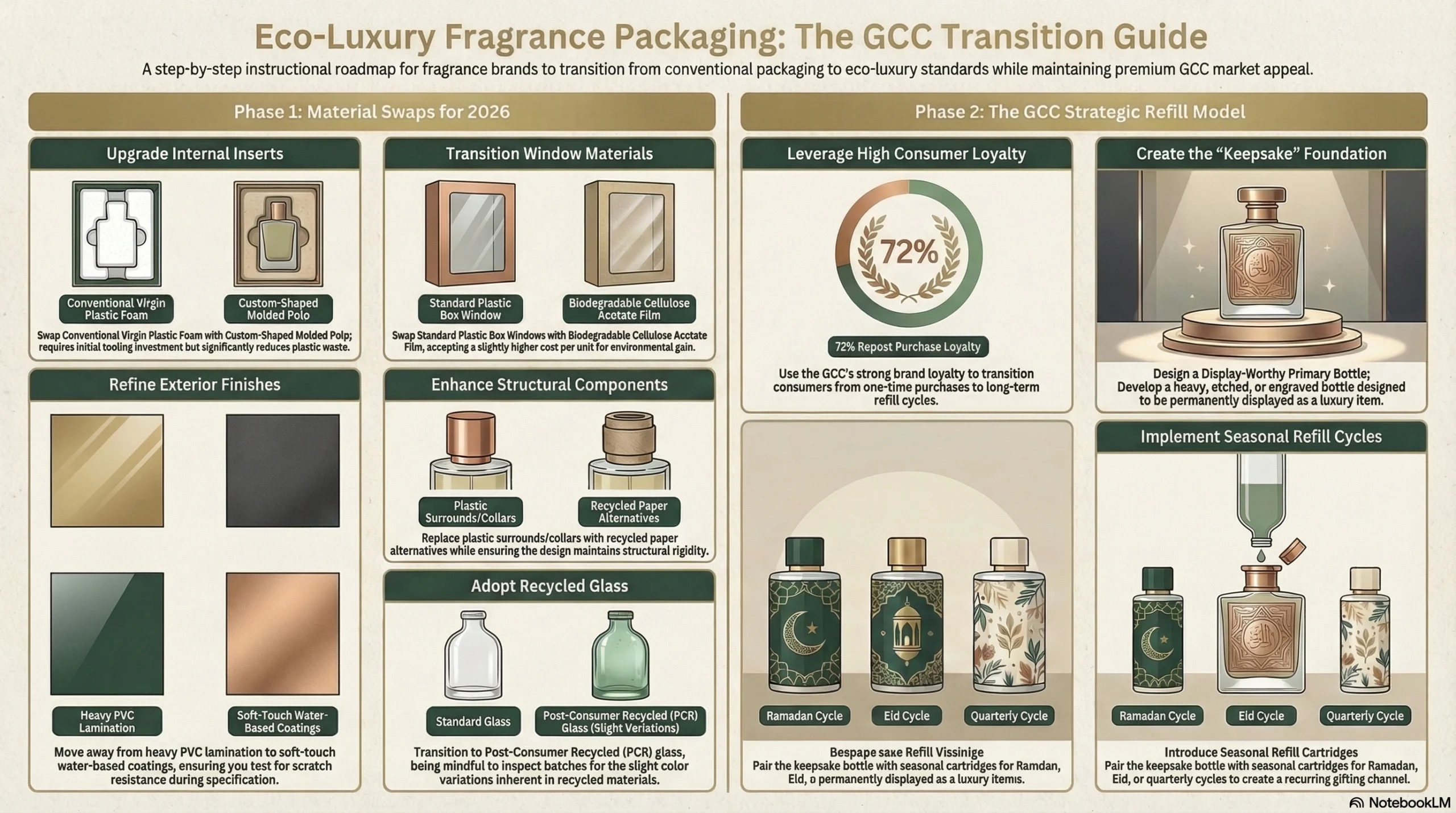
The following swaps are the most commercially viable for GCC fragrance brands entering 2026:
| Conventional Spec | Eco-Luxury Alternative | Trade-off to Manage |
|---|---|---|
| Virgin plastic foam insert | Molded pulp insert (custom shaped) | Requires new tooling investment |
| Plastic window on box | Cellulose acetate film (biodegradable) | Slightly higher cost per unit |
| Heavy PVC lamination | Soft-touch water-based coating | Lower scratch resistance; test spec |
| Plastic collar/surround | Recycled paper collar | Must maintain structural rigidity |
| Standard glass bottle | PCR (post-consumer recycled) glass | Slight color variation; inspect batches |
In a market where 72% of premium brand consumers show strong repeat purchase loyalty, refillable packaging is not just an environmental play — it is a retention mechanic. The model that works best culturally in the GCC is the keepsake bottle + seasonal refill: a heavy, beautifully engraved or etched bottle that a consumer wants to display permanently, paired with Ramadan, Eid, or seasonal refill cartridges. This creates a gifting channel (the refill is a gift), a repeat purchase cycle (one refill per quarter), and a sustainability story — all within a single packaging system.
Omnichannel Packaging: Specialty Stores + E-Commerce + Social Commerce
Why Channel Specs Are Diverging
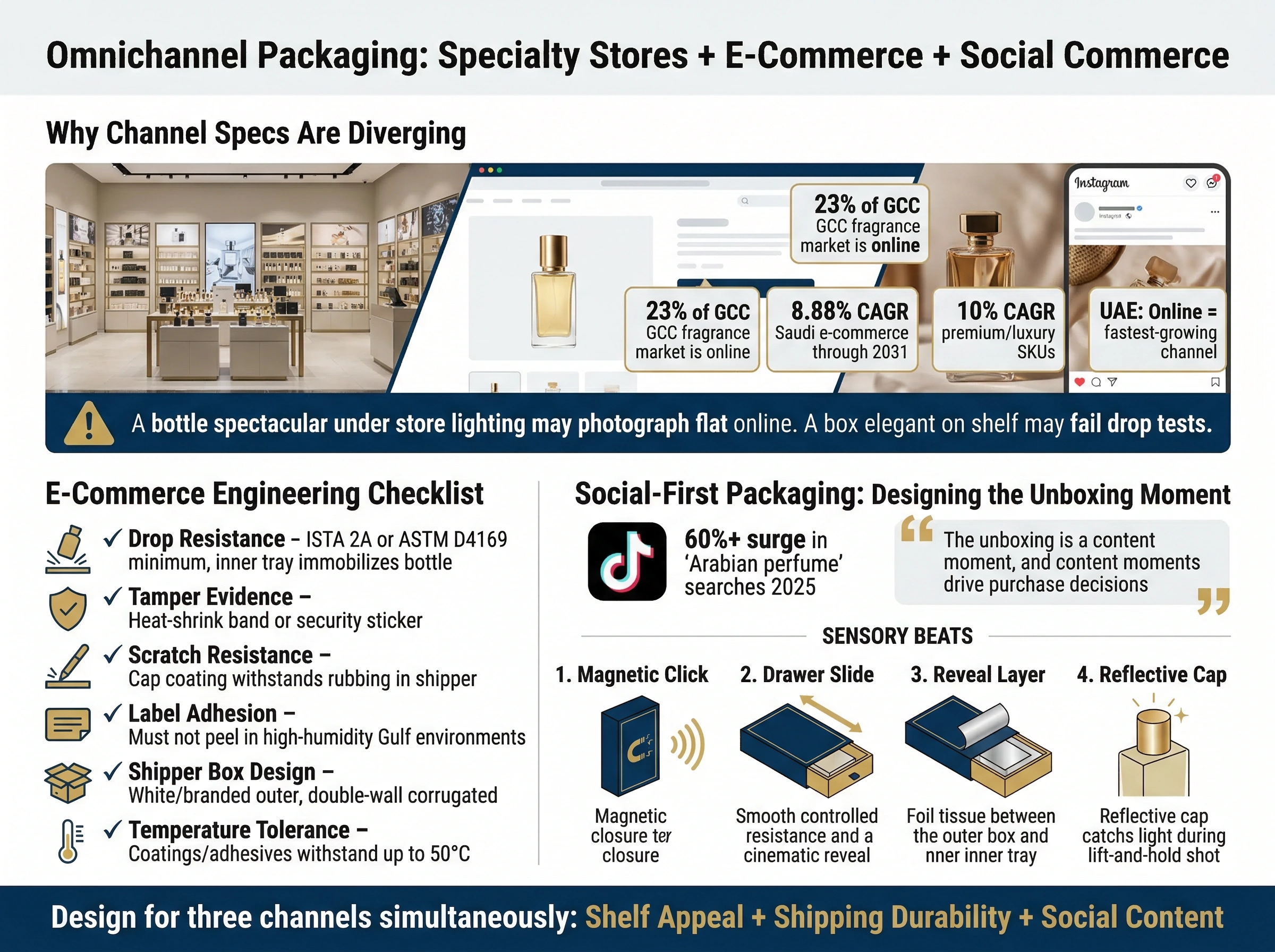
Online sales channels represent 23% of total GCC fragrance market volume and are growing rapidly. Saudi Arabia’s e-commerce cosmetics and fragrances segment is projected to grow at a CAGR of 8.88% through 2031, with premium/luxury SKUs leading at nearly 10% CAGR. The fastest-growing segment in the UAE fragrance market by channel is online. These are not niche channels — they are mainstream and accelerating.
The problem for brands: a bottle that looks spectacular under specialty-store lighting may photograph flat on a white PDP background. A box engineered for elegant shelf presentation may fail a 1.2-meter drop test. Designing for one channel is no longer viable.
E-Commerce Engineering Checklist
Before signing off on packaging for any new GCC launch, verify:
Drop resistance: ISTA 2A or ASTM D4169 minimum; the inner tray must immobilize the bottle against lateral movement
Tamper evidence: Heat-shrink band or security sticker across the box closure
Scratch resistance: Cap coating must withstand rubbing contact in a shipper without scuffing
Label adhesion: Barcode and product label must not peel in high-humidity environments (Gulf summer logistics)
Shipper box design: White or branded outer shipper with void fill, double-wall corrugated for single-piece shipments
Temperature tolerance: Coatings and adhesives must withstand ambient temperatures up to 50°C in regional logistics environments
Social-First Packaging: Designing the Unboxing Moment
The 60%+ surge in “Arabian perfume” searches on TikTok and Google in 2025 confirms what brand teams in Dubai already know: the unboxing is a content moment, and content moments drive purchase decisions. At Beautyworld Middle East 2025, brands like Lattafa attracted massive social attention through visually spectacular booth presentations and packaging that was designed to be filmed.
Engineering the social moment means specifying for distinct sensory beats:
Magnetic click on box closure (auditory cue in video)
Drawer slide with smooth, controlled resistance (cinematic reveal)
Reveal card or foil tissue layer between outer box and inner tray
Reflective cap that catches light during the lift-and-hold shot
Anti-Counterfeit and Trust: Authentication as a Packaging Feature
Why Authentication Matters More as GCC Brands Go Global
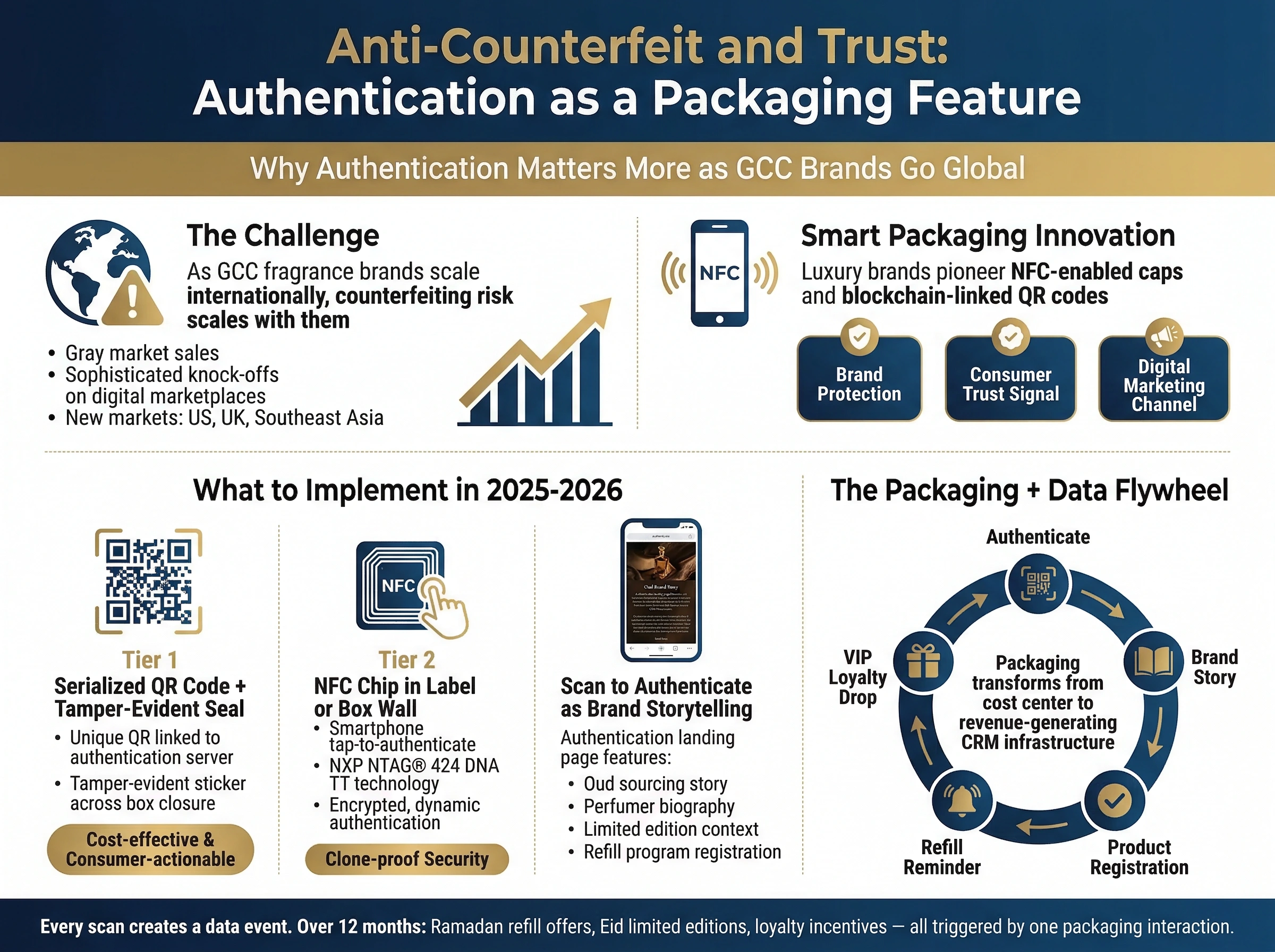
As GCC fragrance brands scale internationally, the counterfeiting risk scales with them. The cosmetics and personal care anti-counterfeit packaging market is experiencing robust growth, driven by the proliferation of gray market sales and sophisticated knock-offs on digital marketplaces. For premium GCC brands entering new markets — the United States, the UK, Southeast Asia — packaging authentication is both a brand protection tool and a consumer trust signal.
Luxury beauty brands are increasingly pioneering “Smart Packaging” features like NFC-enabled caps and blockchain-linked QR codes to offer consumers a premium, interactive authentication experience that doubles as a digital marketing channel. The technology is mature, accessible, and cost-effective at volume.
What to Implement in 2025–2026
Serialized QR Code + Tamper-Evident Seal
The most deployable tier for most brands. Each unit carries a unique QR code linked to a brand authentication server. A tamper-evident sticker across the box closure confirms the product has not been opened. Cost-effective and immediately consumer-actionable.
NFC Chip in Label or Box Wall
NFC tags embedded in the inner label or the side wall of a rigid box allow smartphone tap-to-authenticate without requiring a camera. Technology like the NXP NTAG® 424 DNA TT provides encrypted, dynamic authentication and tamper detection — ensuring that even if a counterfeit tag is cloned, it cannot replicate the dynamic response.
“Scan to Authenticate” as Brand Storytelling
The authentication landing page should not just confirm “this product is genuine.” It should be the entry point to the brand world: the oud sourcing story, the perfumer’s biography, the Ramadan limited edition context, or the refill program registration. Authentication becomes a consumer touchpoint.
The Packaging + Data Flywheel
Every scan creates a data event. Brands that architect this correctly can build a CRM flywheel:
Authenticate → Brand Story → Product Registration → Refill Reminder → VIP Loyalty Drop
Over 12 months, a consumer who scanned at purchase and registered their bottle can receive a Ramadan refill offer, an Eid limited edition pre-release, and a loyalty incentive — all triggered by a single packaging interaction at the point of first use. This transforms packaging from a cost center into a revenue-generating CRM infrastructure.
Why Beautyworld Matters for Packaging Decisions
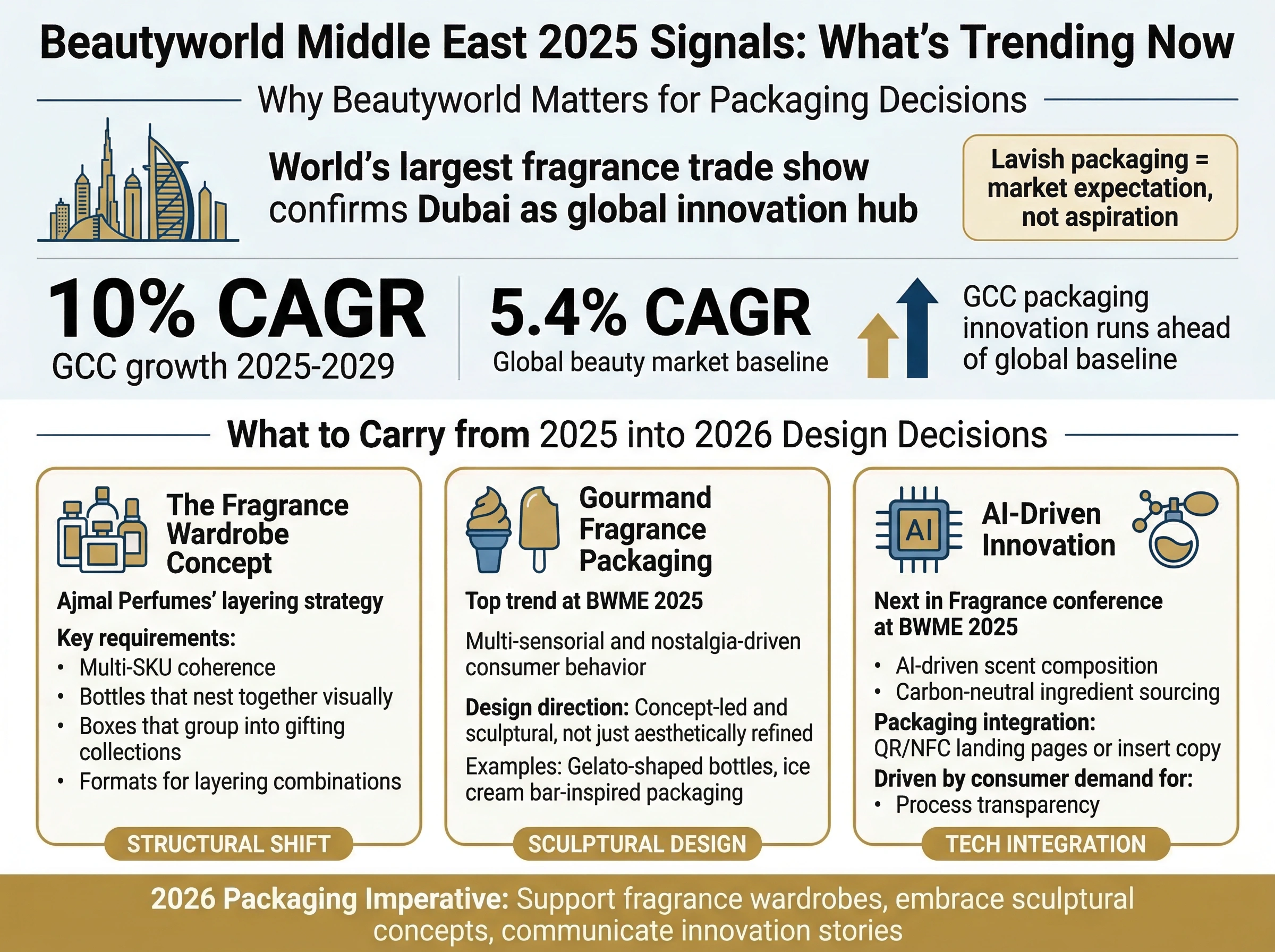
Beautyworld Middle East is the world’s largest fragrance trade show, and its 2025 edition confirmed Dubai’s role as a global fragrance innovation hub. The show showcased “lavish packaging” as a core part of Middle Eastern brands’ global pitch — demonstrating that regional design excellence in packaging is no longer aspirational, it is a market expectation.
The GCC is projected to grow at 10% CAGR from 2025 to 2029, compared to a global beauty market rate of 5.4%, according to figures presented at the show. That differential growth rate means packaging innovation in the GCC is running ahead of the global baseline.
What to Carry from 2025 into 2026 Design Decisions
The Fragrance Wardrobe Concept: Ajmal Perfumes’ strategy of offering layering formats and gifting sets designed for diverse global markets signals a structural shift. Packaging must support multi-SKU coherence: bottles that nest together visually, boxes that group into gifting collections, formats that allow layering combinations to be merchandised as a set.
Gourmand Fragrance Packaging: Among the top trends at BWME 2025 was the evolution of gourmand fragrances — brands displayed gelato-shaped bottles and ice cream bar-inspired packaging, reflecting multi-sensorial and nostalgia-driven consumer behavior. For 2026, this means packaging design is increasingly concept-led and sculptural, not just aesthetically refined.
AI-Driven Innovation: The Next in Fragrance conference at BWME 2025 highlighted AI-driven scent composition and carbon-neutral ingredient sourcing. Packaging narratives that connect to these innovation stories — through QR/NFC landing pages or insert copy — will resonate with a consumer base increasingly interested in process transparency.
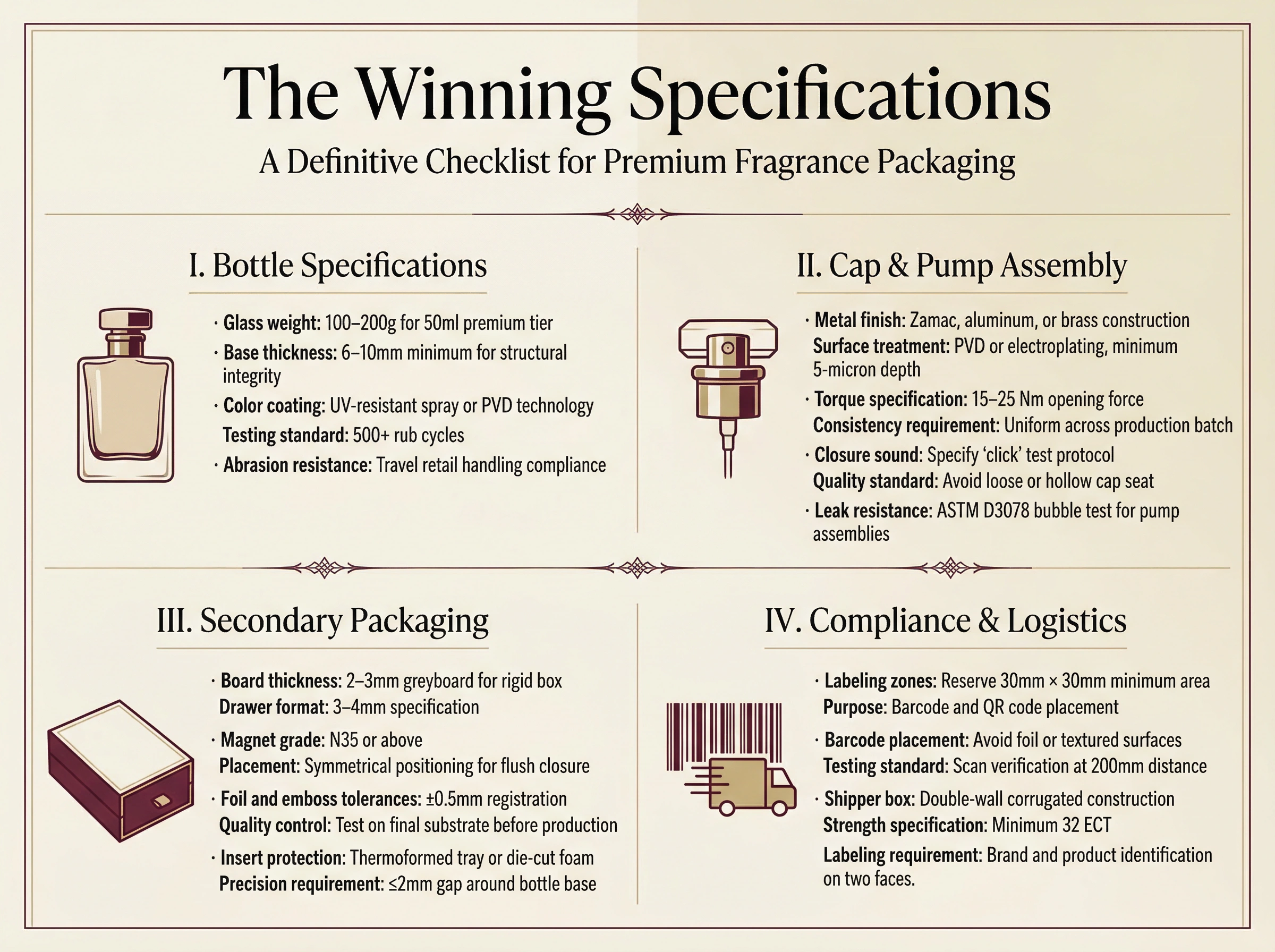
A one-screen reference for procurement and product teams:
Bottle
Glass weight: 100–200g for 50ml premium tier
Base thickness: 6–10mm minimum for structural integrity
Color coating: UV-resistant spray or PVD; test for 500+ rub cycles
Abrasion resistance: Must meet travel retail handling standards
Cap + Pump
Metal finish: Zamac, aluminum, or brass; PVD or electroplating with minimum 5-micron depth
Torque: 15–25 Nm opening force; consistent across production batch
Closure sound: Specify “click” test; avoid loose or hollow cap seat
Leak resistance: ASTM D3078 bubble test for pump assemblies
Secondary Packaging
Board thickness: 2–3mm greyboard for rigid box; 3–4mm for drawer formats
Magnet grade: N35 or above; placed symmetrically for flush closure
Foil + emboss tolerances: ±0.5mm registration; test on final substrate before production
Insert protection: Thermoformed tray or die-cut foam with ≤2mm gap around bottle base
Compliance + Logistics
Labeling zones: Reserve 30mm × 30mm minimum for barcode + QR placement
Barcode placement: Avoid foil or texture surfaces; test scan at 200mm distance
Shipper box: Double-wall corrugated; minimum 32 ECT; brand/product labeling on two faces
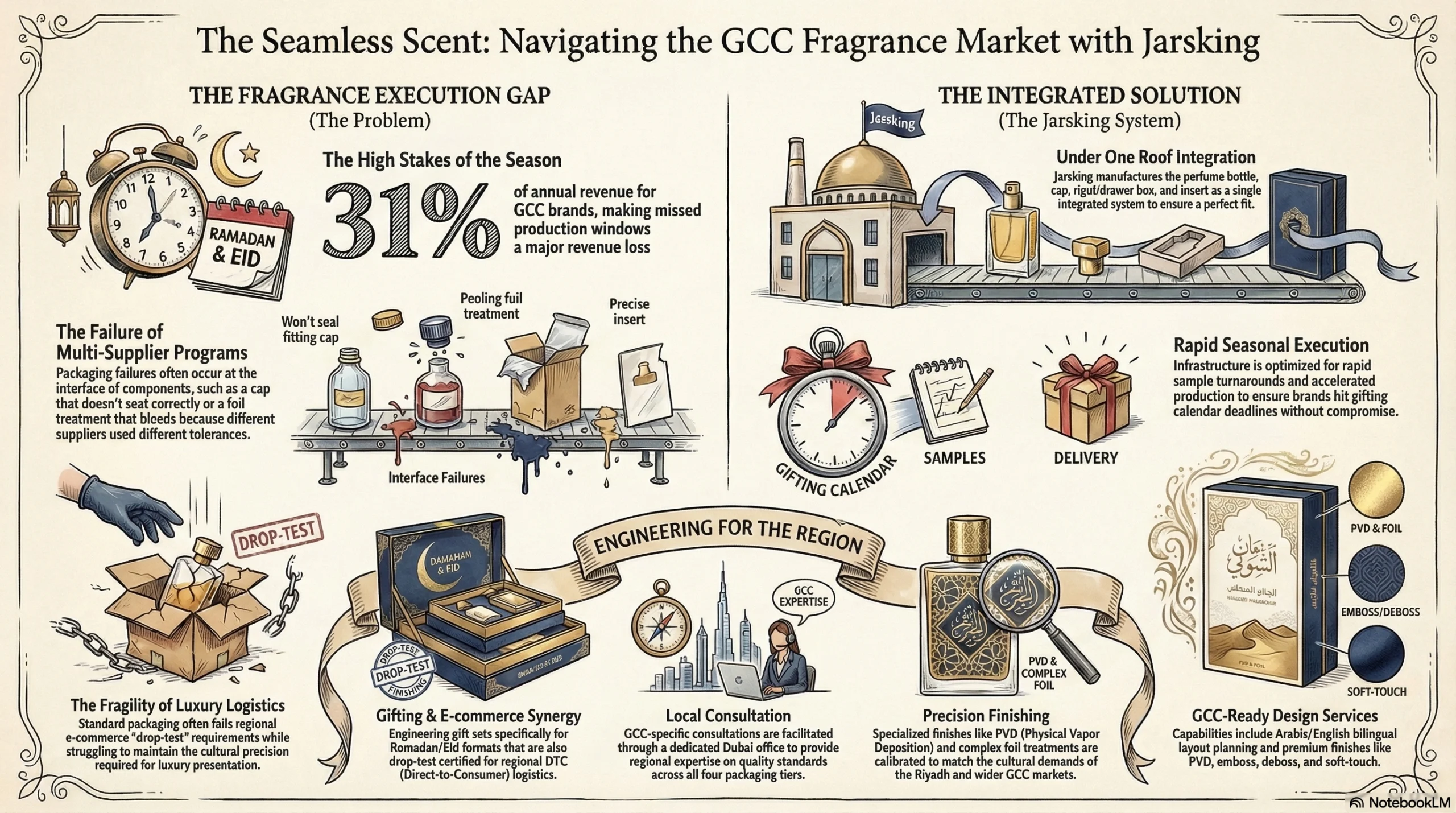
GCC fragrance brands face a specific set of execution challenges: tight seasonal windows, multi-component packaging systems that must integrate perfectly, cultural design requirements that demand precision finishing, and e-commerce specs that must coexist with luxury presentation. Jarsking is built to solve each of these.
Fast Seasonal Execution
With Ramadan and Eid representing 31% of annual revenue, missed production windows are not a minor inconvenience — they are a revenue event. Jarsking’s manufacturing infrastructure supports rapid sample turnarounds and accelerated production scheduling for seasonal programs, helping brands hit their gifting calendar deadlines without compromising quality standards.
System Solution: Bottle + Cap + Box + Insert
Fragrance packaging failures most often occur at the interface between components: a cap that doesn’t seat correctly on a third-party bottle; an inner tray that doesn’t protect the bottle against the box walls; a foil treatment that bleeds across an emboss line because two suppliers used different tolerances. Jarsking offers a complete system — perfume bottle, cap, rigid box and drawer box, and insert — under one roof. That integration eliminates the mismatch risk that multi-supplier fragrance programs routinely encounter.
GCC-Ready Design Services
Jarsking’s design capabilities are specifically calibrated for the GCC market: Arabic and English bilingual layout planning, premium finishing (foil, emboss, deboss, soft-touch, PVD), gift set engineering for Ramadan and Eid formats, and e-commerce drop-test packaging that meets regional logistics conditions. Whether you’re launching your first specialty store SKU in Riyadh or scaling a DTC channel across the GCC, the starting point is a sample kit — request yours here to see the quality standard across all four packaging tiers.
You can also explore our Dubai office for GCC-specific consultations, or browse the full perfume bottle and box catalog for gifting structures.
The 2025–2026 GCC Packaging Brief, in Five Points
The GCC fragrance market is one of the world’s most compelling consumer goods growth stories, and packaging sits at the center of it. Five realities define the 2025–2026 commercial environment:
Premium-led: 68% of GCC fragrance revenue comes from the premium and luxury tier — every packaging decision must earn its place in that context.
Gifting is structural: 28% of annual volume is gifting, which means secondary packaging is not optional — it is a primary commercial format.
Seasonal peaks are non-negotiable: Ramadan and Eid drive 31% of annual revenue — packaging programs must be planned around this calendar, not retrofitted to it.
Omnichannel is the reality: 23% of total market volume is online, and both Saudi Arabia and UAE e-commerce are growing at near-double-digit CAGRs — packaging must perform across specialty retail, e-commerce, and social commerce simultaneously.
Cultural and social momentum is accelerating: With “Arabian perfume” searches up 60%+ in 2025 and brands like Lattafa, Kayali, and Amouage reshaping global fragrance perception, the packaging that carries these brands must match the ambition of the moment.
The brands that will win in 2025–2026 are not those with the largest marketing budgets — they are those with the most cohesive packaging systems, the most culturally intelligent design, and the fastest seasonal execution. If you’re ready to build that system, contact Jarsking for a packaging consultation and sample kit — and see what winning packaging looks and feels like before you commit to a production run.
FAQs
In the GCC, fragrance is part of daily life, cultural identity, and gifting tradition — not just a personal scent choice. That changes everything about how packaging should be designed.
The key differences:
Heavier materials: Thick glass bottles and metal caps signal quality before the bottle is even opened
Ornate finishing: Foil stamping, emboss, and Arabic calligraphy are expected at the premium tier — not optional extras
Gifting-first structure: Rigid boxes with velvet linings matter because a large share of purchases are gifts, not personal buys
Cultural design: Generic “Middle Eastern” patterns don’t work — consumers recognize authentic Arabic design and reward it with loyalty
Ramadan and Eid drive 31% of annual GCC fragrance revenue, so missing the window is a direct hit to your bottom line. Here’s a straightforward timeline working backwards from launch:
| Stage | When to Complete |
|---|---|
| Concept and brief locked | 9 months before launch |
| Supplier brief + tooling confirmed | Months 2–3 |
| Prototype samples approved | Months 4–5 |
| Pre-production strike-off signed off | Month 6 |
| Production run | Months 7–8 |
| Shipped to retail | Month 9 |
You don’t need to overcomplicate it. A two-tier approach covers most brands effectively:
Tier 1 — Essential:
A unique serialized QR code on every unit, linked to your authentication server
A tamper-evident seal across the box closure
Tier 2 — For luxury and export-focused brands:
An NFC chip embedded in the inner label or box wall — consumers simply tap their phone to verify
The smart move: Don’t let your authentication page just say “this product is genuine.” Use it as a brand moment — tell the scent story, offer refill registration, invite consumers into your loyalty program. Every scan becomes a CRM touchpoint.
The secret is framing eco-choices as quality upgrades — not compromises. Here’s how:
Swap foam inserts for molded pulp — when precision-tooled, pulp looks more considered and deliberate than generic foam
Use cellulose film instead of plastic windows — visually identical, but biodegradable
Choose PCR (recycled) glass — same weight and clarity when properly inspected, with a better story
Go refillable — a heavy, beautifully designed “forever bottle” paired with seasonal refill cartridges is arguably the strongest packaging strategy in the GCC right now. It is a sustainability story, a gifting format, and a repeat-purchase mechanic all in one
Bottom line: If your sustainable packaging feels cheaper, the spec is wrong. Eco-luxury is an engineering challenge, not a compromise.
Packaging designed only for shelf display will fail in shipping. Before any new GCC e-commerce launch, make sure your packaging passes these checks:
Inner tray: Bottle must not move more than 2mm in any direction inside the tray
Tamper seal: Heat-shrink band or security sticker across the box closure
Scratch resistance: Cap coatings must survive contact surfaces inside a shipper
Label adhesion: Must hold in humidity exceeding 90% (Gulf logistics reality)
Outer shipper: Double-wall corrugated; branded on at least two faces
Temperature tolerance: All coatings and adhesives rated to 50°C — Gulf warehouses get hot
Bottom line: A beautiful box that arrives damaged destroys your review score and your brand reputation simultaneously. Engineer for the journey, not just the shelf.
Think of it as three market layers, each with its own packaging priority:
Dubai — Sets the global quality benchmark through duty-free, luxury malls, and specialty stores. Your packaging must perform at the highest international standard here.
Riyadh and Jeddah — Saudi Arabia’s e-commerce for cosmetics and fragrances is growing at a CAGR of nearly 9% through 2031. Omnichannel specs — packaging that works both on shelf and in a shipper — are non-negotiable in these markets.
Doha — Punches above its size in corporate and luxury gifting. Premium rigid box formats are especially important here.
TikTok and DTC channels (all markets) — The fastest-growing discovery layer across the entire GCC. Every 2026 packaging brief should include a defined “social moment”: the magnetic click, the drawer reveal, the reflective cap lift — the beats that make an unboxing worth filming.
Bottom line: There is no single GCC channel anymore. Design for the boutique, engineer for the shipper, and choreograph for the camera — all at once.