







You spent months perfecting your serum formula and thousands of dollars on stunning packaging design. Then a customer posts an unboxing video — and instead of a glowing review, they’re holding a dented, crushed box with a cracked product inside.
For direct-to-consumer beauty brands, this scenario isn’t rare. It’s one of the most preventable — and most costly — mistakes in the industry. The root cause? Most DTC beauty folding carton packaging is designed for retail shelves, not the brutal reality of an Amazon fulfillment center conveyor belt, a ShipBob warehouse pick-and-pack station, or a courier van making 200 stops a day.
In this guide, you’ll learn exactly how to spec, design, and test folding cartons that protect your product through every stage of the e-commerce supply chain — without sacrificing the premium unboxing experience your customers expect.
Why Retail Folding Cartons Fail in E-Commerce
A folding carton designed for a Sephora shelf has one job: look great standing still. It needs to catch the eye, communicate the brand, and survive being picked up and put back down a few dozen times a day.
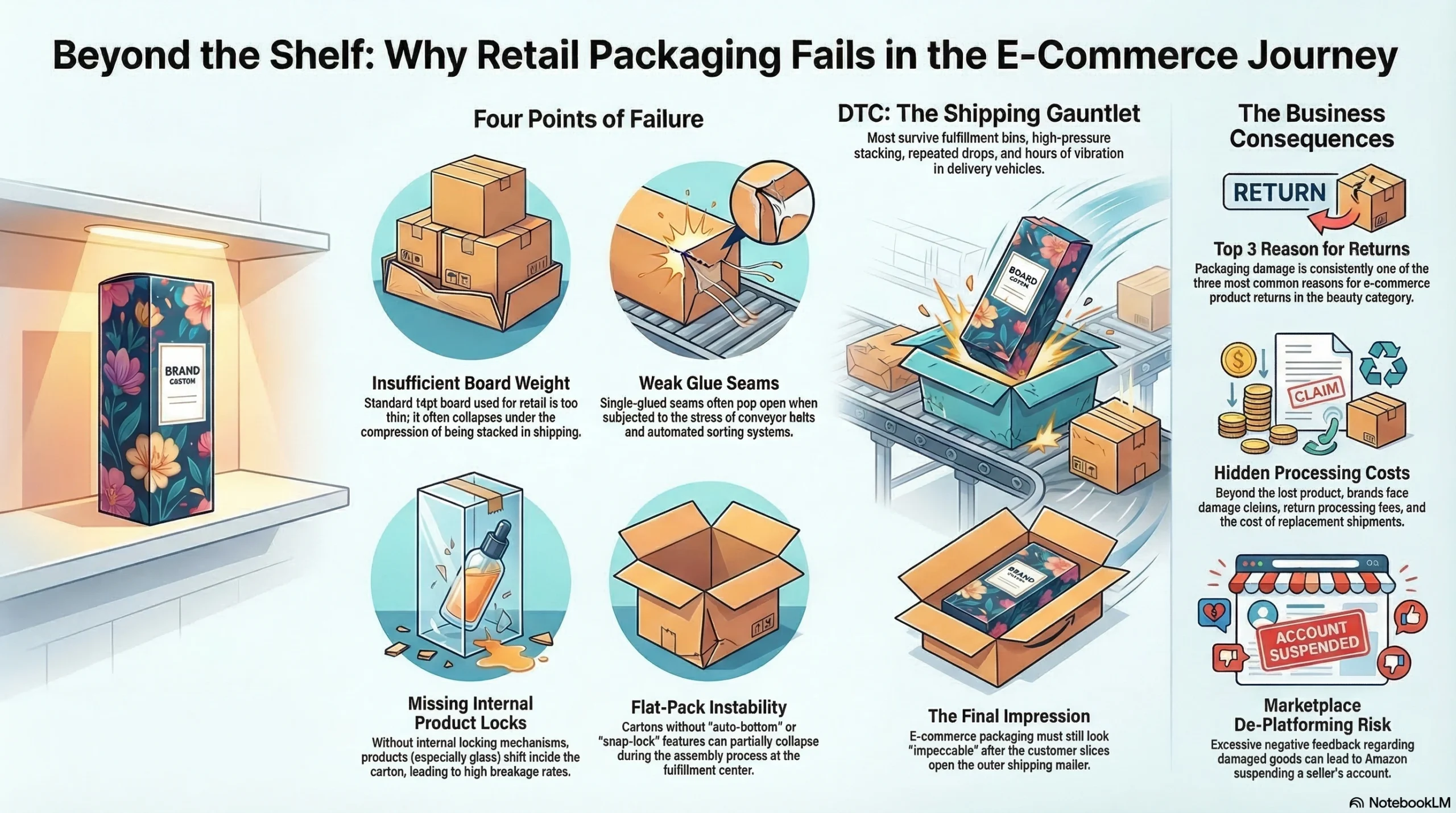
A DTC folding carton has a completely different job description. It needs to survive being tossed into a fulfillment bin, stacked under dozens of other packages, dropped multiple times, rattled around in a delivery truck for hours, and still look impeccable when a customer slices open their shipping mailer.
Standard retail cartons routinely fail in e-commerce for several predictable reasons:
Insufficient board weight — 14pt board designed for static display collapses under stacking compression
Weak glue seams — standard single-glued seams pop open on conveyor belts and during automated sorting
No internal product lock — products shift inside the carton, leading to breakage, especially for glass components
Flat-pack instability — cartons that aren’t auto-bottom or snap-lock can partially collapse during assembly at the fulfillment center
The business consequences go beyond a bad review. Damage claims, return processing fees, replacement shipments, and the risk of Amazon suspending your seller account for excessive negative feedback add up fast. Packaging damage consistently ranks among the top three reasons for e-commerce product returns across the beauty category.
Understanding the Gauntlet — What Your Box Actually Goes Through
Before you can design the right solution, it helps to understand the specific stresses your folding carton faces at each stage of the fulfillment journey.
Amazon FBA: SIOC and Frustration-Free Packaging
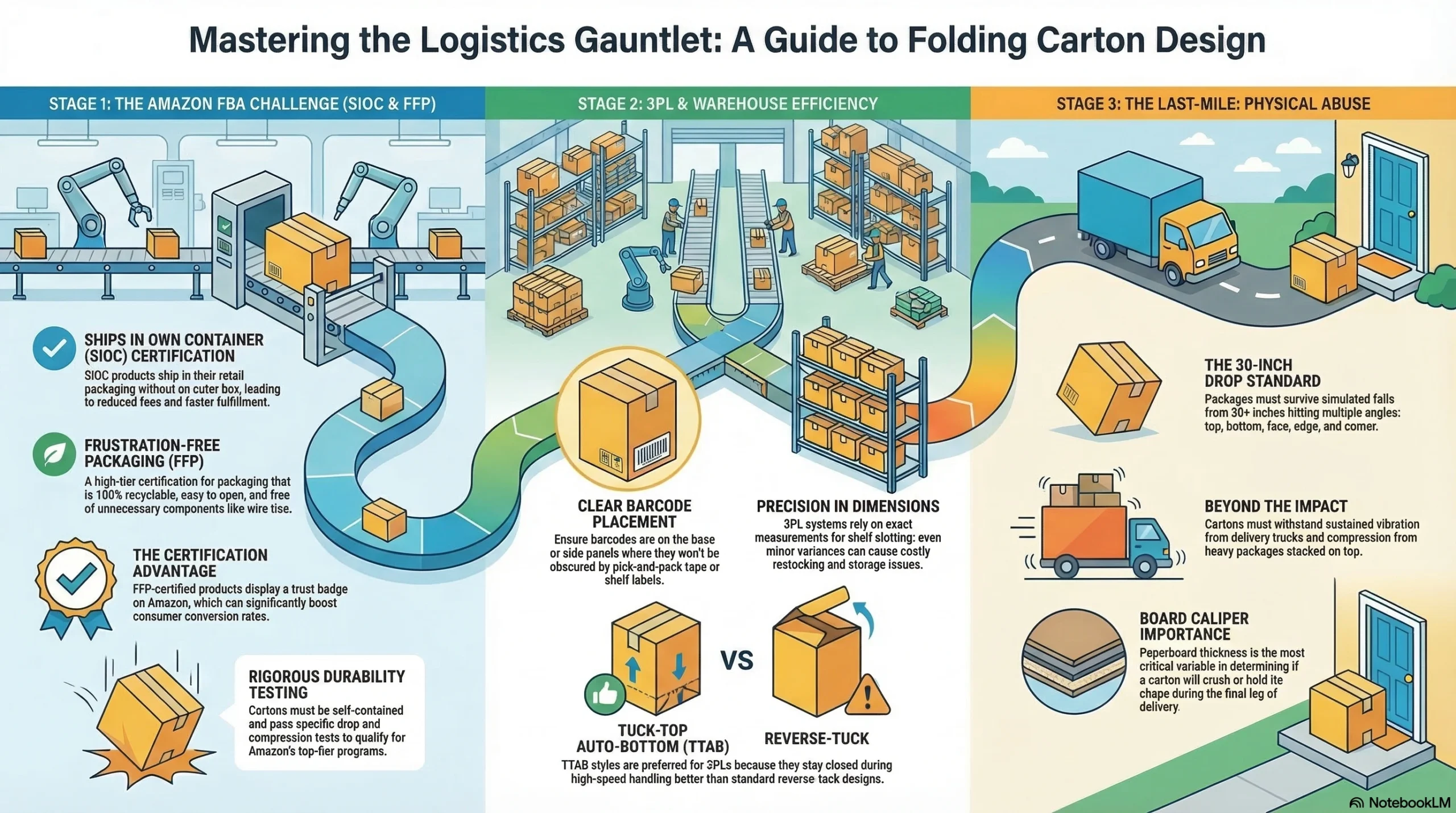
If you sell through Amazon FBA, your packaging is subject to some of the most rigorous handling in e-commerce logistics. Amazon’s Ships in Own Container (SIOC) program certifies products that can be shipped in their retail packaging without an additional shipping box — a designation that reduces fees, speeds up fulfillment, and improves the customer experience.
Amazon’s Frustration-Free Packaging (FFP) program takes it a step further, with tiered certification levels (FFP, NISTIV, SIOC) that reward brands whose packaging is easy to open, damage-resistant, and 100% recyclable. To qualify, your folding carton must be self-contained (no loose void fill), structurally sound enough to pass Amazon’s drop and compression tests, and free from components like wire ties or excess inner packaging.
The upside: FFP-certified products earn the Amazon certification badge, which builds consumer trust and can meaningfully improve conversion rates.
Third-Party Fulfillment: ShipBob, ShipMonk, and Beyond
3PL warehouses handle enormous SKU volumes with speed as the top priority. Your carton needs to work with their systems, not against them.
Key requirements for 3PL-ready folding carton design include:
Clear, unobstructed barcode placement — barcodes on the base or a designated side panel that won’t be covered by pick-and-pack tape
Consistent, precise dimensions — 3PL shelf slotting systems are built around exact measurements; variance from spec creates costly restocking issues
Closures that stay closed — standard reverse-tuck closures frequently pop open during high-speed pick-and-pack; tuck-top auto-bottom (TTAB) styles hold far more reliably
Last-Mile Couriers: UPS, FedEx, USPS, and DHL
The last leg of delivery is where the most physical abuse occurs. Industry drop-test standards simulate falls from 30 inches or more at multiple angles — top, bottom, face, edge, and corner. Beyond single impacts, your carton also needs to withstand sustained vibration (simulating hours in a delivery truck) and compression from other packages stacked on top.
Board caliper — the thickness of the paperboard — is the single biggest variable in determining how your carton performs under these conditions. Getting this right starts at the spec stage, long before you go to print.
The 5 Folding Carton Design Upgrades for DTC Survival
These are the specific, actionable changes that separate a retail carton from a DTC-ready one.
1. Upgrade Your Board Weight
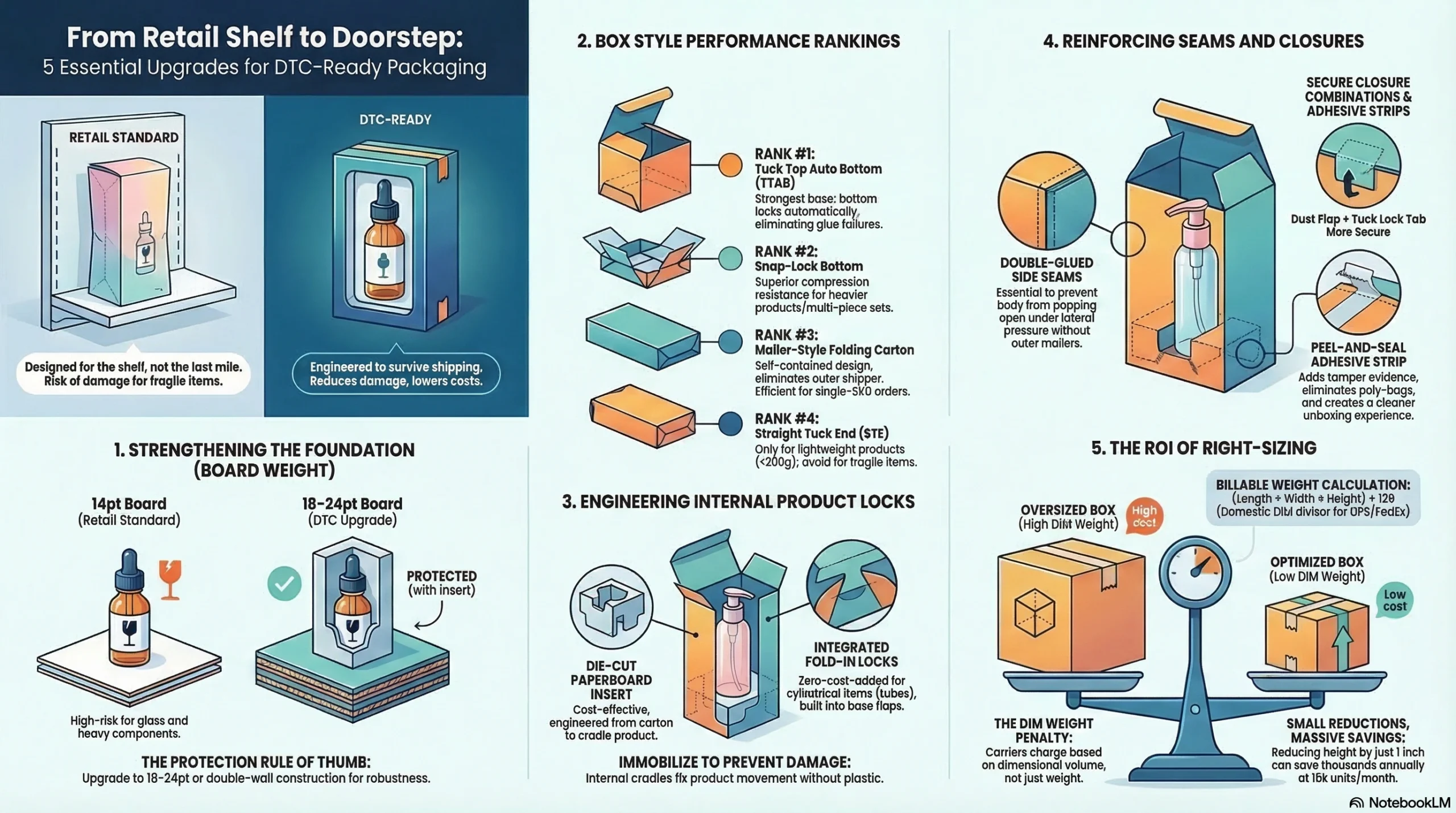
Standard retail folding cartons typically use 14–16pt paperboard. For DTC e-commerce, especially for products with any glass or heavy components, you should be specifying 18–24pt board — or exploring double-wall construction for particularly fragile items.
The rule of thumb: match your board caliper to your product weight and fragility. A 30ml glass dropper bottle in a 14pt carton is a damage claim waiting to happen. The same bottle in an 18pt carton with a paperboard insert is protected.
2. Choose the Right Box Style
Not all folding carton styles are equal when it comes to e-commerce performance. Here’s how the most common styles rank for DTC use:
Tuck Top Auto Bottom (TTAB): The strongest base available in a folding carton format. The bottom locks automatically when erected, eliminating the weak-point glue failure that plagues straight tuck styles. Best for most DTC beauty applications.
Snap-Lock Bottom: Superior compression resistance, ideal for heavier products like full-size glass bottles or multi-piece sets.
Mailer-Style Folding Carton: Self-contained, fully enclosed design that eliminates the need for an outer shipper box — the most efficient option for high-volume DTC brands shipping single-SKU orders.
Straight Tuck End (STE): Fine for lightweight products under 200g, but should be avoided for anything heavier or fragile.
3. Engineer an Internal Product Lock
Product movement inside the carton during transit is the primary cause of damage to glass, pumps, and fragile applicators. The fix doesn’t have to be expensive — and it definitely doesn’t have to be plastic.
The most cost-effective DTC solution is a die-cut paperboard insert engineered from the same sheet as the carton itself, creating a cradle that immobilizes the product during transit. Fold-in product locks built directly into the base flap are another elegant, zero-cost-added option for cylindrical formats like tubes and bottles.
For premium products, custom-shaped inserts in molded pulp or foam can be nested inside the carton to add a luxury unboxing dimension alongside superior protection. Explore Jarsking’s custom folding carton and insert options here.
4. Reinforce Your Seams and Closures
For any carton shipped without an outer mailer box, seam strength is non-negotiable. Specify double-glued side seams to prevent the carton body from popping open under lateral pressure. For the closure, a dust flap + tuck lock tab combination is significantly more secure than a standard tuck alone.
If your brand operates in the DTC subscription or direct-mail space, consider a peel-and-seal adhesive strip closure. It adds tamper evidence (which consumers increasingly expect), eliminates the need for poly-bag overwraps, and creates a cleaner unboxing experience.
5. Right-Size for Dimensional Weight Pricing
Here’s a business case that pays for itself: every carrier — UPS, FedEx, DHL — charges based on dimensional (DIM) weight, not just actual weight. The formula is straightforward:
Billable Weight = Length × Width × Height ÷ 139 (UPS/FedEx domestic DIM divisor)
An oversized folding carton with unnecessary internal void space is literally costing you money on every shipment. At scale — say, 10,000 units per month — even a 1-inch reduction in carton height can translate to thousands of dollars in annual shipping savings. Work with your packaging partner to spec the tightest possible fit around your product that still allows for your insert and closure system.
How to Test Your Folding Carton Before Mass Production
Skipping packaging tests before a full production run is one of the most expensive mistakes a DTC beauty brand can make. A single batch of 5,000 units with a structural flaw can generate hundreds of damage claims, trigger negative reviews, and — in the case of Amazon — put your seller account at risk. Testing before you commit is not a luxury. It is the only reliable way to validate your carton spec against real-world conditions.
There are four core test categories that every DTC folding carton should pass before going to production.
Drop Testing — Simulating the Handling Journey
Drop testing is the most critical test for any carton shipping through last-mile courier networks. The industry benchmark is defined by ISTA 1A and ASTM D5276, which simulate the falls and impacts that occur at every stage of handling — from a warehouse picker tossing a package into a bin, to a delivery driver setting a parcel on a doorstep a little too enthusiastically.
What happens during a drop test:
Your packaged product is dropped from a standardized height — typically 24 to 30 inches — onto a rigid flat surface. The drop is repeated from multiple orientations: flat face, flat base, flat side, each edge, and each corner. This matters because corner and edge impacts are consistently where folding cartons fail first. The glue seam, the base lock, and any internal insert are all stress-tested in a single sequence.
What to look for after the test:
Seams splitting or delaminating
Base lock or auto-bottom releasing
The product shifting or breaking inside the carton
Exterior print cracking or lamination lifting at stress points
Practical tip for beauty brands: Glass components — dropper bottles, perfume flacons, and jar lids — should be filled to production weight before testing. An empty bottle behaves very differently on impact than a full one.
Compression Testing — Simulating the Stack
Once your package leaves a fulfillment center, it is stacked under other parcels in a delivery vehicle, often for hours at a time. Compression testing, governed by ASTM D642, applies a sustained, measured load to the top face of your carton and measures how much it deforms before the structure fails.
What happens during a compression test:
A flat platen presses down on the top of your erected, filled carton at a controlled rate. The test records the maximum load the carton sustains before it buckles or collapses. Results are expressed in pounds of force (lbf) or Newtons.
Why this matters specifically for folding cartons:
Folding cartons have a natural weak point at the top closure. A standard tuck-end closure offers minimal compression resistance — which is exactly why auto-bottom and snap-lock styles significantly outperform straight tuck formats in this test. Board caliper plays a major role here too: an 18pt board can absorb roughly 30–40% more compression load than a 14pt board of the same dimensions.
Target benchmark: For most DTC beauty cartons, a minimum compression resistance of 150–200 lbf is a reasonable baseline. Your packaging supplier should be able to provide the ECT (Edge Crush Test) rating for the board spec they are recommending.
Vibration Testing — Simulating the Road
Drop tests capture isolated impact events. Vibration testing captures something more damaging over time: the constant, repetitive micro-stresses of being transported in a delivery truck, on a conveyor belt, or in an air freight container. ISTA 2A is the standard most commonly referenced for parcel-level e-commerce shipments.
What happens during a vibration test:
Your packaged product is placed on a vibration table that replicates the frequency and amplitude profiles recorded from real delivery vehicles. The test typically runs for 60 to 90 minutes, simulating several hours of road transport in an accelerated timeframe.
What vibration testing reveals that drop testing misses:
Progressive loosening of tuck closures that eventually pop open mid-transit
Gradual abrasion between the product and the carton interior — particularly damaging to metallic or soft-touch exterior finishes
Fatigue failure at score lines and fold points that appear structurally sound after drop testing
Practical tip: If your carton contains a glass component without a fitted insert, vibration testing will almost always expose it. The glass doesn’t need to shatter in a single drop — the sustained rattling wears away at the contact points and can cause cracking or cosmetic damage that is just as problematic from a customer experience standpoint.
Climate and Humidity Testing — Simulating Real-World Storage
This is the most frequently overlooked test in the beauty packaging industry, and it is particularly relevant for brands selling into humid climates, shipping during summer months, or stocking inventory in non-climate-controlled 3PL warehouses. The governing standard is ASTM D4332.
What happens during climate testing:
Cartons are conditioned in a controlled environment chamber at defined temperature and humidity levels — typically 73°F / 50% relative humidity for standard conditioning, or elevated to 104°F / 90% RH to simulate tropical or summer warehouse conditions. After conditioning, the cartons are immediately subjected to standard drop and compression tests.
Why this matters for folding cartons specifically:
Paperboard absorbs moisture from the ambient environment. A carton that passes compression testing at room humidity can lose up to 40% of its compression resistance after prolonged exposure to high humidity. This is especially critical for:
Brands shipping to Southeast Asia, the Middle East, or Florida/Gulf Coast US markets
Products stored in non-climate-controlled 3PL facilities during summer months
Subscription box brands whose cartons may sit in a customer’s mailbox for hours in summer heat
Moisture resistance can be improved through barrier coatings applied during the printing process — aqueous coatings, UV coatings, and certain lamination films all provide meaningful moisture resistance without significantly impacting recyclability.
The Practical Testing Workflow for DTC Beauty Brands
You don’t need to operate a testing laboratory to validate your carton spec. Here is a straightforward process that works for brands at any scale:
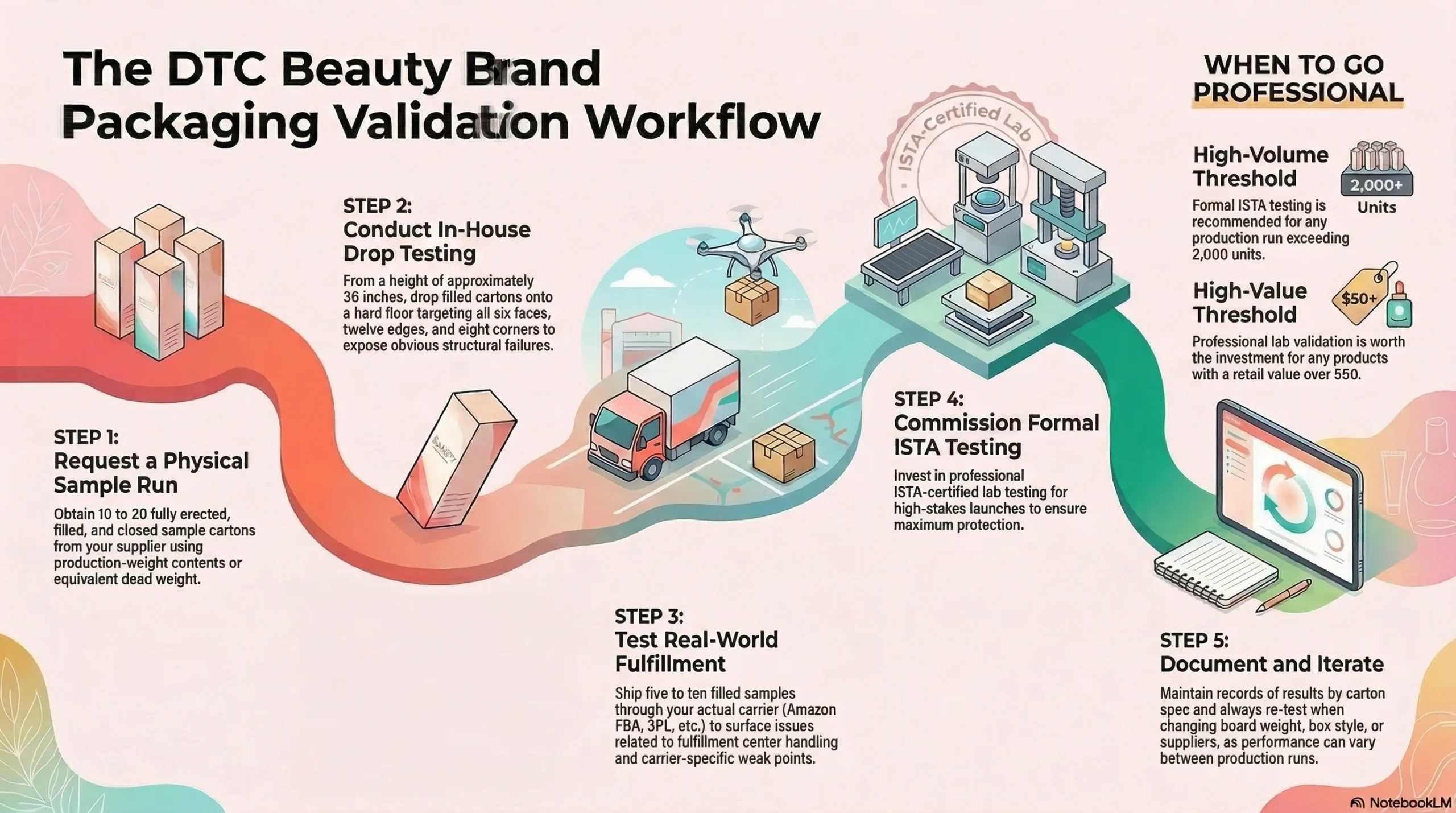
Step 1 — Request a physical sample run.
Before approving a production order, always request fully erected, filled, and closed sample cartons from your supplier — ideally 10 to 20 units. Fill them with production-weight contents or equivalent dead weight.
Step 2 — Conduct informal in-house drop testing.
Drop your filled sample cartons from counter height (approximately 36 inches) onto a hard floor from all six faces, all twelve edges, and all eight corners. This is not a substitute for lab testing, but it will immediately expose obvious structural failures before you invest in formal testing.
Step 3 — Ship a sample through your actual fulfillment network.
Send five to ten filled sample cartons through your real fulfillment channel — through Amazon FBA, your 3PL, or your own shipping carrier — to a test address. The real-world journey will surface issues that controlled lab tests occasionally miss, including fulfillment center handling damage and carrier-specific weak points.
Step 4 — Commission formal ISTA testing for large or high-value launches.
For any production run exceeding 2,000 units, or for products with a retail value over $50, formal ISTA-certified lab testing is worth the investment. ISTA-certified test labs can be found through the International Safe Transit Association, and many packaging suppliers either operate their own facilities or have preferred lab partners.
Step 5 — Document and iterate.
Keep a record of your test results by carton spec. When you change board weight, box style, or supplier, re-test. Packaging performance can vary between paper mills and production runs even when the nominal spec is identical.
For a complete overview of packaging test standards and protocols, the International Safe Transit Association (ISTA) is the industry’s leading authority and publishes open guidance on test procedures.
Balancing Protection With Brand Experience
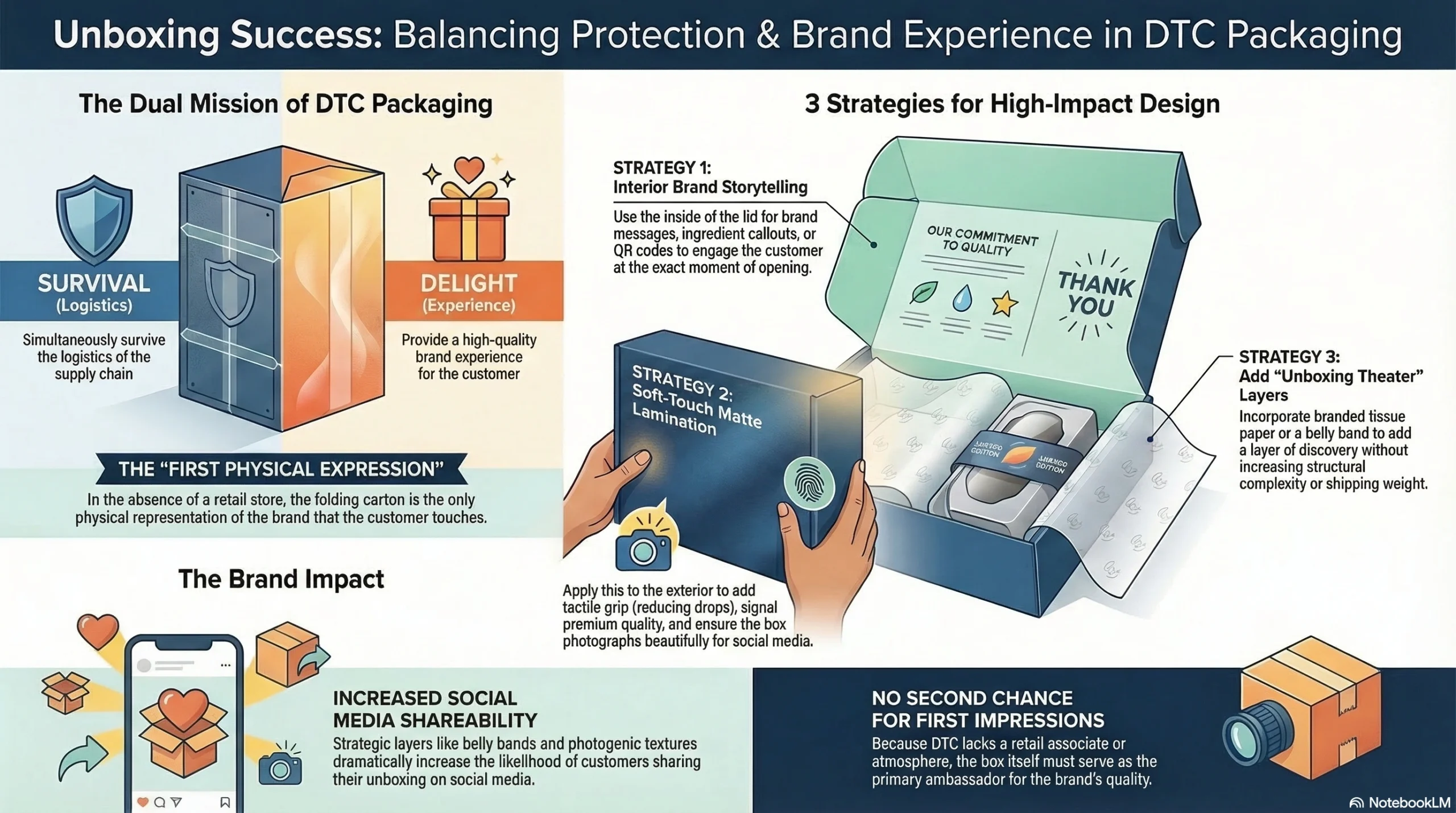
A DTC folding carton has to do two jobs simultaneously: survive the supply chain and delight the customer. These goals are not mutually exclusive — but they require intentional design.
Here are three design strategies that serve both protection and brand experience at once:
Use the interior for brand storytelling. Print a brand message, ingredient callout, or QR code linking to a how-to video on the inside of the lid. The customer only sees it at the moment of opening — when they’re most engaged and receptive.
Specify soft-touch matte lamination on the exterior. It photographs beautifully for unboxing content, adds tactile grip that reduces drops by the end consumer, and signals premium quality from the first touch.
Add a branded tissue paper or belly band inside the carton. It creates an additional layer of unboxing theater without adding meaningful structural complexity or weight — and it dramatically increases the likelihood of a social media share.
The folding carton is the first physical expression of your brand that the customer touches. In DTC, where there’s no retail associate, no in-store atmosphere, and no second chance at a first impression, that box is your brand.
Working With a Packaging Partner Who Understands DTC
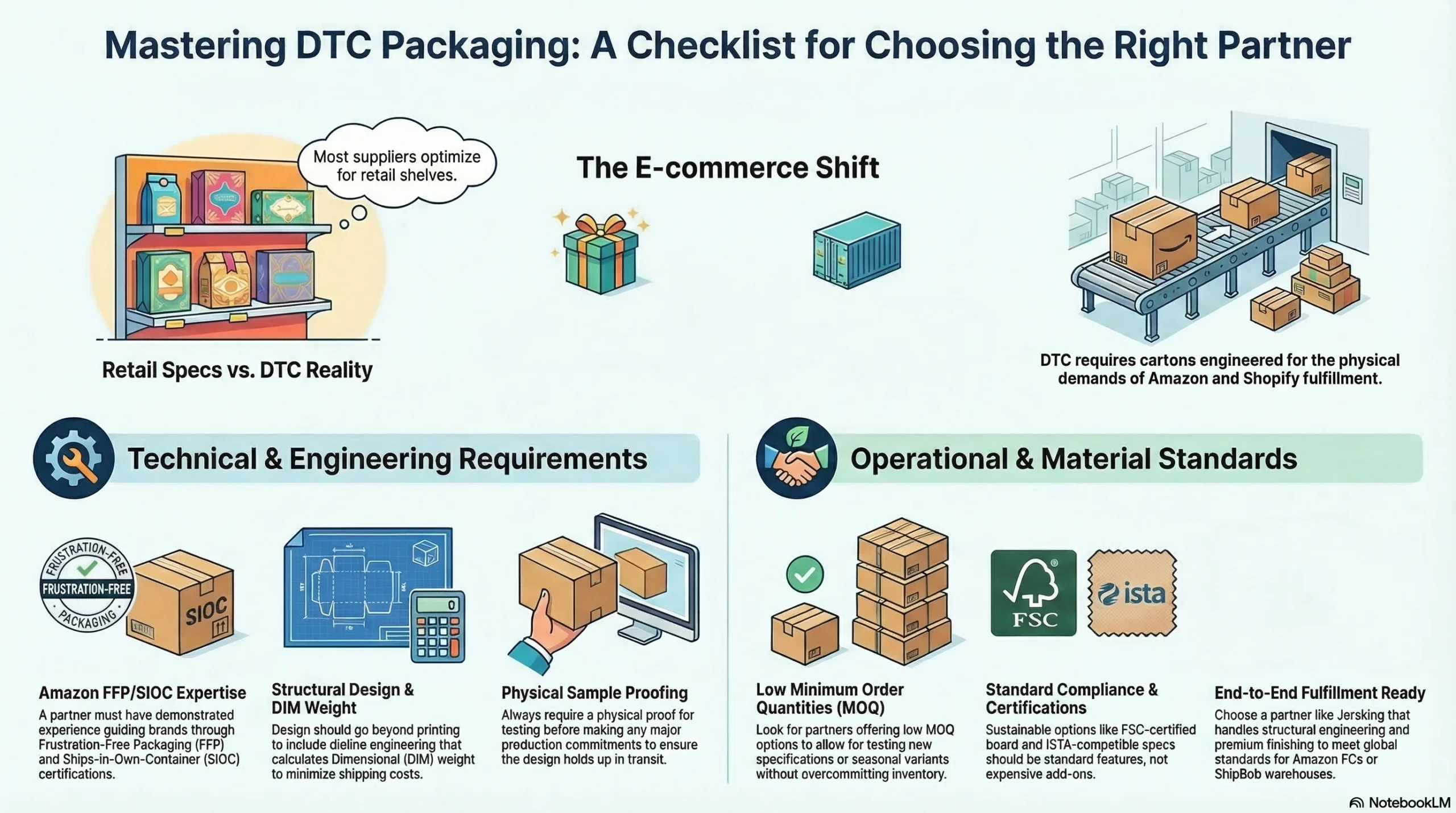
Not all packaging suppliers are equipped for e-commerce fulfillment realities. Most are optimized for retail shelf performance — and will spec your carton accordingly, even if your entire business runs through Amazon and Shopify.
When evaluating a packaging partner for DTC, look for:
Demonstrated experience with Amazon FFP/SIOC submissions — they should be able to walk you through the certification process
Structural design capability — not just print, but dieline engineering with DIM weight calculations built in
Physical sample proofing before any production commitment
Low MOQ options that allow you to test a new spec or seasonal variant without overcommitting inventory
Material certifications — FSC-certified board, recyclable construction, and ISTA-compatible specs should be standard offerings, not premium add-ons
At Jarsking, our end-to-end custom packaging capability covers structural engineering, premium finishing, and compliance with global fulfillment standards — so your carton is designed right the first time, whether it’s heading to an Amazon FC, a ShipBob warehouse, or direct to a customer’s front door.
Conclusion
Designing folding cartons for a DTC beauty brand is not simply a creative exercise — it is an operational and commercial decision that directly affects your margins, your reviews, and your customer relationships. Every element covered in this guide, from board weight selection to ISTA drop testing, exists to solve a single problem: the gap between how a carton performs on a design mockup and how it performs after 48 hours inside a real supply chain.
The beauty brands winning in DTC today are not necessarily the ones with the biggest packaging budgets. They are the ones who treat packaging as a system — one that has to survive a fulfillment center, impress a customer at the doorstep, and earn enough trust to turn that customer into a repeat buyer. A folding carton that checks all three of those boxes is not an accident. It is the result of deliberate structural decisions made early in the design process, validated through proper testing, and executed by a supplier who understands e-commerce from the inside out.
The good news: every upgrade outlined in this guide — stronger board, smarter box styles, engineered inserts, right-sized dimensions, proper testing — is achievable at accessible MOQs and price points. You do not need to be a legacy beauty conglomerate to ship like one.
Key Takeaways
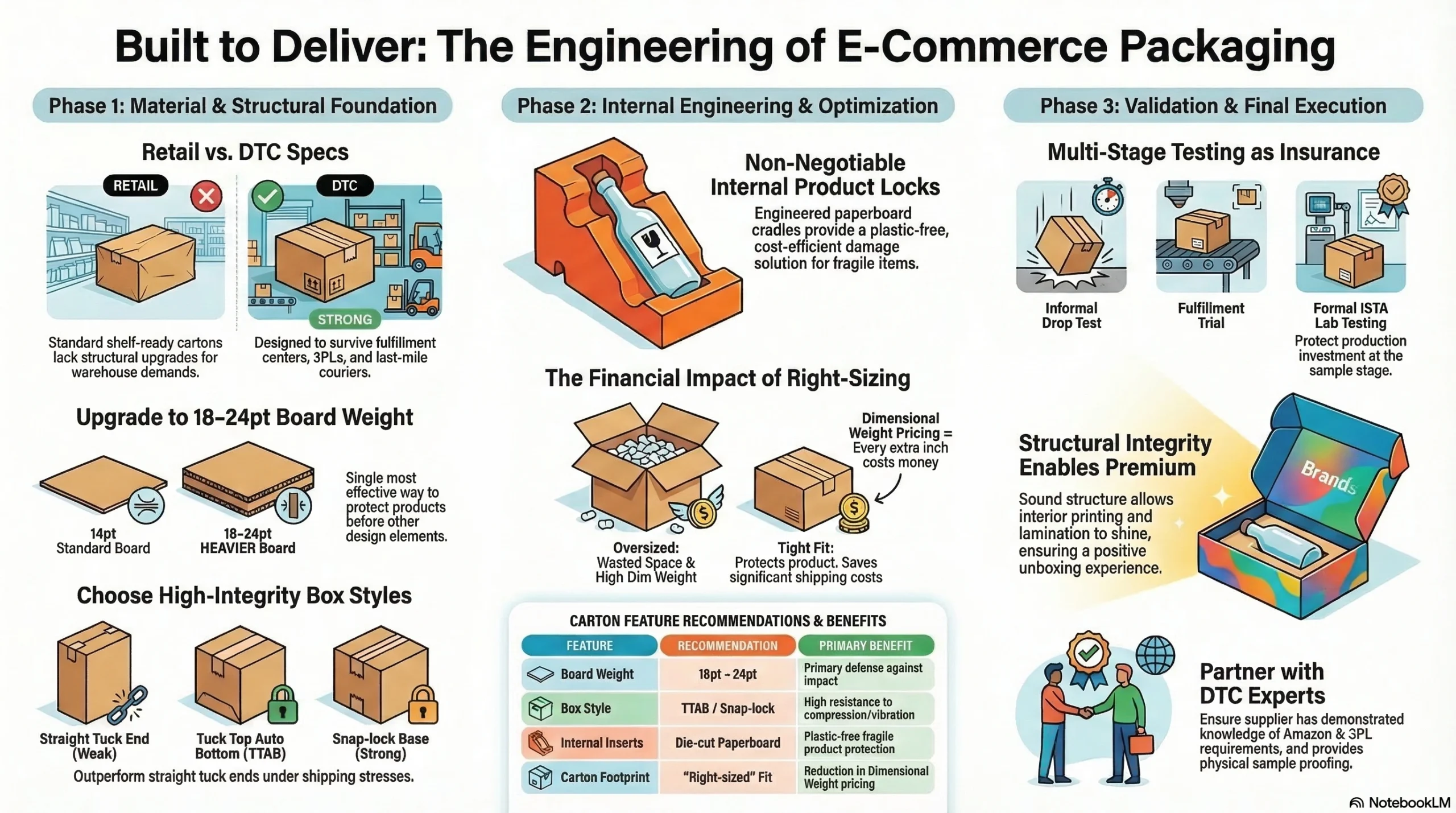
Retail carton specs and DTC carton specs are not interchangeable. The physical demands of fulfillment centers, 3PL warehouses, and last-mile couriers require specific structural upgrades that standard shelf-ready cartons are not built to handle.
Board weight is your first line of defense. Upgrading from 14pt to 18–24pt board is the single highest-impact, lowest-complexity change you can make for e-commerce performance — and it protects your product before any other design element does.
Box style determines structural integrity. Tuck Top Auto Bottom (TTAB) and snap-lock base styles dramatically outperform straight tuck end formats under the compression and vibration stresses of real-world shipping.
Internal product lock is non-negotiable for glass and fragile components. Die-cut paperboard cradles engineered directly into the carton dieline are a cost-efficient, plastic-free solution that eliminates the #1 cause of in-transit damage.
Right-sizing saves real money at scale. Dimensional weight pricing means every unnecessary inch in your carton footprint adds up across thousands of shipments. Work with your packaging partner to spec the tightest fit that still protects the product.
Testing before production is insurance, not overhead. Informal drop testing, real-world fulfillment trials, and formal ISTA lab testing at the sample stage protect your production investment and your brand reputation.
Protection and premium brand experience are not competing goals. With the right interior printing, lamination choices, and unboxing details, your DTC carton can delight customers because it is structurally sound — not in spite of it.
Your packaging partner’s expertise matters as much as the spec. Choose a supplier with demonstrated DTC and e-commerce fulfillment knowledge, physical sample proofing capability, and material certifications that meet Amazon, 3PL, and global carrier requirements.
FAQs
A retail folding carton is designed primarily for shelf display — it needs to look great standing still and withstand light handling in a store environment. A DTC folding carton, by contrast, must survive the full e-commerce supply chain: automated fulfillment centers, high-speed pick-and-pack stations, compression in delivery vehicles, and multiple drop impacts before it ever reaches a customer’s hands. This means DTC cartons typically require heavier board weight, stronger base styles (like TTAB or snap-lock), reinforced glue seams, and engineered internal product locks that retail cartons rarely need.
For most DTC beauty applications, 18–24pt paperboard is the recommended range. Standard retail cartons use 14–16pt board, which is insufficient for the compression and drop stresses of e-commerce fulfillment. The right board weight depends on your product’s total weight and fragility — a lightweight pressed powder compact can likely use 18pt, while a heavy glass perfume bottle or multi-piece gift set should be specced at 22–24pt or explored in a double-wall construction. Always ask your packaging supplier to match the board caliper recommendation to your specific product weight and carton dimensions.
Not every product sold on Amazon FBA is required to be FFP-certified, but qualifying for the program offers significant advantages — including reduced fulfillment fees, faster processing, and the Amazon FFP certification badge, which improves consumer trust and conversion rates. More importantly, if your packaging fails Amazon’s handling standards at the fulfillment center, Amazon can charge per-unit re-packaging fees that quickly erode your margins. At minimum, your carton should be structurally self-contained, pass ISTA drop and compression benchmarks, and be made from 100% recyclable materials. If Amazon FBA is a primary sales channel, it is worth pursuing formal pre-certification through Amazon’s approved lab network.
The key is right-sizing your carton to eliminate unnecessary dimensional weight. Major carriers — UPS, FedEx, DHL — calculate billable weight using the formula: Length × Width × Height ÷ 139 (for domestic US shipments). An oversized carton with excess internal void space inflates your billable weight on every single shipment. Work with your packaging partner to engineer the tightest possible fit around your product that still accommodates your insert system and closure. Even a 0.5-inch reduction in one dimension can generate meaningful savings at volumes of 5,000+ units per month. Switching to a mailer-style folding carton that eliminates the need for a separate outer shipper box is another high-impact cost reduction for single-SKU DTC orders.
ISTA (International Safe Transit Association) testing is a globally recognized set of protocols that simulate the real-world stresses of shipping and handling — including drops, compression, vibration, and climate exposure. For DTC beauty brands, the most relevant standards are ISTA 1A (drop testing), ISTA 2A (vibration and drop combined), and ASTM D642 (compression). Formal ISTA lab testing is strongly recommended for any production run exceeding 2,000 units or for products with a retail value above $50. At smaller scales, in-house informal drop testing combined with real-world fulfillment trials can catch the most critical structural issues before you commit to full production. The cost of testing is always a fraction of the cost of a damaged-goods recall or a surge in return claims.
Absolutely — and it should. Protection and premium brand experience are not competing goals. The structural upgrades that make a carton DTC-ready (heavier board, stronger base, reinforced seams) actually enhance the perceived quality of the packaging rather than diminishing it. On top of that, finishing techniques like soft-touch matte lamination, interior brand printing, spot UV coating, and hot stamping are all fully compatible with DTC-spec cartons. Soft-touch lamination, for example, adds tactile grip that reduces consumer drops and photographs beautifully for unboxing content. A well-engineered DTC carton does not just survive the supply chain — it earns social shares, drives repeat purchases, and makes your brand look as good at the doorstep as it does on a shelf.