













Shoppers are no longer buying skincare based only on promises like “glow” or “hydrate.” They’re asking harder questions: What does niacinamide actually do? Can I layer this with retinol? When in my routine does vitamin C go? And critically — will I know how to use this correctly when I get it home?
This shift is not a niche behavior. It reflects a fundamental change in how people shop for skincare. Ingredient-led buying has become mainstream, driven by social media education, growing awareness of skin barrier science, and a generation of consumers who research before they purchase. Today’s skincare shopper arrives at the shelf — physical or digital — already informed enough to ask specific, technical questions.
The problem is that most skincare packaging hasn’t kept pace. Labels still default to INCI lists, vague “with niacinamide” callouts, and dense back-panel text that assumes scientific fluency the average consumer simply doesn’t have. That gap between what consumers need to know and what packaging actually tells them creates confusion, erodes trust, and, in many cases, causes products to underperform — not because the formula fails, but because the user didn’t know how to apply it correctly.
This article explores why the skincare education boom is happening, what current packaging is getting wrong, and — most importantly — what smarter, more educational packaging looks like in practice. For skincare brands and packaging teams, the opportunity is significant: packaging that teaches is packaging that sells, retains, and builds lasting credibility.
Why the Skincare Education Boom Is Happening
Consumers Are Searching for Ingredient Answers, Not Just Product Names
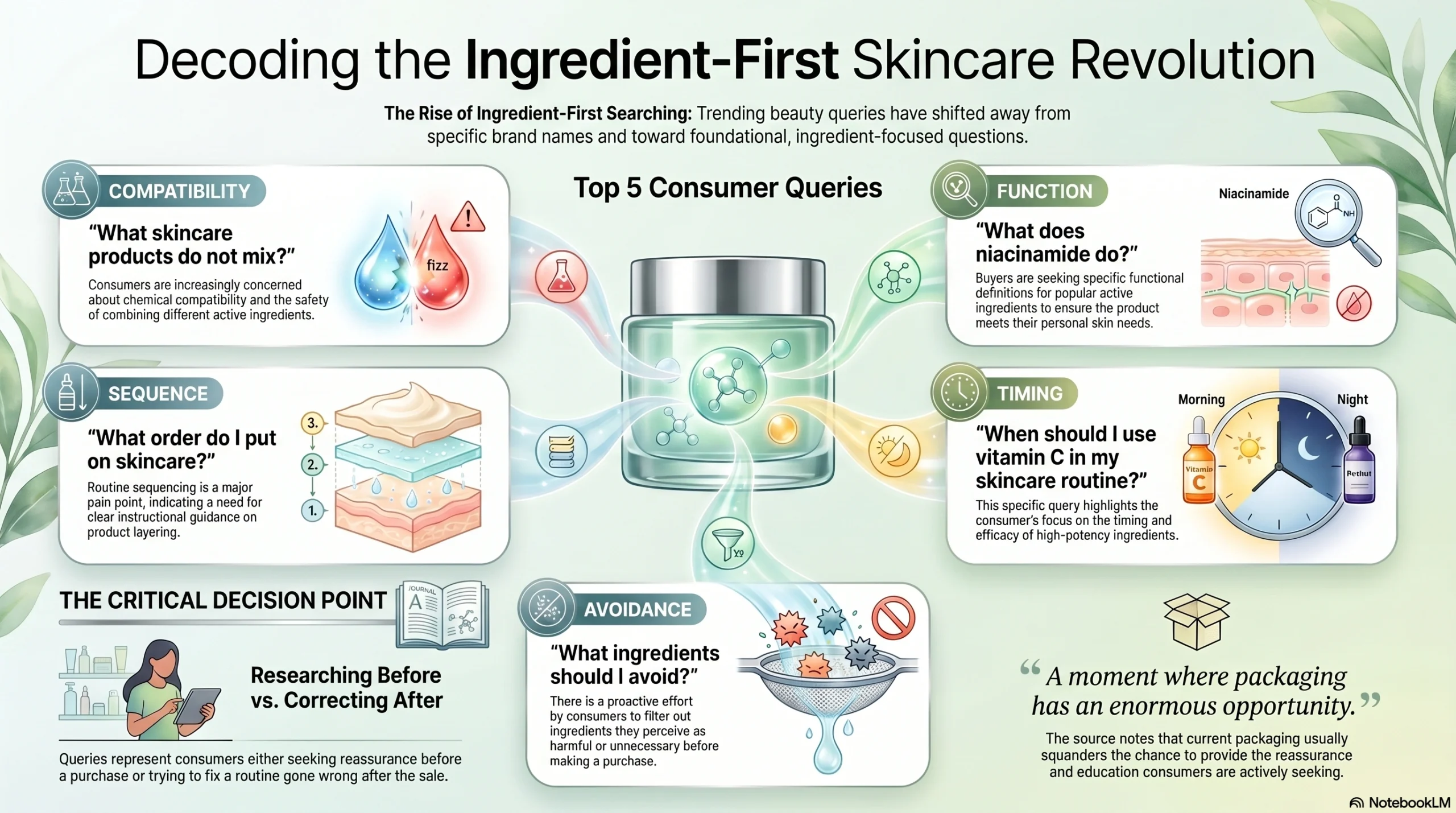
The clearest signal that skincare has shifted to an ingredient-first mindset comes from what people are actually searching for online. The top trending beauty-related queries in recent years aren’t product names or brand comparisons — they’re foundational, ingredient-focused questions:
“What skincare products do not mix?”
“What does niacinamide do?”
“What order do I put on skincare?”
“What ingredients should I avoid in skincare?”
“When should I use vitamin C in my skincare routine?”
These aren’t casual queries. They represent buyers at a critical decision point — researching before purchase or trying to correct a routine gone wrong after purchase. A consumer asking “what does niacinamide do?” is actively looking for reassurance that the product they’re considering (or just bought) is right for them. That’s a moment where packaging has an enormous opportunity — and usually squanders it.
Social Media Made Ingredients Famous, But Not Always Understandable
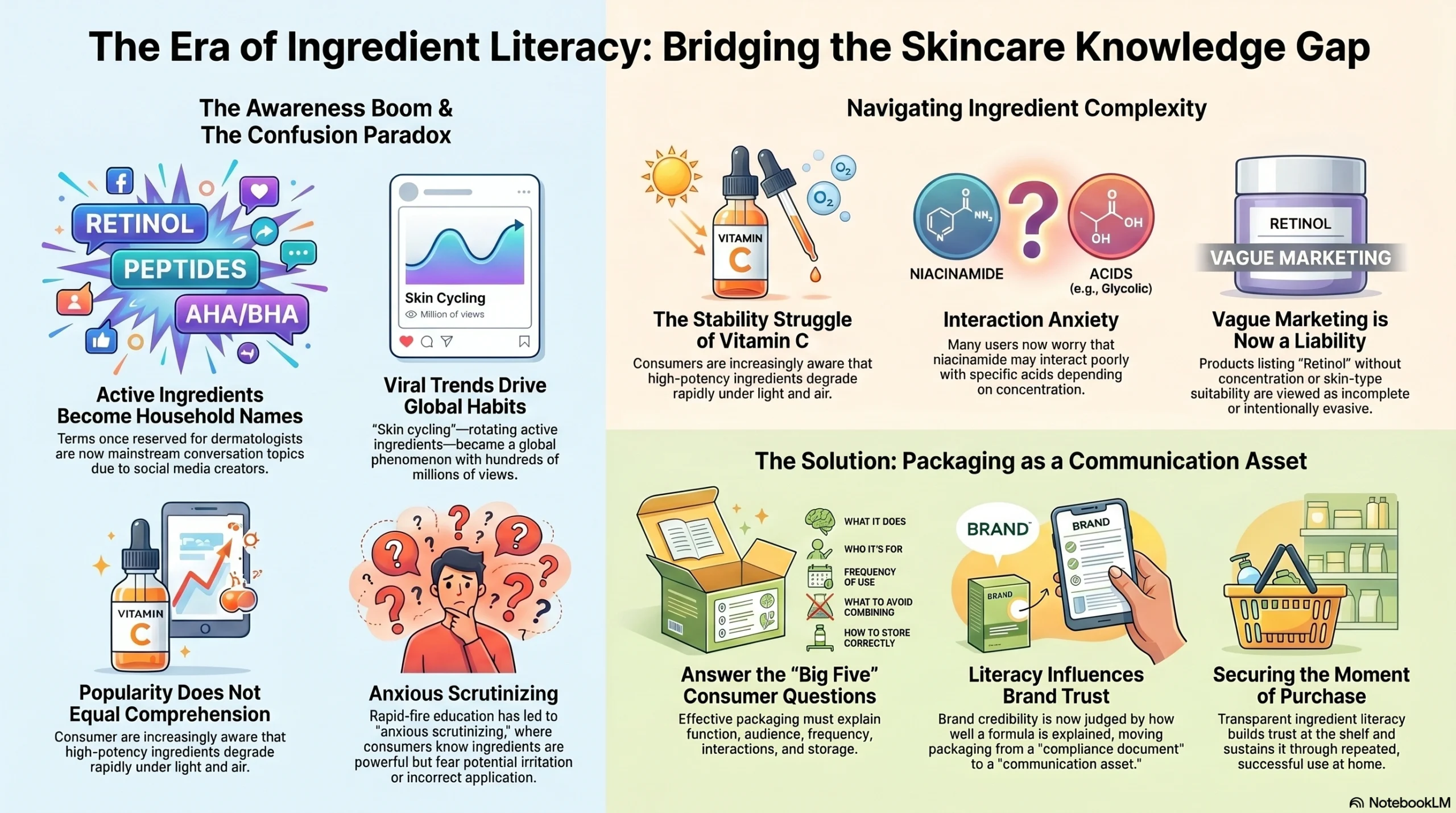
TikTok, YouTube dermatologists, and creator-driven skincare content have done something remarkable: they’ve turned active ingredients into household names. Terms like “retinol,” “hyaluronic acid,” “peptides,” and “AHA/BHA” now circulate freely in mainstream conversation. “Skin cycling” — the practice of rotating actives across evenings to prevent irritation — became a global phenomenon on social platforms, reaching hundreds of millions of views.
But popularity does not equal comprehension. When millions of consumers learn that retinol is powerful but also potentially irritating, that niacinamide is broadly tolerable but may interact poorly with certain acids at certain concentrations, or that vitamin C degrades when exposed to light and air — they develop a more anxious, more scrutinizing approach to what they buy and how they use it. Social media accelerated awareness; it also accelerated confusion. The result is a consumer who is highly motivated but frequently uncertain.
Ingredient Literacy Now Influences Trust
The practical consequence of this education boom is that consumers now judge brand credibility partly through the lens of how well a brand explains its formula. A product that simply says “with retinol” without addressing concentration, timing, frequency, or skin-type suitability feels incomplete — or worse, evasive.
Today’s skincare buyer wants packaging to answer:
What does this ingredient do for my skin?
Who is it for?
When and how often should I use it?
What should I not combine it with?
How should I store or dispense it to keep it effective?
Brands that treat packaging as a communication asset — not just a compliance document — are better positioned to earn that trust at the moment of purchase and sustain it across repeated use.
The Problem: Most Skincare Packaging Still Assumes Consumers Already Understand the Formula
INCI Lists Are Necessary, But Not Enough
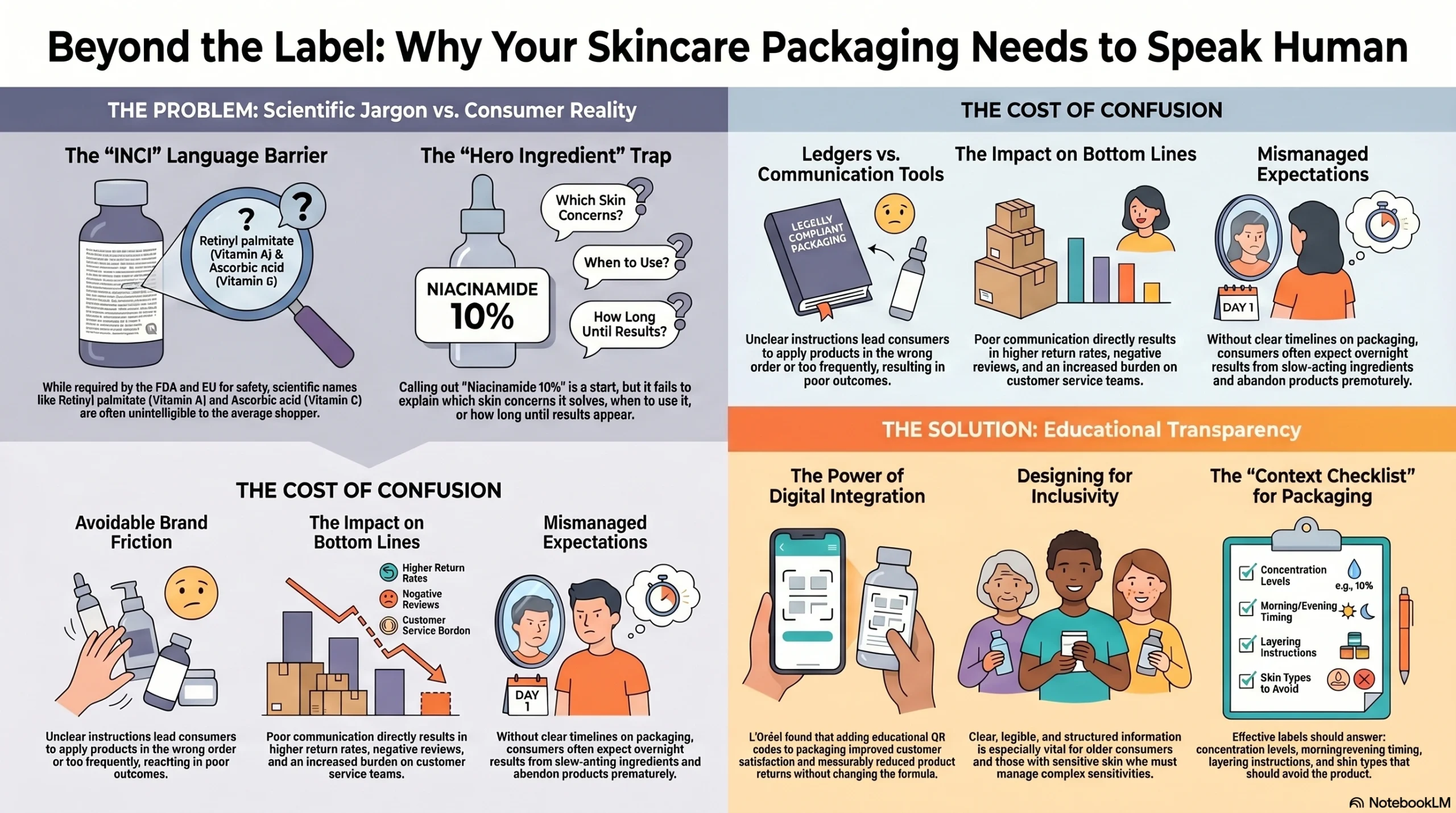
Every cosmetic product sold in markets like the US and EU must display its ingredients using the International Nomenclature of Cosmetic Ingredients (INCI) system. This is a regulatory requirement enforced by the FDA and equivalent international bodies, and it exists for important reasons — safety, transparency, and allergen awareness. But INCI names are written in scientific nomenclature. “Retinyl palmitate” is a form of vitamin A. “Ascorbic acid” is vitamin C. “Tocopherol” is vitamin E. Most consumers have no idea.
Packaging that lists ingredients in INCI format and nothing else is legally compliant, but commercially weak. It treats the label as a formulation ledger rather than a communication tool — satisfying regulators while leaving consumers without the context they actually need to make confident decisions.
"Hero Ingredient" Marketing Often Oversimplifies the Routine
Many skincare packs have moved toward hero ingredient callouts: “Niacinamide 10%,” “Retinol Complex,” “Vitamin C Brightening.” These are a step in the right direction — they translate one ingredient into the consumer’s vocabulary. But they still leave most of the important questions unanswered:
What concentration is effective for which skin concerns?
Should this be used morning or evening?
How does it layer with other steps?
How long before results are visible?
Are there skin types or conditions that should avoid it?
A single hero ingredient callout without any of that context is marketing, not education. It generates initial interest but fails to build the kind of informed confidence that drives repeat purchase.
Confusing Packaging Creates Avoidable Friction
The downstream consequences of unclear packaging are measurable. When consumers don’t know how to use a product correctly, they:
Misuse it — applying at the wrong time, in the wrong order, or too frequently
Develop unrealistic expectations — expecting overnight results from slow-acting ingredients
Return the product — citing “didn’t work” when the issue was actually incorrect use
Leave negative reviews — based on outcomes shaped by poor usage, not poor formulation
Create customer service burden — reaching out with questions that could have been answered on the pack
L’Oréal’s experience with QR-enabled packaging education offers a telling data point: introducing educational QR content on cosmetic packaging led to improved customer satisfaction, clearer product expectations, and a measurable reduction in returns. The formula didn’t change. The communication did.
Older Consumers and Sensitive-Skin Users Especially Rely on Packaging Clarity
Skincare education is not exclusively a Gen Z issue. Older consumers — including those managing age-related concerns, sensitive skin, or complex ingredient sensitivities — rely on packaging to guide safe and effective use. Mintel explicitly notes that clear, detailed on-pack information carries especially high value for this demographic. A brand that invests in legible, structured, plain-language packaging is communicating inclusively — and capturing a wider slice of the market.
Packaging Is Becoming a Teaching Tool, Not Just a Container
Packaging Now Has Four Jobs
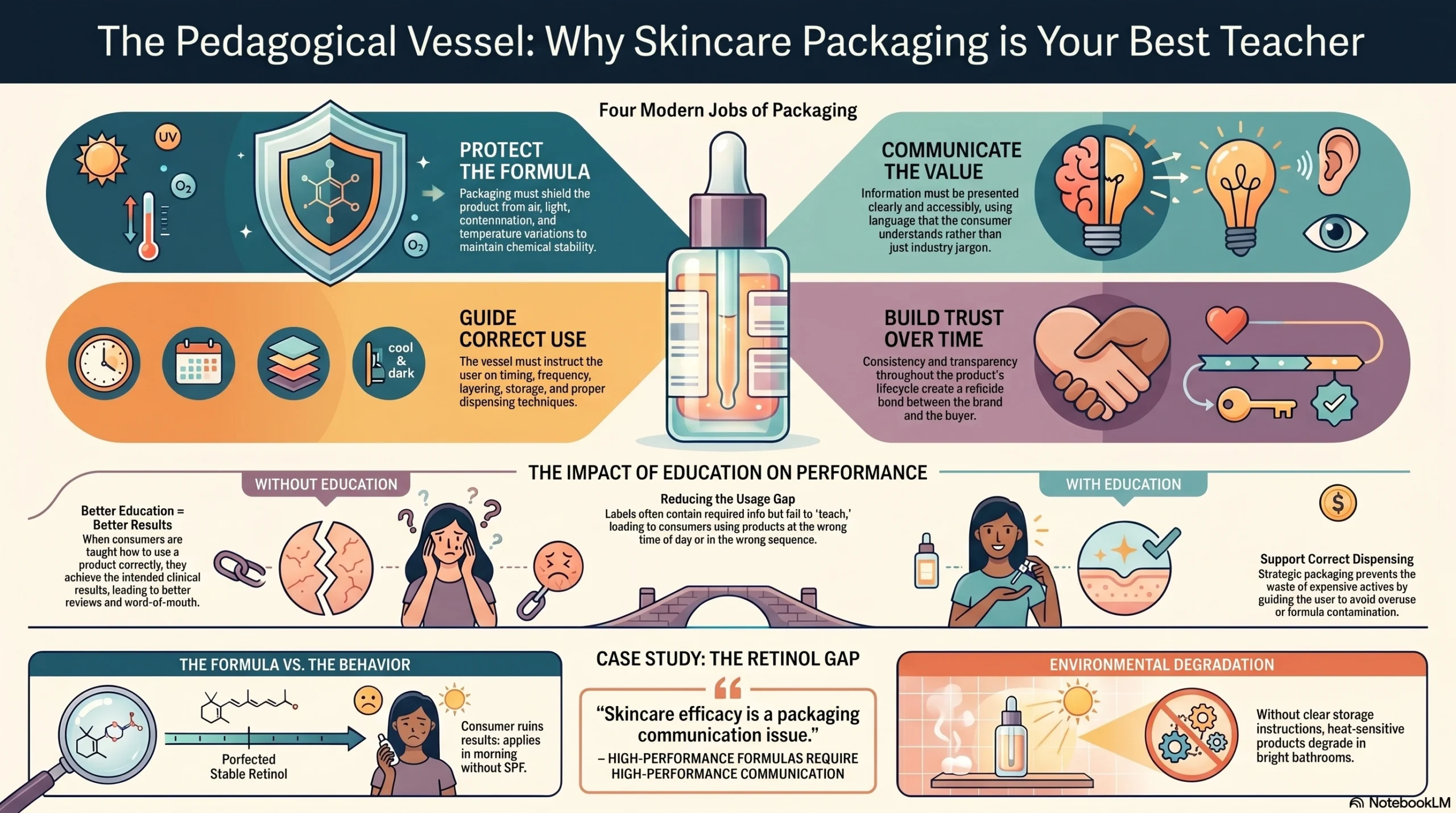
The traditional view of skincare packaging is that it has two jobs: contain the product and present the brand. In 2026, that framework is obsolete. Effective skincare packaging now needs to perform four distinct functions:
Protect the formula — from air, light, contamination, and temperature variation
Communicate the value — clearly, accessibly, and in the consumer’s language
Guide correct use — timing, frequency, layering, storage, and dispensing
Build trust over time — through consistency, transparency, and useful information at every stage of the product lifecycle
These functions are interdependent. A beautiful package that fails to guide correct use will produce a disappointed consumer. A technically excellent airless dispenser that doesn’t explain why it’s designed that way misses a trust-building opportunity.
Educational Packaging Improves Both Experience and Performance
This is one of the most underappreciated arguments for investing in packaging communication: when consumers understand how to use a product correctly, they get better results. Better results create better reviews, stronger word-of-mouth, and higher repeat purchase rates.
Good packaging communication can:
Support correct dispensing (avoiding overuse or contamination)
Clarify frequency and timing (preventing irritation from overuse of actives)
Preserve active ingredients (by explaining correct storage)
Set realistic expectations (reducing disappointment during the early weeks of use)
Skincare efficacy is not only a formulation issue. It is also a packaging communication issue.
Better Communication Reduces the Gap Between Intent and Real Usage
A brand can spend years perfecting a retinol formula — sourcing the most stable derivative, optimizing the delivery system, clinically testing the outcome — and then lose all of that investment because the consumer applied it every morning instead of every other evening, didn’t use SPF alongside it, or stored it on a bright bathroom shelf where heat and light degrade its potency.
The label had all the required information. But it didn’t teach. Packaging that bridges the gap between formula complexity and consumer behavior is packaging that delivers on its promise — for the brand and for the buyer.
What Better Ingredient Education Looks Like on Packaging
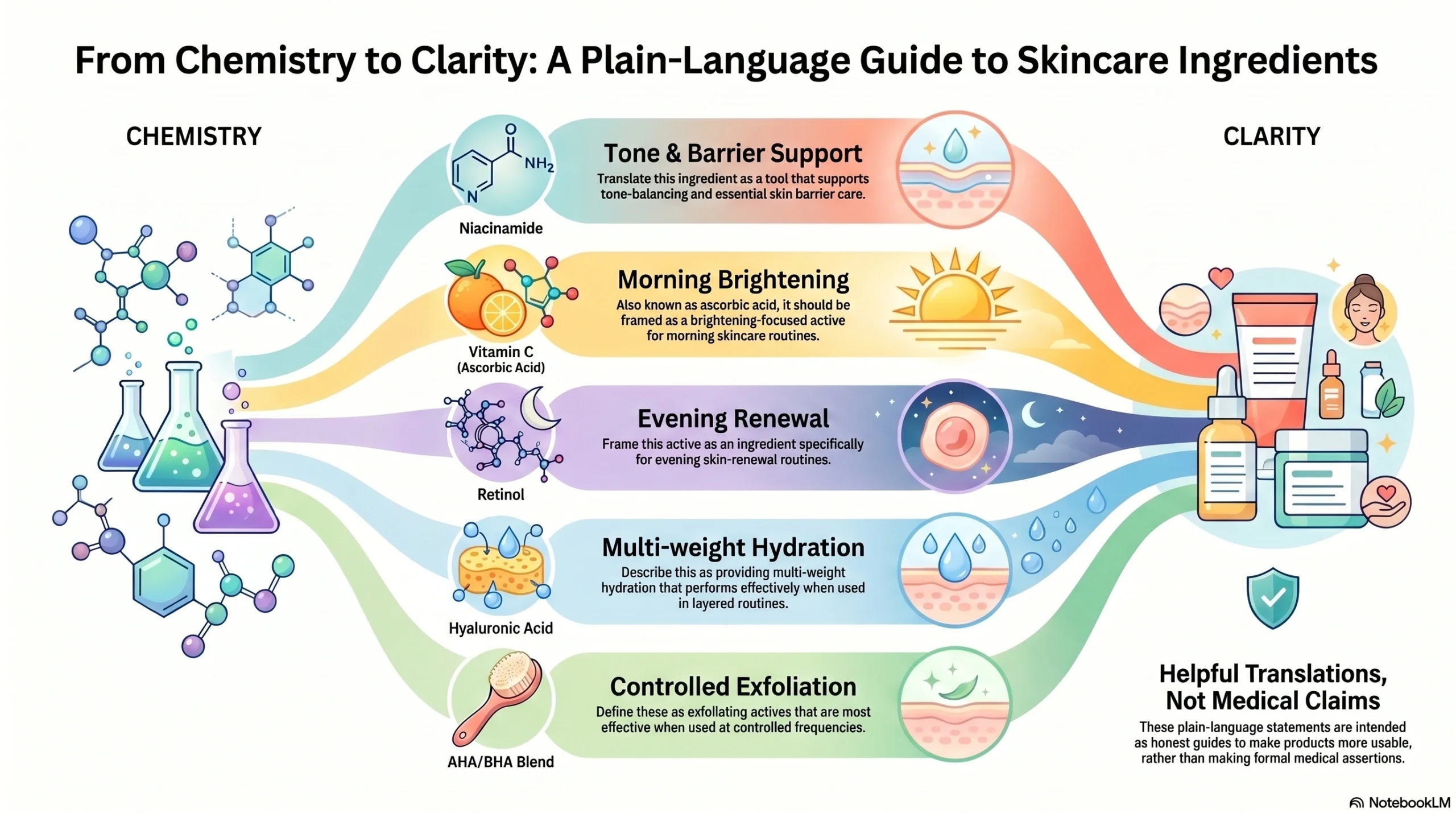
Plain-Language Benefit Statements
Niacinamide → Supports tone-balancing and skin barrier care
Vitamin C (ascorbic acid) → Used in brightening-focused morning routines
Retinol → For evening skin-renewal routines
Hyaluronic acid → Multi-weight hydration; works well in layered routines
AHA/BHA blend → Exfoliating actives; best used in controlled frequencies
These statements are not medical claims. They are helpful, honest translations that make the product immediately more accessible and usable.
Clear Routine Guidance
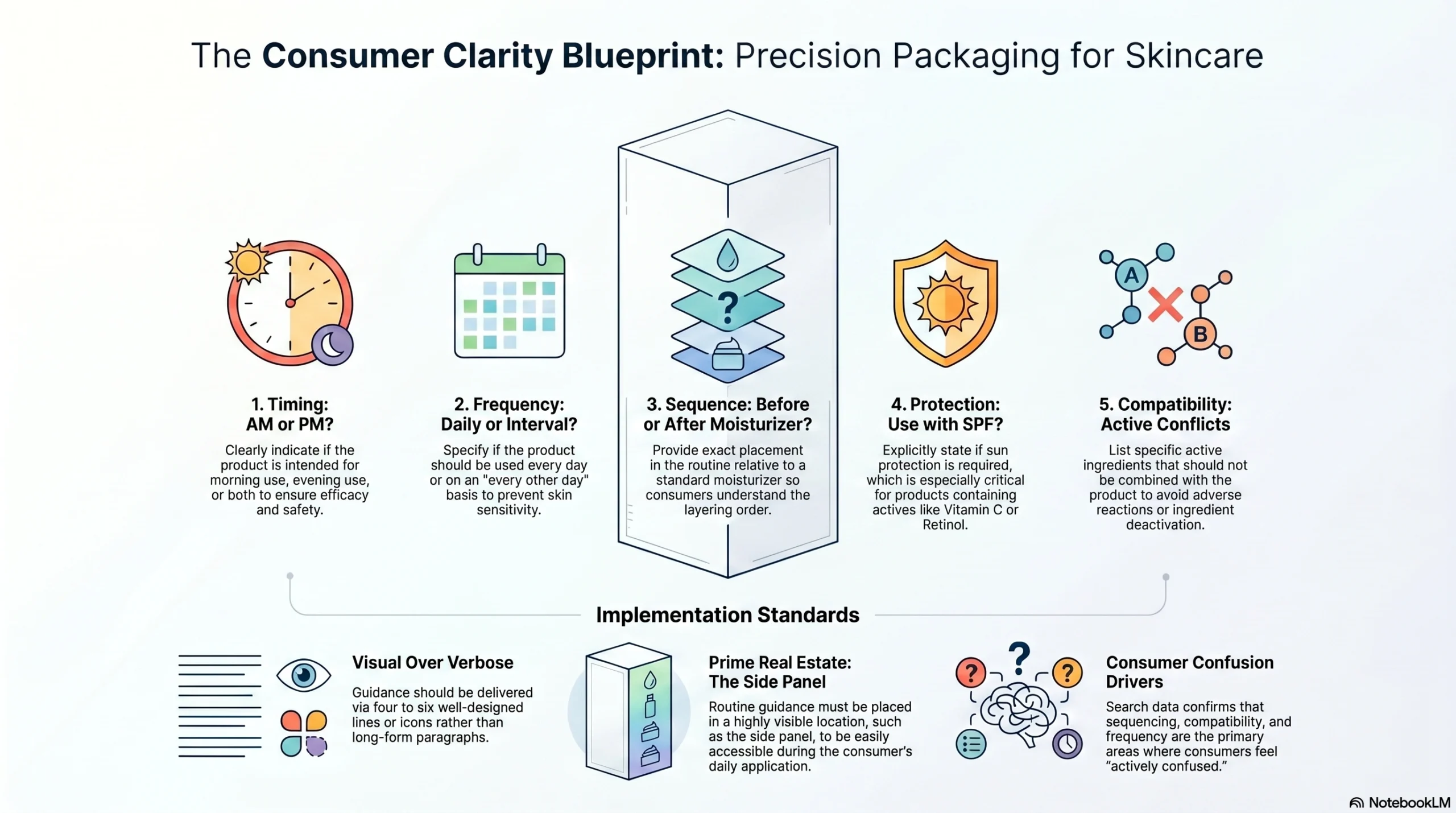
Search behavior tells us that consumers are actively confused about sequencing, compatibility, and frequency. Packaging should answer — clearly, concisely, and in a visible location:
Morning (AM) or evening (PM)?
Daily use or every other day?
Before or after moisturizer?
Use with SPF? (Especially relevant for actives like vitamin C and retinol.)
Avoid combining with which other actives?
This guidance doesn’t require a paragraph — it can be delivered with four to six well-designed lines or icons placed on the side panel. The key is that it exists and is visible.
Visual Hierarchy That Makes Information Usable
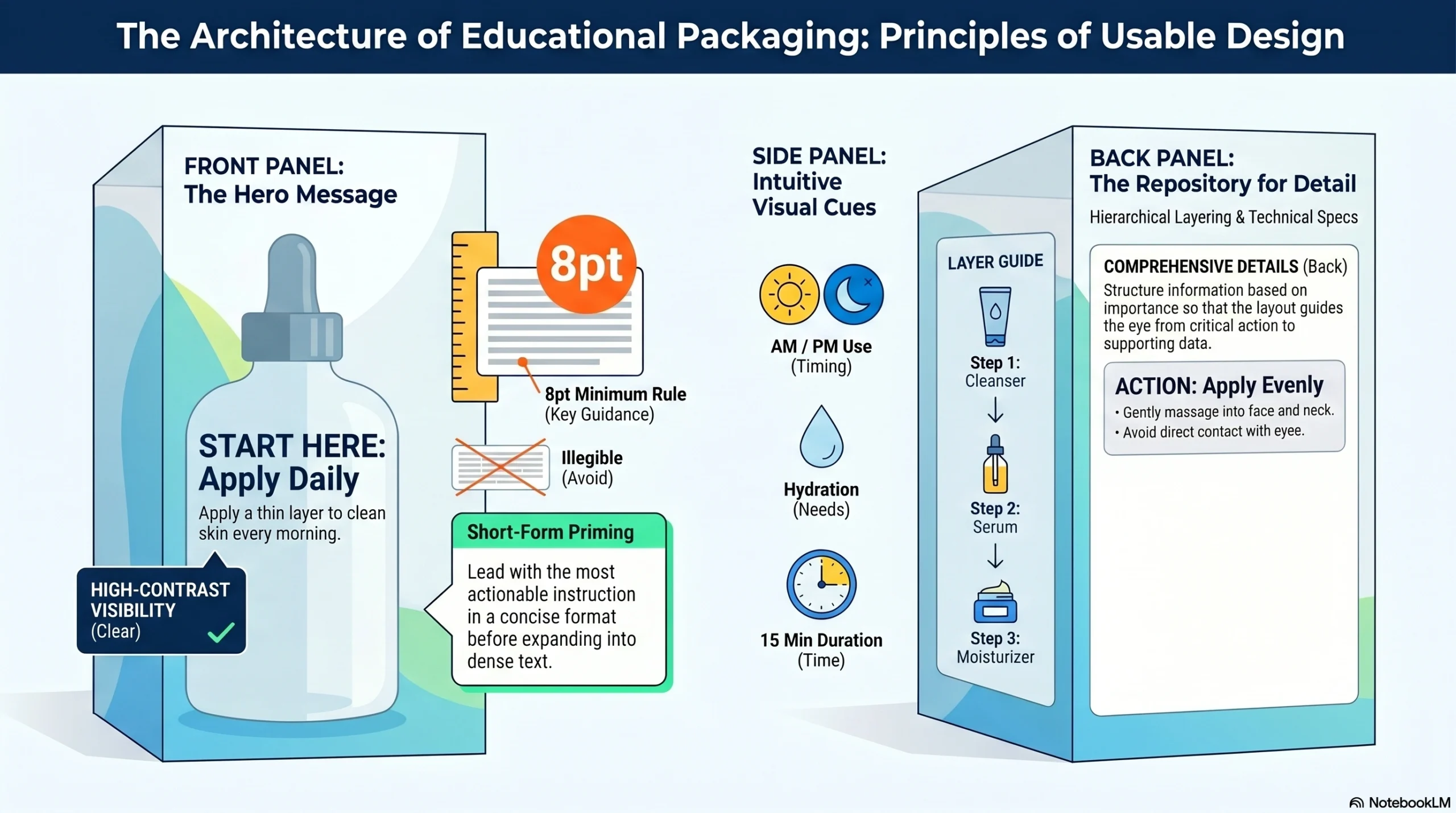
Strong contrast between background and type, particularly on smaller containers
Readable font sizes — a minimum of 8pt for key guidance, ideally larger for primary information
Icon systems — sun/moon icons for AM/PM, drop icons for hydration, clock icons for timing
Front/back logic — front carries the hero message; back carries the full detail
Side-panel layering guides — showing where this product fits in a routine (step 1, 2, 3)
Short-form instructions before dense text — lead with the most actionable line, then expand
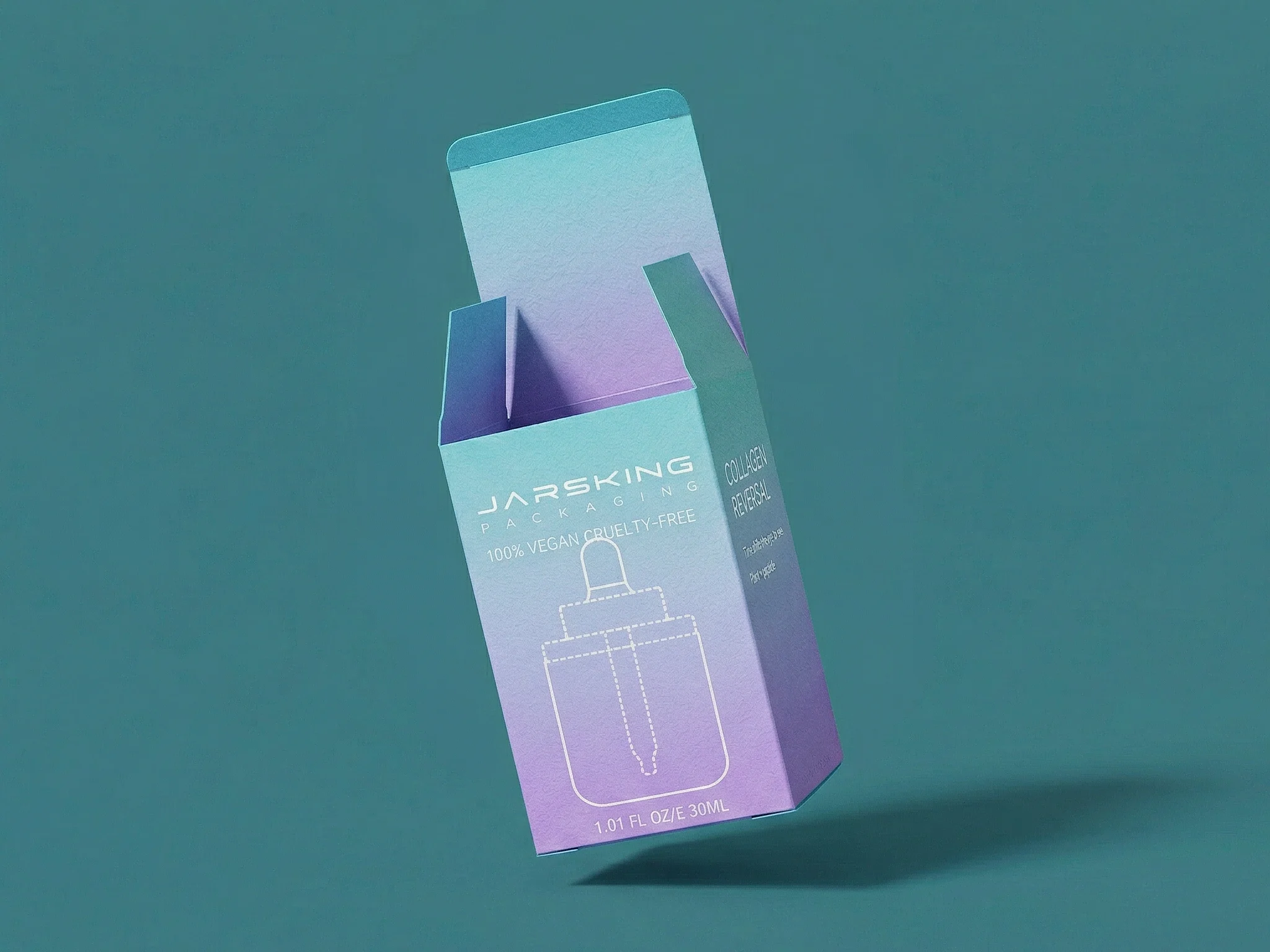
Secondary Packaging as an Education Asset
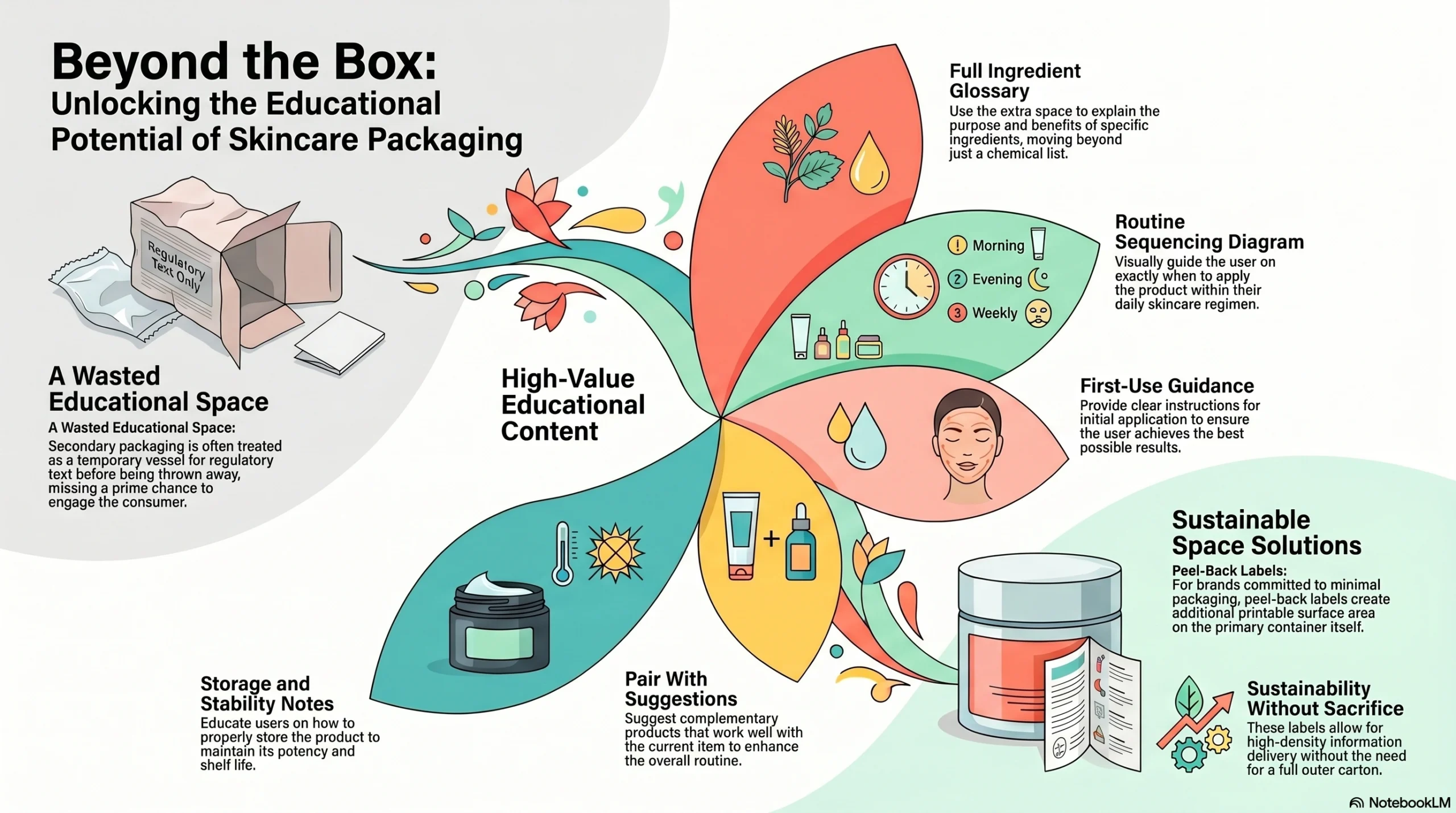
Full ingredient glossary
Routine sequencing diagram
First-use guidance
“Pair with” product suggestions
Storage and stability notes
Peel-back labels are another option for brands committed to sustainability and minimal secondary packaging. They create additional printable space without requiring a full outer carton.
QR Codes and Connected Packaging
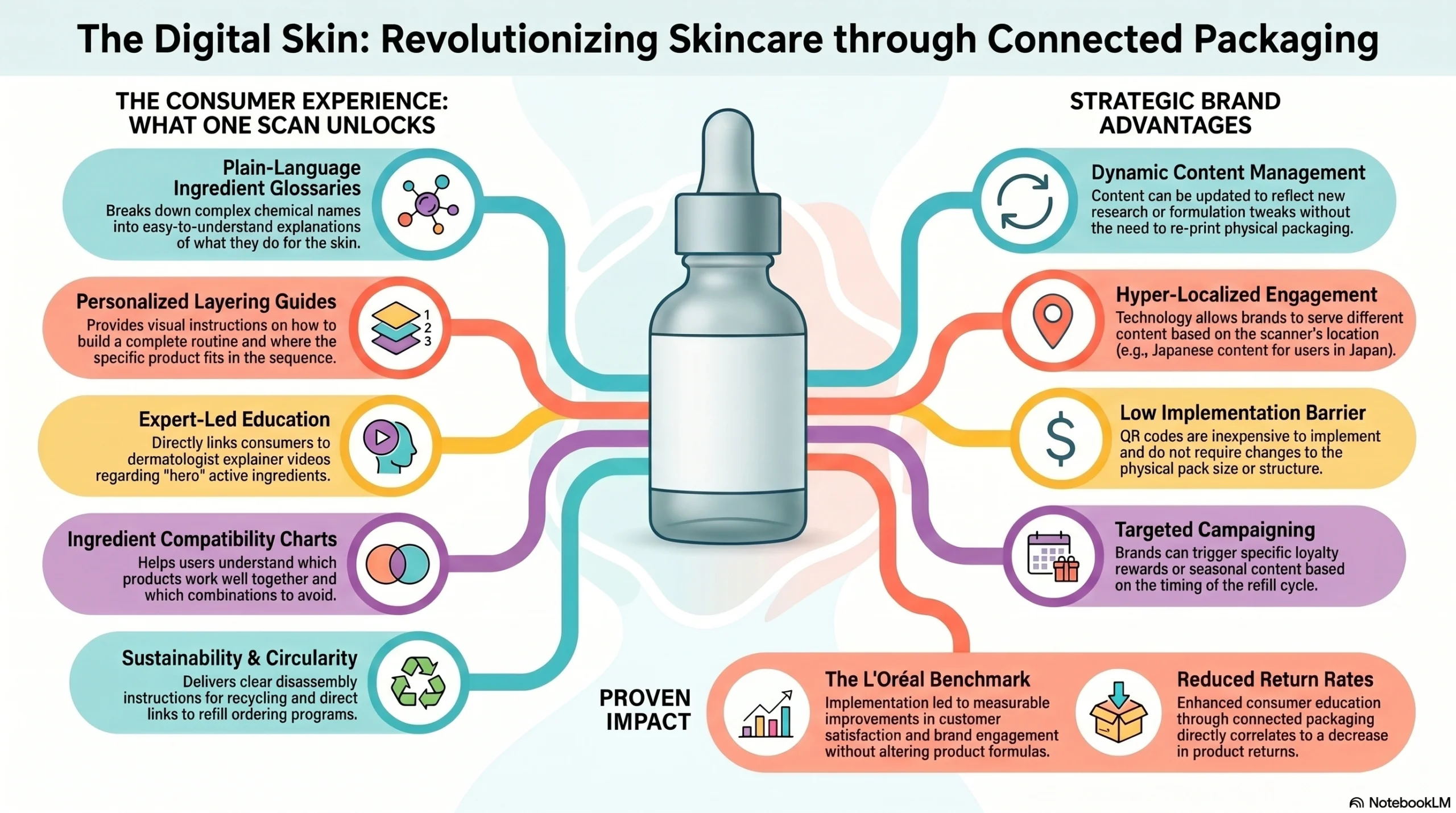
QR codes represent one of the most powerful and currently underutilized tools in skincare packaging education. In 2026, connected packaging is shifting from a novelty to a functional layer that supports transparency, retention, and long-term consumer engagement.
A single QR code on a skincare pack can open:
A full ingredient glossary with plain-language explanations
A layering guide showing how to build a complete routine
A dermatologist explainer video on the hero active
An ingredient compatibility chart
Recycling and disassembly instructions
Refill ordering and program information
The technology is inexpensive to implement, doesn’t require changing pack size or structure, and can be updated dynamically — meaning the same code can surface seasonal content, new research, or formulation updates without reprinting. QR codes also allow brands to serve different content to different audiences: a scan from Japan can show Japanese-language content; a scan during a refill campaign can surface loyalty rewards.
L’Oréal’s use of QR codes on cosmetic packaging demonstrated measurable improvements across customer satisfaction, return rates, and brand engagement — all without changing the formula or the base label.
Personalization and Segmentation
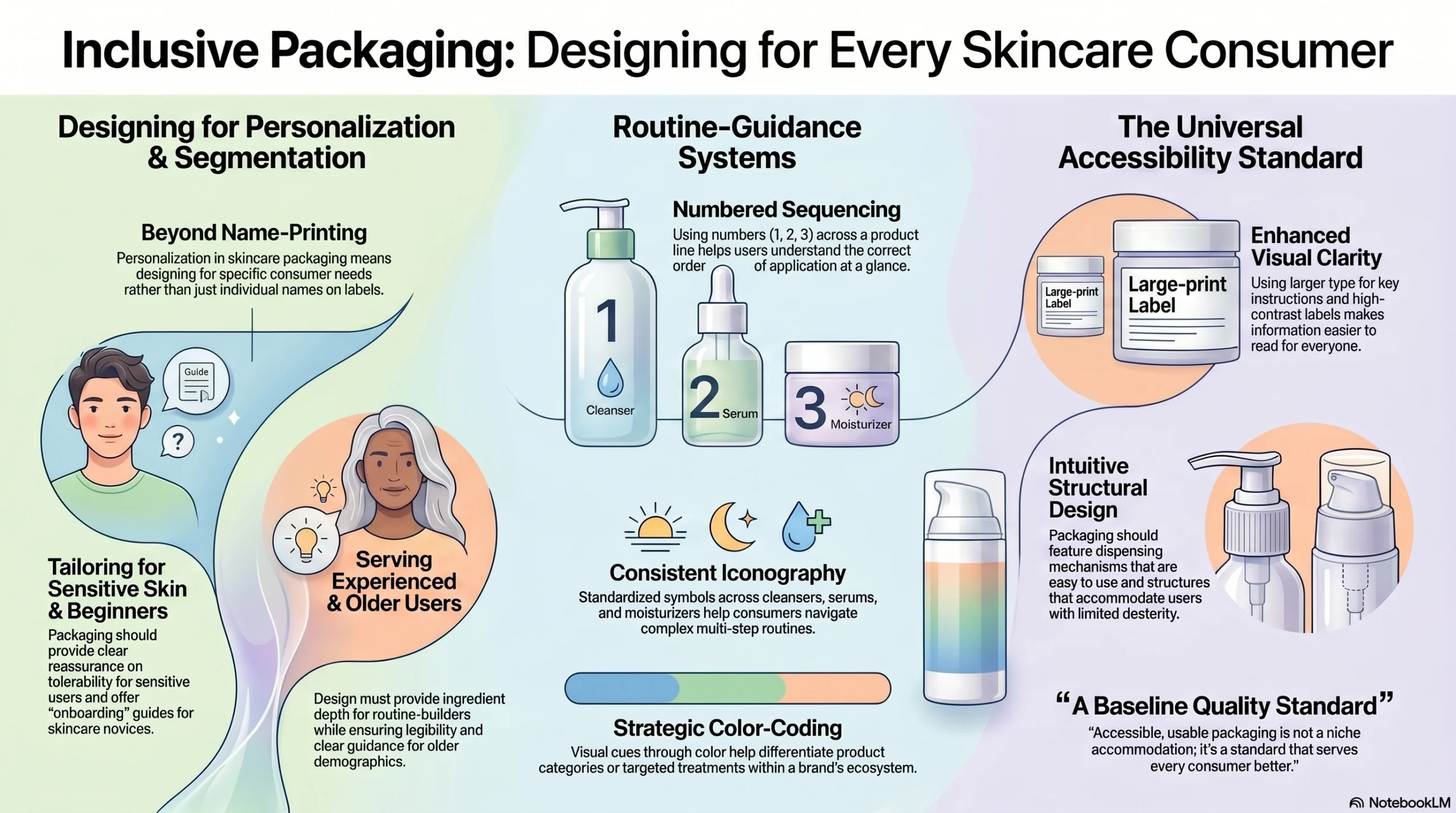
Mintel identifies personalization as a growing force in packaging strategy. For skincare, this doesn’t necessarily mean printing individual names on bottles. It means designing packaging that speaks clearly to specific consumer segments:
Sensitive-skin users who need reassurance about tolerability
Experienced routine-builders who want ingredient depth
Beginners who need step-by-step onboarding
Older users who value legibility and clear use guidance
Refill-program participants who need system-level education
Brands with product ranges — a cleanser, a serum, a moisturizer, a targeted treatment — can use consistent icon systems, color-coding, or numbered sequencing across the line to help consumers understand the full routine at a glance.
Accessibility Matters Too
Packaging education should be easier to read, easier to open, and easier to follow for every consumer — not just the most digitally engaged or ingredient-fluent. That means larger type on key instructions, higher contrast, intuitive dispensing mechanisms that require no separate explanation, and structural openings that work for consumers with limited dexterity.
Accessible, usable packaging is not a niche accommodation. It’s a baseline quality standard that happens to serve every consumer better.
Why Packaging Format Matters When Actives Are Sensitive
Ingredient Communication Should Match Ingredient Protection
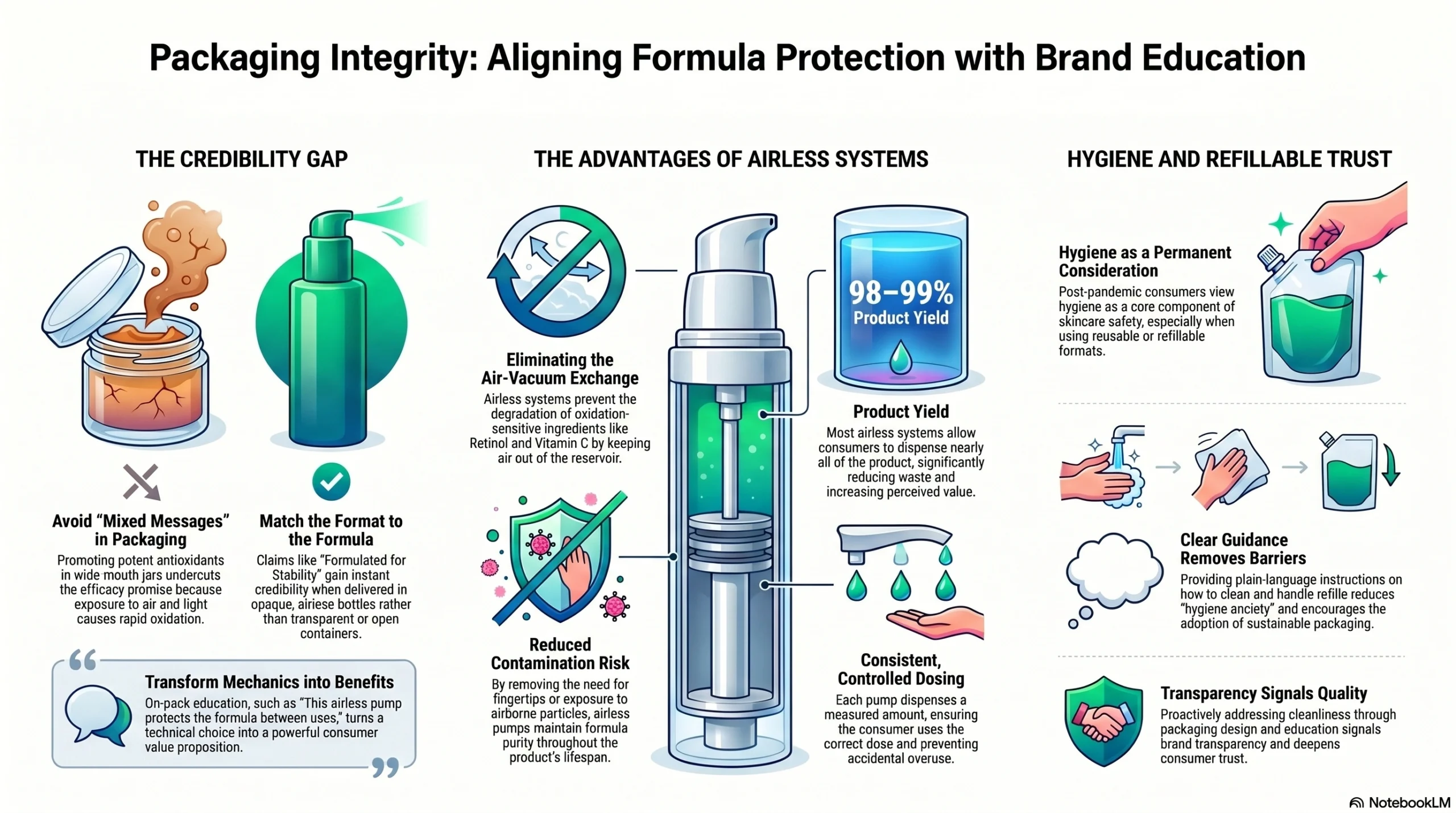
A brand cannot credibly promote a high-performance retinol or vitamin C formula in packaging that exposes that active to air, light, and contamination at every use. The format should reinforce the efficacy promise — not undercut it. Packaging that says “potent antioxidant complex” and then delivers it in a wide-mouth jar that oxidizes on the shelf is sending a mixed message.
When packaging format and formula communication align, the educational message becomes more credible. “Formulated for stability” means more when it comes in an opaque, airless bottle.
Airless Systems, Pumps, and Controlled Dispensing Support Education Claims
Airless packaging has become one of the most recommended formats for active skincare ingredients — and for good reason. By eliminating the air-vacuum exchange that happens every time a traditional bottle is pumped, airless systems:
Protect oxidation-sensitive ingredients like vitamin C, retinol, and antioxidant complexes from degrading between uses
Reduce contamination risk — no fingertips or airborne particles entering the product reservoir
Deliver consistent dosing — each pump dispenses a controlled, measured amount that minimizes overuse
Increase yield — most airless systems dispense 98–99% of product, reducing waste
Brands using airless formats are in a strong position to use that format choice as an on-pack education moment: “This airless pump system protects the formula’s active ingredients between every use.” That single sentence transforms a mechanical decision into a consumer benefit.
Hygiene Is Part of Consumer Trust
Post-pandemic, hygiene has become a permanent consumer consideration — particularly in skincare. Consumers who are willing to invest in a refillable or reusable format need clear guidance on how to clean, handle, and safely replenish the product. Without that guidance, hygiene anxiety becomes a barrier to adoption.
Packaging that addresses hygiene proactively — with visible, plain-language guidance on how to maintain cleanliness between uses or across refill cycles — removes a key adoption barrier and signals brand transparency.
Educational Packaging Should Explain the "Why" Behind the Format
Every structural or material choice in skincare packaging is an opportunity to communicate efficacy. Examples of format-as-education:
“Why this comes in an opaque bottle” → Light degrades active ingredients; opacity preserves potency
“Why this uses an airless pump” → Each use introduces no air, protecting the formula’s stability
“Why this refill pod is sealed” → Minimizes light exposure and contamination between fills
“Why this dropper has a controlled tip” → Precise dosing prevents waste and overuse
These are not marketing claims. They are accurate, useful explanations that deepen consumer trust in the formula and the brand. Packaging that explains its own design is packaging that demonstrates confidence in its craft.
| Format | Hygiene Control | Dosing Consistency | Active Protection | Education Opportunity |
|---|---|---|---|---|
| Wide-mouth jar | Low | Low | Low | Limited — open system |
| Dropper bottle | Moderate | Moderate | Moderate | Good — drop count guidance |
| Standard pump | Moderate | Good | Moderate | Good — dose-per-use messaging |
| Airless pump | High | High | High | Excellent — format explains formula care |
Smart Brands Are Turning Transparency into a Competitive Advantage
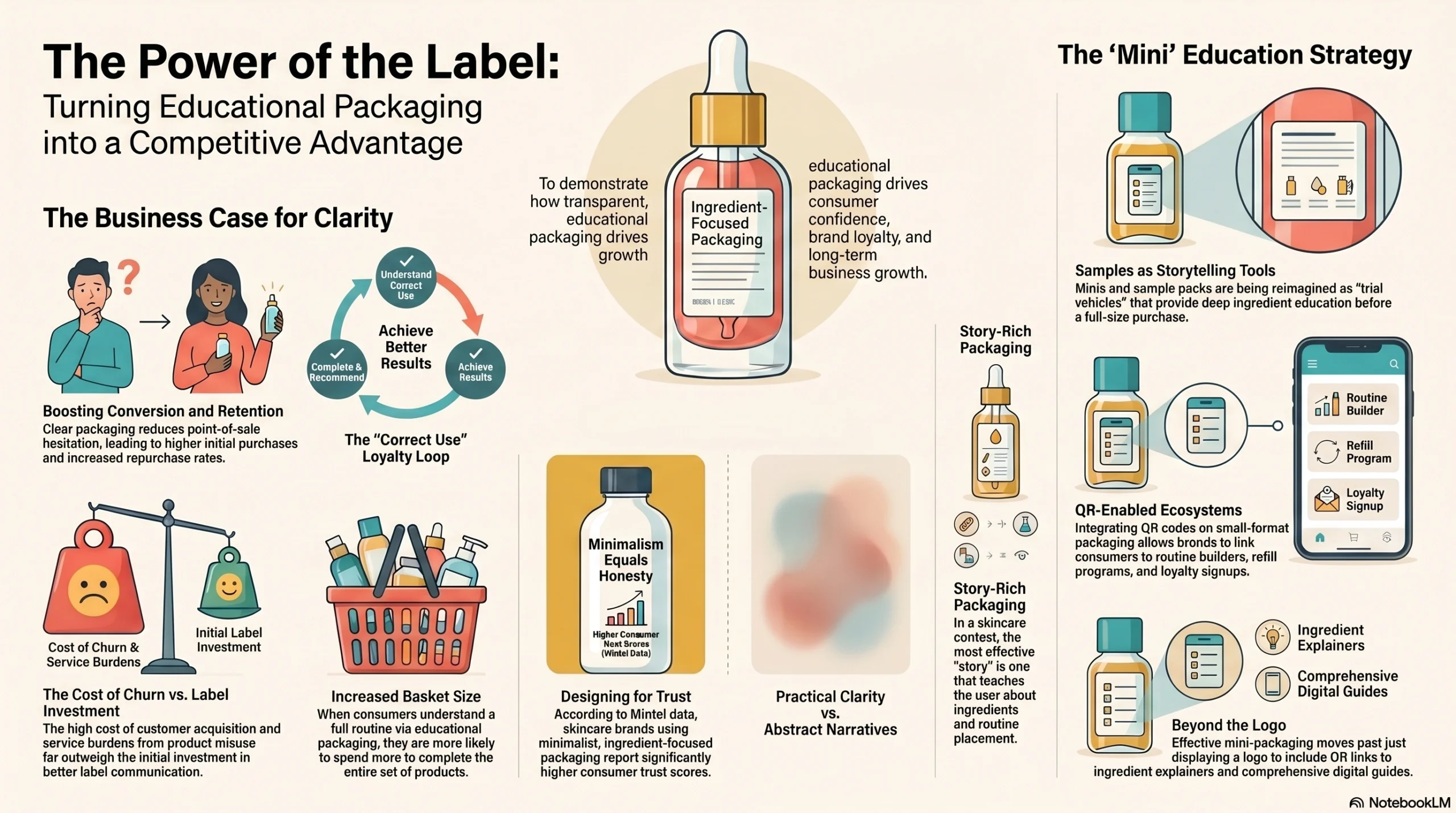
Clearer Packaging Can Improve Conversion and Retention
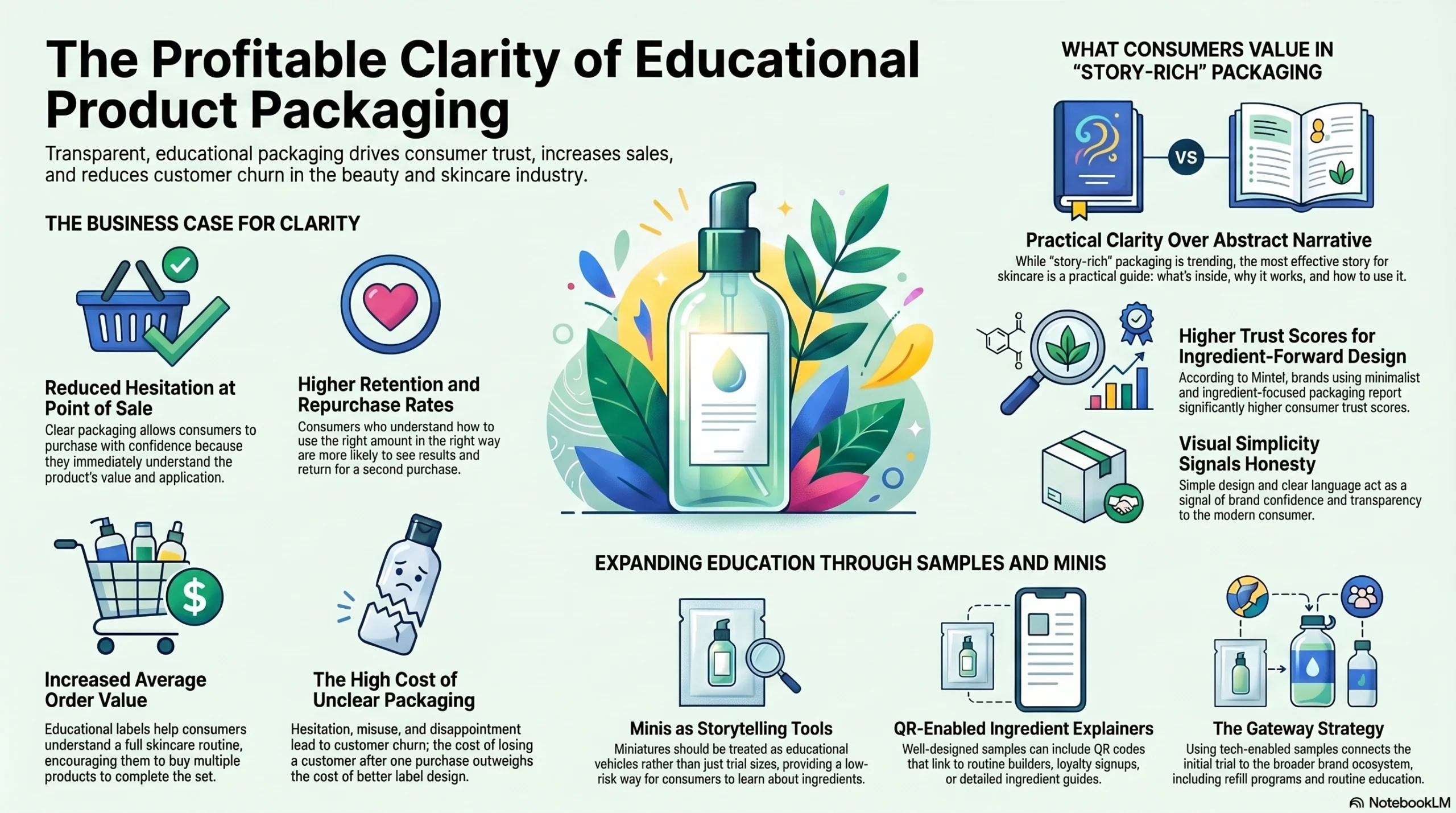
The commercial case for educational packaging is direct. A consumer who understands what a product does and how to use it correctly is more likely to:
Purchase with confidence — reduced hesitation at the point of sale
Complete the product — because they’re using the right amount in the right way
Repurchase — because they experienced results from correct use
Recommend — because they feel knowledgeable about something they trust
Spend more — because they understand the full routine and want to complete it
Unclear packaging, by contrast, creates hesitation, misuse, disappointment, and churn. The cost of losing a customer after one purchase — acquisition cost, product cost, customer service burden — significantly outweighs the investment in better label communication.
Story-Rich Packaging Performs Better When It Teaches Something Useful
Mintel notes that story-rich packaging is gaining traction across beauty categories. But for skincare, the most resonant “story” isn’t an abstract brand narrative — it’s practical clarity. A consumer who scans a package and immediately understands what’s inside, why it works, how to use it, and where it fits in their routine has had a meaningful brand experience. That’s more powerful than a lifestyle image of a dewy-skinned model.
Brands like those following minimalist, ingredient-forward packaging design are already seeing the impact: according to Mintel’s beauty packaging data, skincare brands with minimalist, ingredient-focused packaging report significantly higher consumer trust scores. The visual simplicity signals confidence. The clear language signals honesty.
Sampling and Minis Can Extend Education
The growing market for beauty minis and sample formats offers an underutilized channel for ingredient education. Beauty Packaging notes that sample packs and minis are increasingly being used as storytelling tools, not just trial vehicles. A well-designed mini — complete with a QR code linking to an ingredient explainer or routine guide — can educate a consumer before they make a full-size purchase commitment. That’s a more effective trial experience than a small container with only the hero ingredient name and a logo.
QR-enabled samples can also connect trial to a broader brand ecosystem: a routine builder, a loyalty signup, a refill program preview. The mini becomes a gateway, not just a sample.
What Skincare Brands Should Ask Their Packaging Partner Now
Questions Brands Should Be Asking
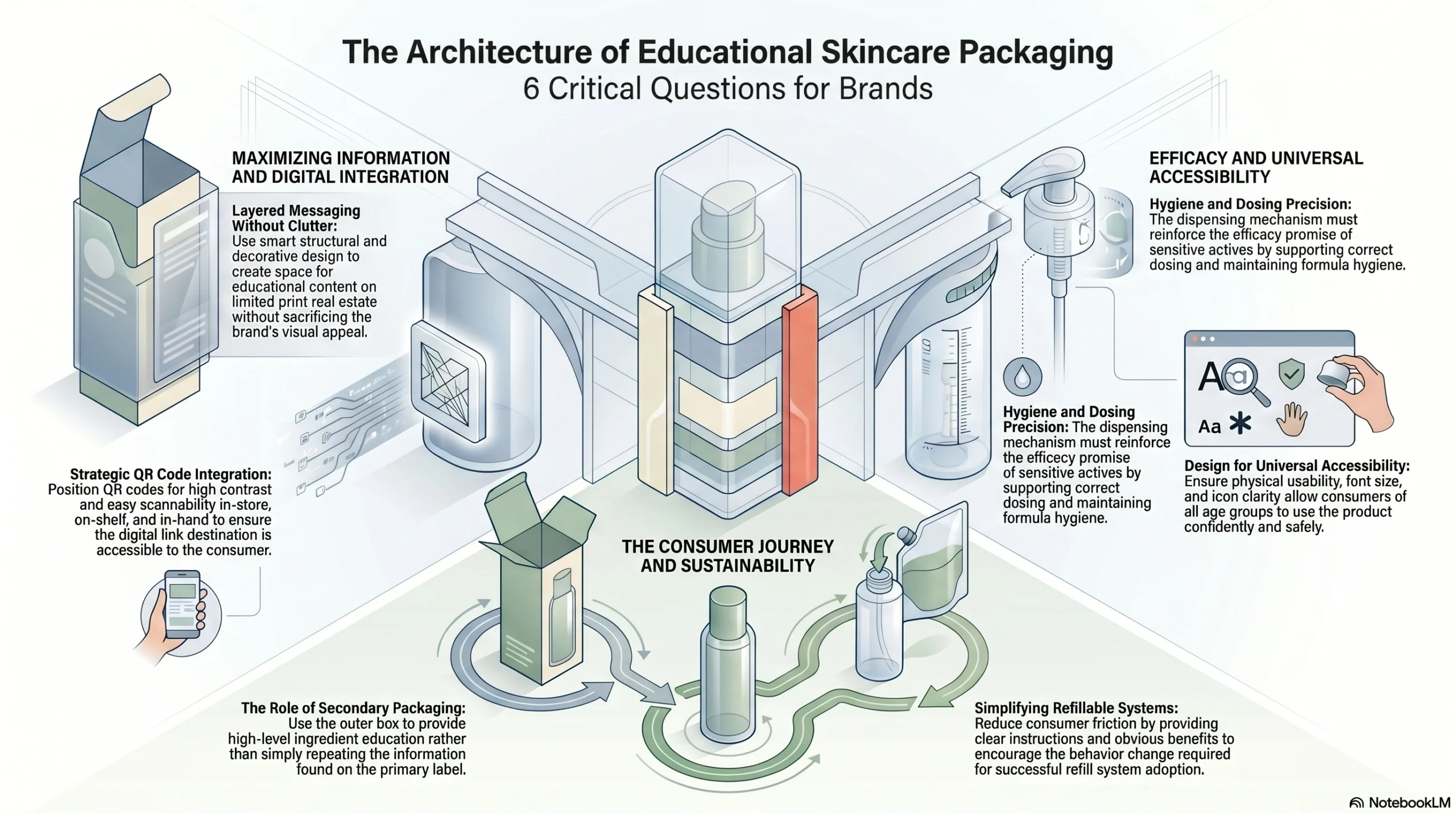
Can this pack carry layered educational messaging without feeling cluttered? Print real estate is limited. Good structural and decorative design creates the space needed for educational content without sacrificing visual appeal.
Is there room for QR code integration? The code itself is small, but the position matters. It needs to be scannable in-store, on-shelf, and in the consumer’s hand — which means placement and contrast are as important as the link destination.
Does the format support hygiene and correct dosing for this formula? If the product contains sensitive actives, the dispensing mechanism should reinforce the efficacy promise — not contradict it.
Is the packaging easy to read and use across age groups? Font size, contrast, icon clarity, and physical usability all affect who can access the product confidently. For a brand selling to a broad demographic, accessibility is a commercial priority, not an afterthought.
Can the secondary packaging carry ingredient education elegantly? The outer box is often the first interaction a consumer has with the product. Does it start the education, or does it simply repeat the primary label?
Can refillability be explained clearly enough to avoid friction? Refill systems require consumer behavior change. That change only happens when the instructions are clear, the process feels clean and safe, and the benefit is obvious.
Why This Requires Cross-Functional Packaging Thinking
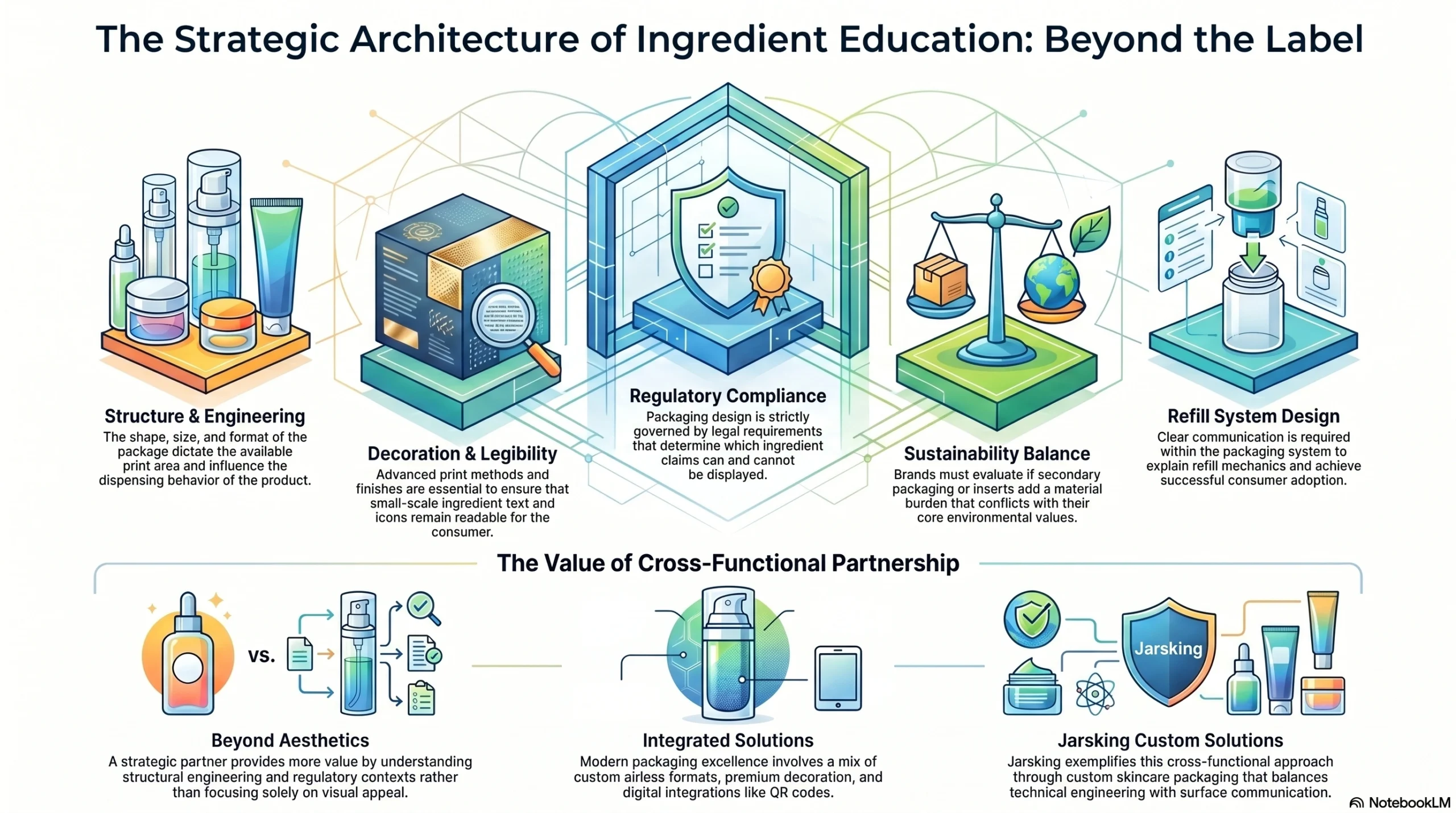
Ingredient education on packaging is not simply a copywriting task assigned at the end of the design process. It affects:
Structure — the shape, size, and format that determines available print area and dispensing behavior
Decoration — the print methods and finishes that make text legible and icons readable
Compliance — the regulatory requirements that determine what can and cannot be claimed
Sustainability — whether secondary packaging or inserts add material burden that conflicts with brand values
Refill design — whether the system can be explained clearly enough to achieve consumer adoption
A packaging partner that understands this full picture — from structural engineering to surface communication to regulatory context — is significantly more valuable than one focused on aesthetics alone. For brands developing ingredient-forward skincare lines, that partner should be able to speak fluently across all of these dimensions, from custom airless formats and premium decoration to QR integration and refill-ready system design. You can explore Jarsking’s custom skincare packaging solutions to understand what this kind of cross-functional partnership looks like in practice.
Conclusion: The Future of Skincare Packaging Is Educational, Not Just Aesthetic
Today’s skincare consumer is more ingredient-aware than any previous generation — but not necessarily more ingredient-confident. They know that niacinamide is beneficial, that retinol requires care, that vitamin C is light-sensitive. What they often don’t know is how to make all of that knowledge work together in a consistent, safe, effective routine. Packaging is the bridge between formula complexity and consumer clarity.
The brands that will win the next decade of skincare are not those with the prettiest bottle or the most evocative campaign. They will be the brands that treat packaging as part of the product experience — an educational interface that explains what an ingredient does, guides how to use it correctly, reinforces why the format matters, and builds trust with every interaction.
That means plain-language labeling. Thoughtful visual hierarchy. QR codes that open into genuinely useful content. Format choices — airless systems, opaque containers, controlled-dose dispensers — that are explained honestly and match the formula’s needs. Secondary packaging that teaches before the consumer even opens the primary container. And accessibility standards that include every consumer, not just the most digitally fluent.
For skincare brands, the next packaging upgrade may not be a new shape or finish. It may be a smarter way to explain the formula.
Ready to develop packaging that communicates as powerfully as your formula performs? Contact Jarsking to explore custom skincare packaging built for today’s ingredient-educated consumer.
FAQs
Skincare ingredient transparency means honestly and clearly disclosing every ingredient in a formula — not just highlighting a few “hero” actives on the front of the pack. It matters because today’s consumers actively research what they’re putting on their skin, and brands that provide clear, accessible ingredient information are consistently judged as more trustworthy and credible. Transparency is no longer a brand differentiator — it’s an expectation.
Yes. In the US, the FDA requires all cosmetic products to list ingredients in descending order of predominance using INCI (International Nomenclature of Cosmetic Ingredients) names, under the Fair Packaging and Labeling Act. The EU, South Korea, Japan, and most major markets have similar requirements. However, regulatory compliance and meaningful consumer communication are two different things — a fully compliant label can still be impossible for the average consumer to understand.
INCI names are written in scientific nomenclature designed for regulatory consistency, not consumer comprehension. “Ascorbic acid” is vitamin C, “retinyl palmitate” is a form of vitamin A, and “tocopherol” is vitamin E — but most shoppers don’t know that. Brands that translate INCI names into plain-language benefit statements, alongside the full ingredient list, close the gap between legal compliance and genuine consumer understanding.
A QR code on a skincare pack can link directly to content that a physical label simply cannot accommodate — a full ingredient glossary, a layering guide, a dermatologist explainer video, a compatibility chart, or refill instructions. The technology is low-cost to implement, can be updated without reprinting the label, and can surface different content for different audiences or markets. For brands selling ingredient-forward formulas, a connected QR layer turns the pack into a continuously evolving education tool.
Active ingredients like retinol and vitamin C are highly sensitive to air, light, and contamination — repeated exposure degrades their efficacy before the product is even half used. Packaging formats like airless pumps and opaque bottles protect these actives by minimizing oxidation and contamination risk with every use. When a brand explains why the format was chosen — “this airless pump protects the formula between every use” — it reinforces the efficacy claim and builds consumer trust in the product’s performance.
Brands should look for a packaging partner capable of thinking across structure, decoration, compliance, and consumer communication simultaneously. The right partner can help evaluate whether a format supports the correct dosing and active protection the formula needs, whether the label architecture creates space for educational messaging without clutter, and whether QR integration, refill systems, or secondary packaging can extend the education further. Ingredient transparency is not just a copywriting decision — it is a structural, material, and design decision that needs cross-functional expertise from the start.