













A perfume may smell luxurious, but if the atomizer leaks, the cap falls off, or the bottle arrives damaged, the packaging becomes the story.
That story is rarely flattering. For perfume brand founders, sourcing managers, and product developers, packaging failure is not an aesthetic inconvenience — it is a business problem with measurable costs. A leaked bottle in transit means wasted inventory. A cap that slips off in a bag means a one-star review. An atomizer that squirts instead of mists makes a $300 fragrance feel like a $12 body spray from a discount shelf.
When customers buy a premium fragrance, they are purchasing an entire experience: the weight of the bottle in their hand, the satisfying resistance of the cap, the fine mist of the atomizer, the elegance of the outer box. Every physical interaction communicates brand quality — or undermines it.
Perfume buyers expect premium packaging to feel secure, elegant, and reliable from the first unboxing to the last spray. When it doesn’t, the issue spreads fast. It appears in Reddit fragrance threads, in Amazon reviews, in customer service inboxes, in return requests. The fragrance itself may be exceptional, but the packaging becomes the headline.
This article is not a consumer complaint roundup. It is a B2B diagnostic guide that translates the most common visible packaging failures into packaging engineering, sourcing, QC, and brand-risk lessons. We will cover:
Why leaks, loose caps, and bad atomizers actually happen at the design and production level
What these failures cost fragrance brands commercially
How better packaging design, component matching, and quality control can prevent them
The core principle behind everything that follows: When perfume packaging fails, it is rarely random. It is usually the result of weak component matching, poor closure design, inadequate QC, or packaging choices made without considering transit, refillability, user handling, and brand positioning.
What Perfume Buyers Complain About Most
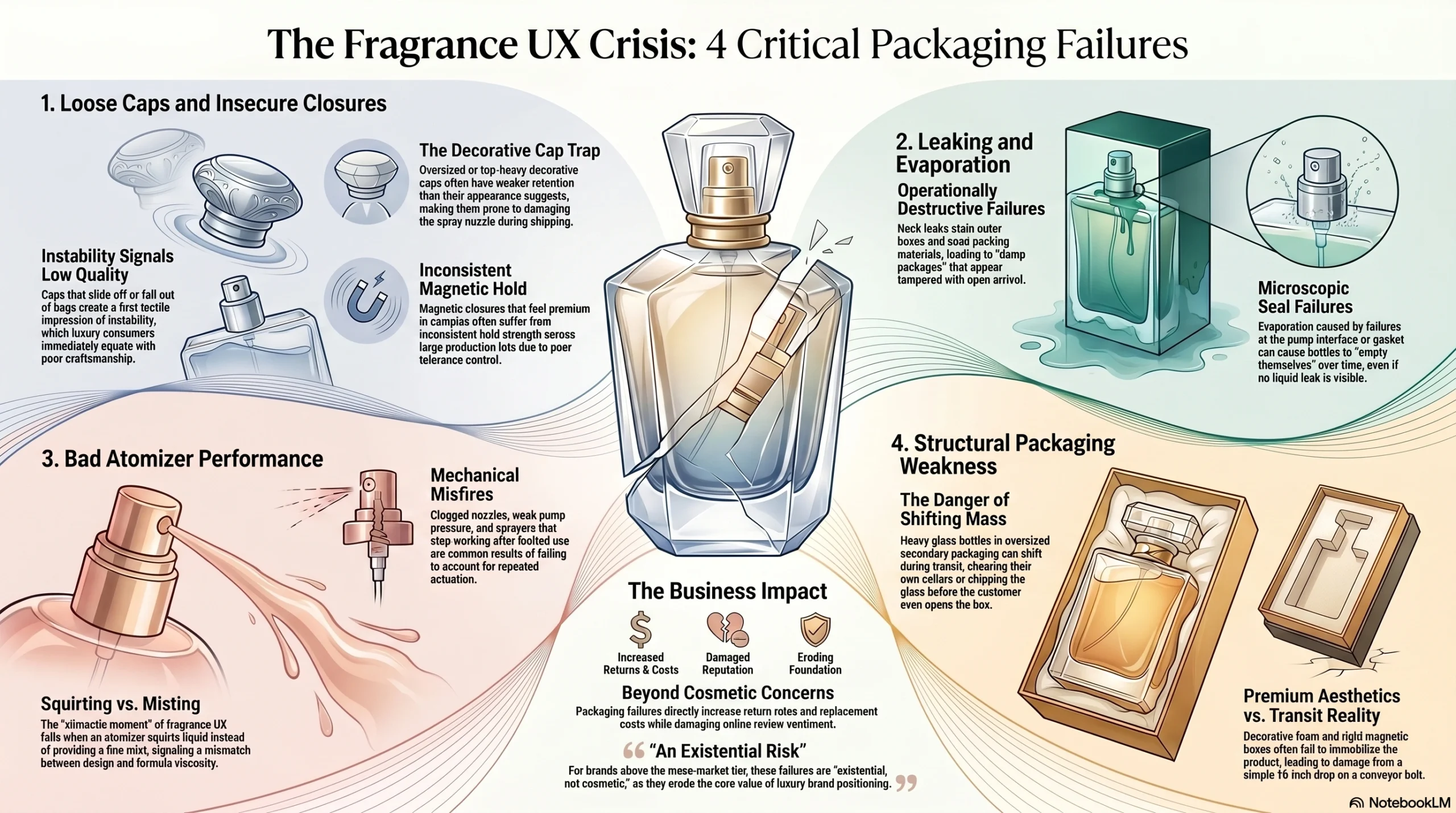
Before examining root causes, it helps to understand how packaging failure actually presents itself to end customers. These are the four most reported failure categories — and each maps directly to an engineering or sourcing decision made long before the bottle reached a consumer’s hands.
Loose Caps and Insecure Closures
Consumers frequently describe caps that slide off too easily, fall out of bags, or damage the spray nozzle during shipping. Decorative caps that are oversized or top-heavy tend to have weaker retention than their appearance suggests. Magnetic closures that feel luxurious in sampling often lose hold strength across production lots when tolerance control is inconsistent. The result is a first tactile impression that feels unstable — and in luxury fragrance, instability reads as low quality.
Leaking Bottles and Evaporation
Leakage at the bottle neck is one of the most operationally destructive failures. A leak rarely stays contained: it stains the outer box, soaks packing materials, and can arrive at the customer’s door as a partially filled, damp package that immediately reads as defective or tampered with. Evaporation, caused by microscopic seal failures at the pump interface or gasket, may not be immediately visible but reduces product volume over time — creating complaints about bottles that seem to “empty themselves.”
Bad Atomizer Performance
Squirting instead of misting is a defining failure moment in fragrance UX. Users describe atomizer failures in emotional terms precisely because spraying is the climactic moment where the packaging and fragrance experience converge. Clogged nozzles, inconsistent spray force, weak pump pressure, and sprayers that stop functioning after limited use are all commonly reported. Each signals a mismatch between the atomizer’s design specification and the realities of actual use — including formula viscosity, repeated actuation, and storage conditions.
Outer Packaging That Fails to Protect
Oversized or structurally weak secondary packaging allows bottles to shift during transit. A heavy glass bottle moving inside a presentation box can shear its own collar, damage the pump, or chip the glass — all before the customer has even opened it. Decorative foam inserts and magnetic-closure rigid boxes may look premium on a product page but provide inadequate immobilization when the package is dropped, stacked, or subjected to courier handling. The perceived value created by beautiful secondary packaging can be destroyed in a single 18-inch drop from a conveyor belt.
These are not just user annoyances. They directly affect return rate, replacement cost, customer service burden, online review sentiment, and luxury brand positioning. For any fragrance brand operating above the mass-market tier, these outcomes are existential, not cosmetic.
Why Perfume Packaging Fails: The Technical Root Causes
Moving from symptoms to causes is where brand teams gain real leverage. Most perfume packaging failures trace back to one of six engineering or sourcing breakdowns.
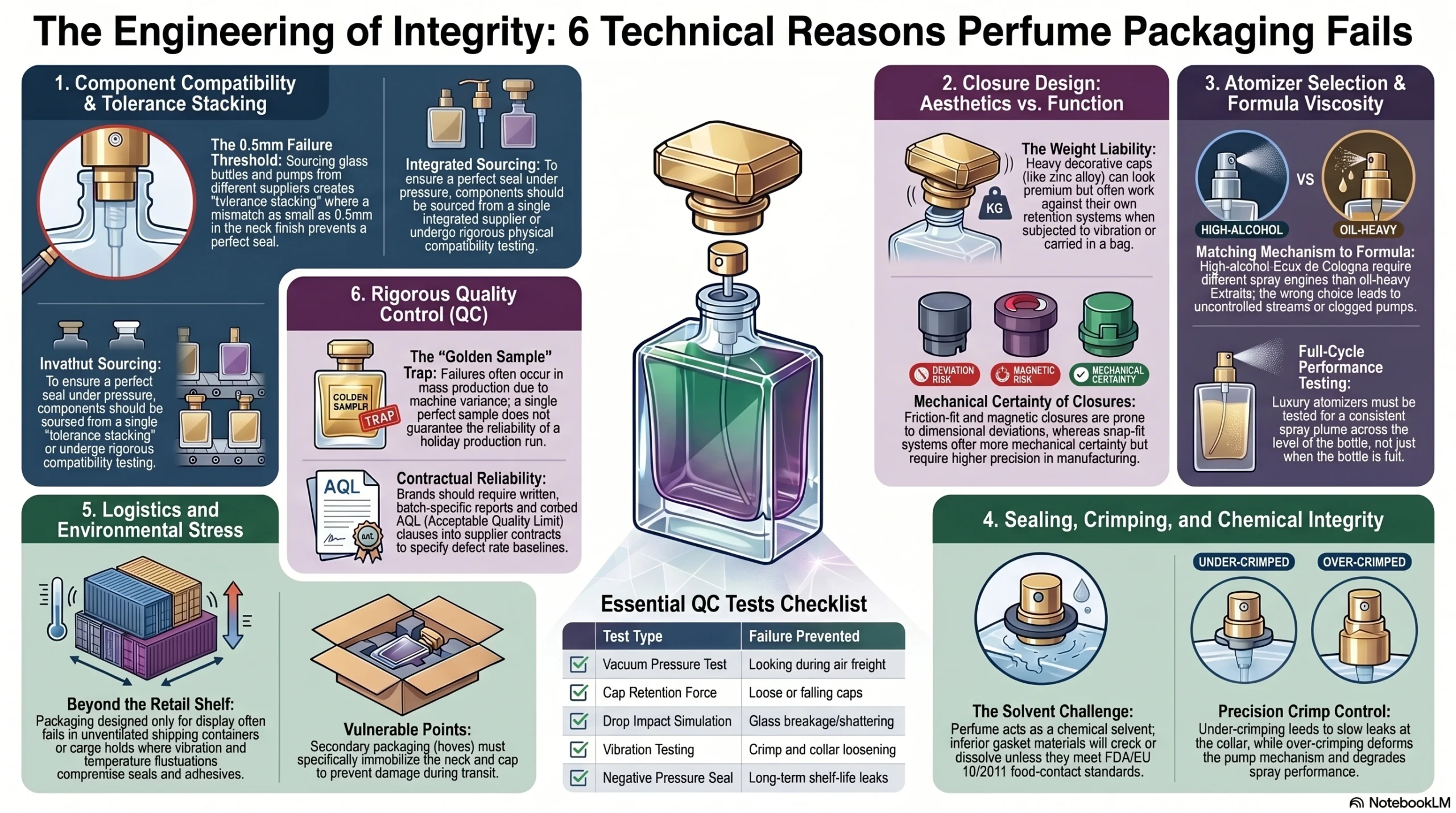
Poor Component Compatibility
The most common cause of leakage is deceptively simple: the bottle neck finish and the pump mechanism were not designed or validated to work together. When brands source glass bottles from one supplier and spray pumps from another — a common cost-saving practice — they introduce tolerance stacking risk. If a glass neck thread is even 0.5mm too wide for the chosen spray pump, those two components will never seal perfectly. The bottle may appear fine when empty, but once pressurized with liquid and subjected to movement, it leaks.
The same mismatch problem applies to caps, actuators, collars, and crimped pump ferrules. Each component in a perfume assembly has its own tolerance range. When those ranges come from different manufacturers with different equipment, the combinations can fall outside any individual specification — even when each part passes its own inspection. This is why sourcing from a single integrated supplier, or at minimum conducting physical compatibility testing before production, is non-negotiable.
Weak Closure Design
Not all cap systems are engineered equally. Friction-fit caps depend on dimensional consistency across thousands of production units; small deviations in the cap bore diameter or the bottle collar immediately affect retention force. Magnetic closures can feel elegant in samples but may not maintain hold strength when caps are slightly misaligned or when the magnet positions vary between lots. Snap-fit systems offer more mechanical certainty but require precise tolerancing of both the male and female components.
The underlying problem is that decorative caps often prioritize visual impact over functional security. A heavy zinc alloy cap with an ornate design creates a top-heavy bottle profile. Under vibration or when carried in a bag, that cap’s own weight works against its retention system. What looked impressive in a design rendering can become a reliability liability in the hands of an actual user.
Atomizer Selection That Doesn’t Match Formula or Positioning
Not all atomizers are equal, and selecting one based on aesthetics or lowest unit cost is a high-risk shortcut. The spray engine’s orifice size, spring tension, actuator stroke length, and dip tube diameter all determine spray plume quality — the difference between a fine, even mist and an uncontrolled stream.
Formula viscosity matters enormously here. A heavy, oil-forward extrait de parfum requires a different spray mechanism than a light, high-alcohol eau de cologne. An atomizer calibrated for low-viscosity formulas will over-spray and create a wet, uneven plume with richer compositions. Conversely, an atomizer with insufficient spring force for a heavy formula may clog within weeks. Luxury brands need consistent spray output across the bottle’s entire fill level, not just in early use — which requires selecting pumps tested against the actual formula at multiple fill stages.
Inadequate Sealing and Crimp Control
For crimped pump systems — the standard for most fine fragrance — the ferrule crimp is the primary seal between the pump mechanism and the bottle. If the crimp is too loose, the pump can work its way free under vibration, creating a slow leak at the collar. If it is over-crimped, the mechanism is deformed and spray performance degrades.
Gasket material selection adds another layer of risk. Perfume is a chemical solvent — a mixture of alcohol, water, and concentrated essential oils that degrades inferior sealing materials over time. If suppliers use cheap rubber or low-grade plastic for inner sealing gaskets, those fragrance oils will break them down within months. Gaskets must meet FDA and EU 10/2011 food-contact material standards to withstand high-alcohol content over the product’s shelf life without cracking, hardening, or dissolving.
Packaging Designed for Shelf Display, Not Logistics
A beautiful bottle-and-box combination that performs well on a retail shelf can fail catastrophically when introduced to the logistics chain. Heavy glass bottles and ornate metal caps behave very differently under vibration than their static appearance suggests. Presentation boxes with decorative foam liners or magnetic flap closures may not immobilize the bottle at the neck and cap — the two most vulnerable points during transit.
Temperature variation is an underappreciated factor. Air freight cargo holds and unventilated shipping containers can reach temperatures that affect fragrance composition, gasket integrity, and even adhesive performance in outer cartons. Packaging systems that pass desk-level review can fail under these real-world logistics conditions without ever having been tested for them.
Insufficient Quality Control
The most insidious packaging failures are those that pass sampling and fail in production. A golden sample represents a single carefully assembled unit; mass production introduces machine variance, operator variation, material lot differences, and time pressure. Factories racing to meet holiday deadlines may skip vacuum pressure tests or spray performance checks that add even half a day to the production schedule.
Professional QC for perfume packaging requires more than a visual inspection for scratches. It needs to include spray performance validation, cap retention force testing, drop impact simulation, seal integrity testing under negative pressure, and vibration testing that mimics actual transit conditions. Demand written, batch-specific inspection reports — not verbal assurances from a sales representative. Require AQL (Acceptable Quality Limit) clauses contractually embedded in your supplier agreement, specifying defect rate baselines for both major and minor flaws.
Reliable perfume packaging depends on viewing the bottle, pump, cap, and secondary packaging as one system rather than isolated parts. Designing or sourcing them as separate components and hoping for compatibility is where most preventable failures begin.
The Hidden Business Cost of Leaks, Loose Caps, and Bad Atomizers
Understanding why packaging fails is only half the equation. Understanding what failure costs is what drives the investment in getting it right.
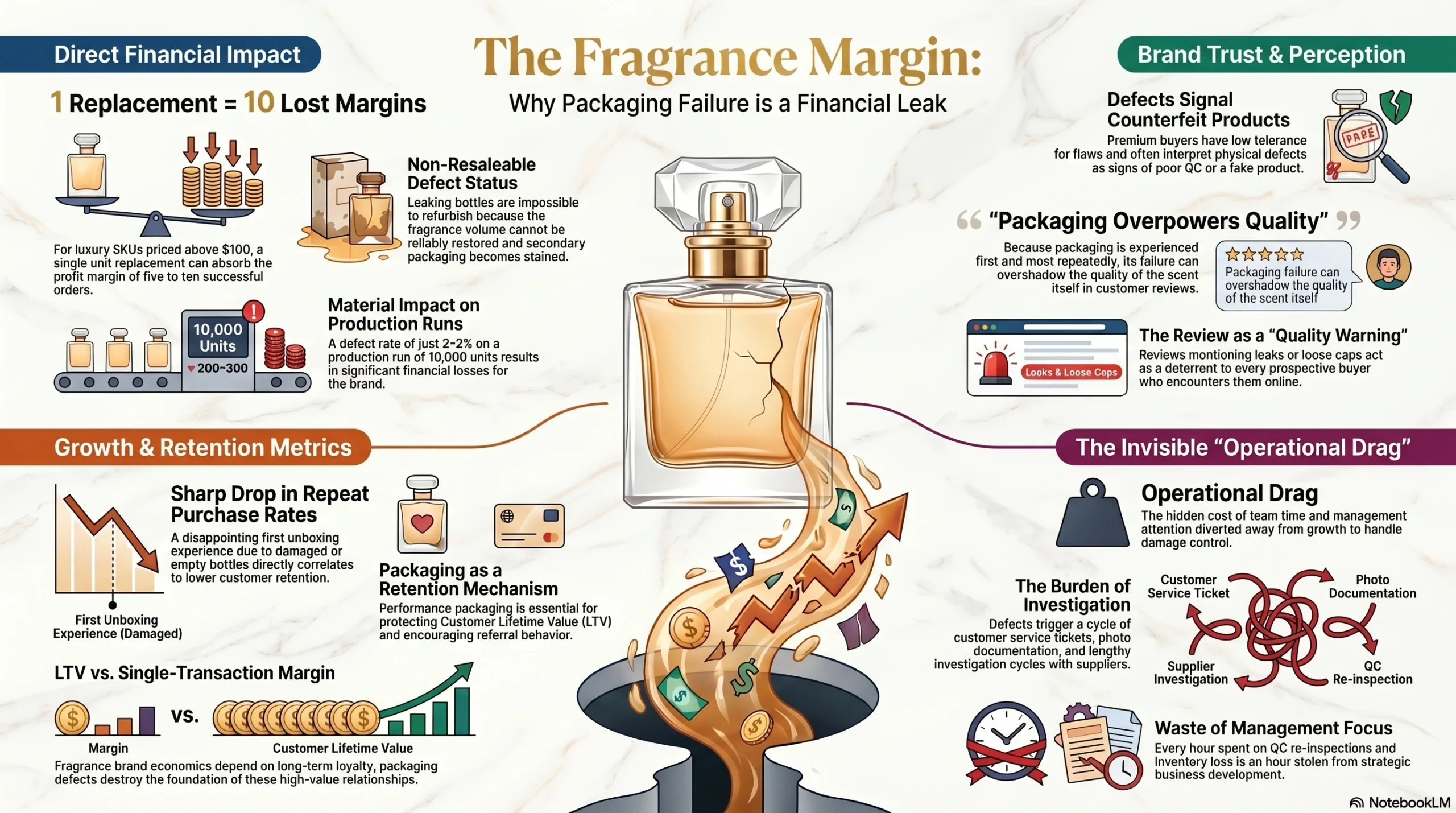
Returns and Replacements
A leaking perfume bottle is, in most cases, non-resaleable. The fragrance cannot be reliably re-filled to original volume, the secondary packaging is stained, and the customer’s perception of the product is already damaged. For luxury SKUs priced above $100, a single unit replacement can absorb the margin from five to ten successful orders. Multiply that across a defect rate of even 2–3% on a production run of 10,000 units, and the financial impact becomes material very quickly.
Brand Trust Erosion
Premium fragrance buyers have exceptionally low tolerance for packaging failure. In high-consideration purchase categories, customers interpret physical defects as signals of poor quality control — or, worse, as potential signs of counterfeit product. A review that says “beautiful scent but the cap kept falling off and the bottle leaked in my bag” does not read as a minor complaint. It reads as a quality warning to every prospective buyer who encounters it. Packaging problems can overpower fragrance quality in reviews because packaging is what the customer experiences first, last, and most repeatedly.
Higher Customer Acquisition Cost Pressure
If a customer’s first-order experience is disappointing — unboxing a damaged or partially empty bottle — repeat purchase rates drop sharply. For fragrance brands where the economics depend on customer lifetime value rather than single-transaction margin, packaging defects directly reduce LTV and suppress referral behavior. Performance packaging is not just a launch requirement; it is a retention mechanism.
Operational Drag
Beyond the visible financial costs, packaging defects create invisible operational drag: more customer service tickets requiring photo documentation, more investigation cycles with suppliers, more QC re-inspections, more wasted inventory from damaged units. Each of these consumes team time and management attention that should be directed toward growth, not damage control.
Bad packaging doesn’t just leak perfume. It leaks margin.
How to Prevent Perfume Bottle Leakage
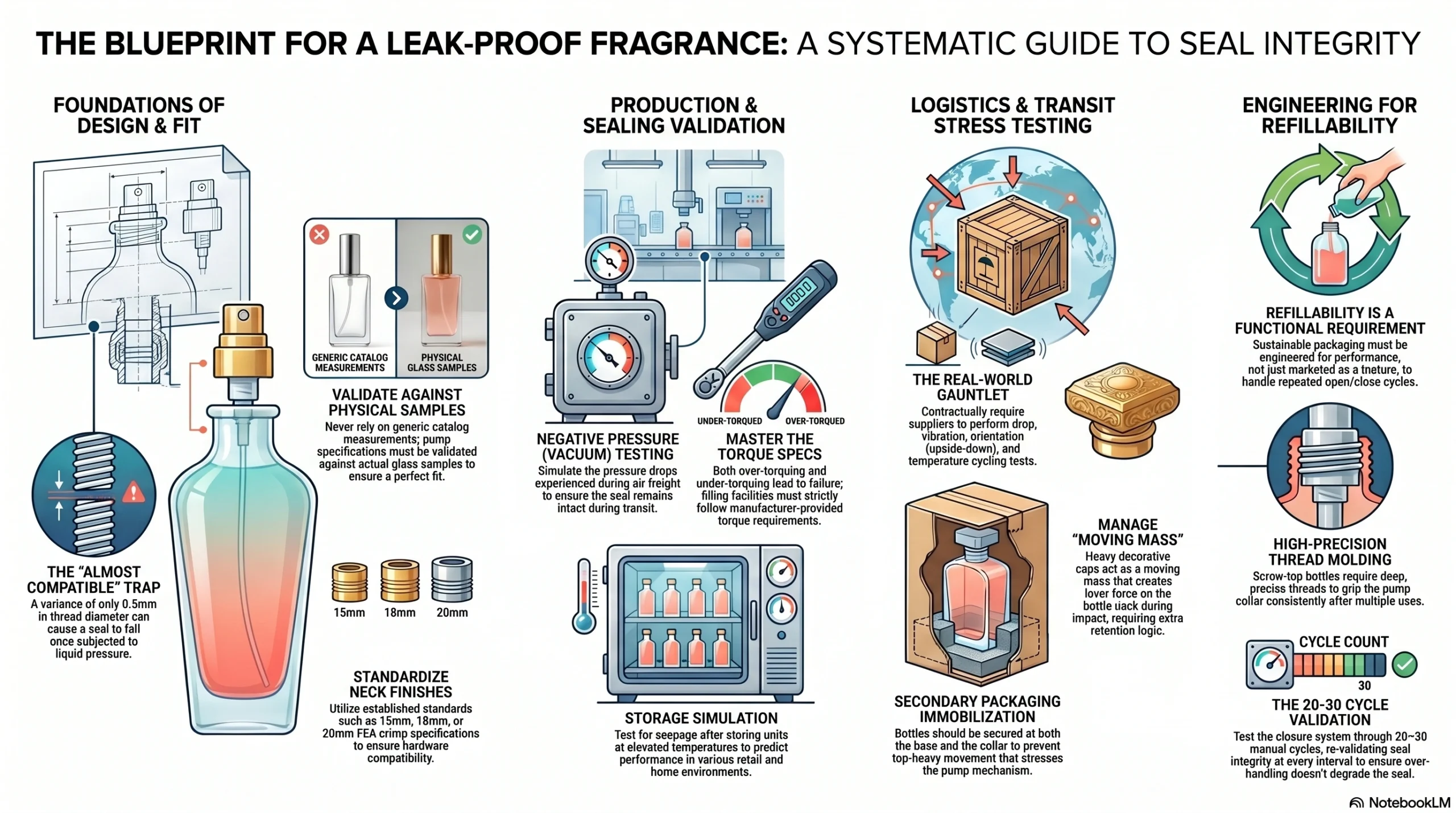
Leakage prevention is systematic, not reactive. The following practices apply at the design and pre-production stage — not after the first customer complaint.
Start with the Neck Finish and Pump Fit
Compatibility between the bottle neck and the spray pump is the foundation of a leak-proof system. “Almost compatible” is not compatible in fragrance packaging — a 0.5mm variance in thread diameter can create a seal failure that only becomes visible under liquid pressure. Specify neck finish standards (such as 15mm, 18mm, or 20mm FEA crimp) and confirm that pump specifications are validated against the actual glass sample, not against a generic catalog measurement.
Validate Crimping and Sealing Performance
For crimped pump systems, crimp consistency must be verified across the full production run, not just on pilot samples. Test for seal integrity using negative pressure (vacuum) testing that simulates the pressure changes of air freight. Check for seepage after storage simulation at elevated temperatures. Require evidence that your filling facility is using the torque specifications provided by the packaging manufacturer — over-torquing and under-torquing both create seal failure at different points in the product’s life.
Test Under Real Logistics Conditions
Drop testing, vibration testing, orientation testing (bottle upside-down in transit), and temperature cycling should all be part of pre-launch validation. These tests are standard practice among tier-one fragrance packaging suppliers and should be contractually required of any supplier you scale production with. Do not assume that passing a visual inspection at the factory equates to surviving a cross-continental logistics chain.
Secure the Cap and Actuator for Shipment
Heavy decorative caps need stronger retention logic in their connection to the bottle than a lightweight cap. In secondary packaging, the bottle should be immobilized at the base and, where possible, at the collar — preventing top-heavy movement that can stress both the cap connection and the pump mechanism. Transit packaging should treat the cap as a moving mass that creates lever-force on the bottle neck under impact.
Review Refillability Carefully
Refillable packaging has strong appeal for sustainability positioning and premium brand building — but each open/close cycle introduces new seal and user-handling variables. A screw-top refillable bottle requires high-precision thread molding; shallow or imprecise threads cannot grip the pump collar consistently after repeated cycling. Refillability must be engineered as a functional requirement, not simply marketed as a feature. Test the closure system through 20–30 open/close cycles and re-validate seal integrity after each interval.
How to Design Caps That Feel Luxurious and Stay Secure
Cap performance is one of the most visceral aspects of fragrance UX — and one of the most commonly underengineered.
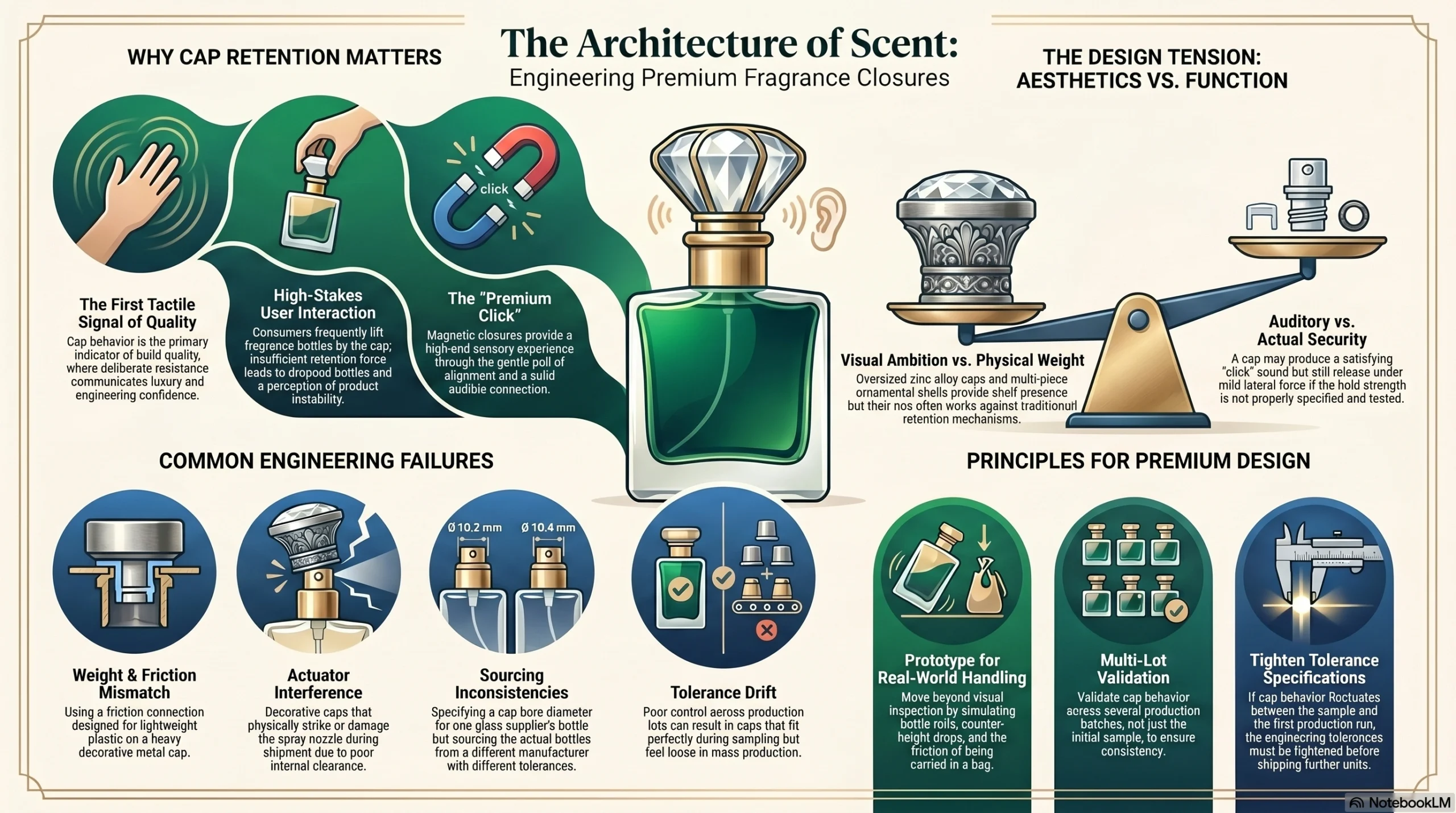
Why Cap Retention Matters More Than Brands Think
Consumers often pick up fragrance bottles by the cap. If the cap slips, the bottle falls. If the cap feels loose, the entire product feels unstable. Cap behavior is the first tactile signal customers receive about build quality, and it shapes their perception of everything that follows. A cap that requires gentle but deliberate force to remove — and gives a satisfying resistance when replaced — communicates engineering confidence. A cap that slides off accidentally communicates the opposite.
Balancing Aesthetics and Retention Force
The most common design tension in premium fragrance caps is between visual ambition and functional security. Oversized zinc alloy caps, decorative metal shells, and multi-piece ornamental closures are often chosen for their shelf presence. But their weight and dimensional complexity can work against retention. Magnetic closures create an excellent sensory experience when properly engineered — the gentle pull of alignment and the solid click of connection feel premium — but magnetic retention force must be specified and tested, not assumed.
User satisfaction requires both the click feel and actual hold strength. A cap that sounds secure but releases under mild lateral force will frustrate users within days of first use.
Common Design Mistakes
Heavy cap paired with a weak friction connection designed for a lighter cap
Decorative cap that physically interferes with the spray actuator, causing nozzle damage during shipment
Poor tolerance control across production lots, creating caps that fit well in sampling and loosely in mass production
Cap bore diameter specified to one supplier’s glass but sourced from another’s bottle
Better Design Principles
Design for grip, retention, and repeat use — not just visual impact. Prototype with real handling tests: carry the bottle in a bag, drop it from counter height, simulate what happens when the bottle rolls. Ensure cap behavior is validated across multiple production lots, not just the first sample. If the cap behavior changes between the sample and production, the tolerance specification needs to be tightened before another batch ships.
What Separates a Premium Atomizer from a Bad One
For perfume brands, the atomizer is where packaging engineering becomes user experience. The spray is the moment of delivery — the physical act of applying fragrance — and its quality shapes how customers perceive the product every time they use it.
Fine Mist vs. Squirt
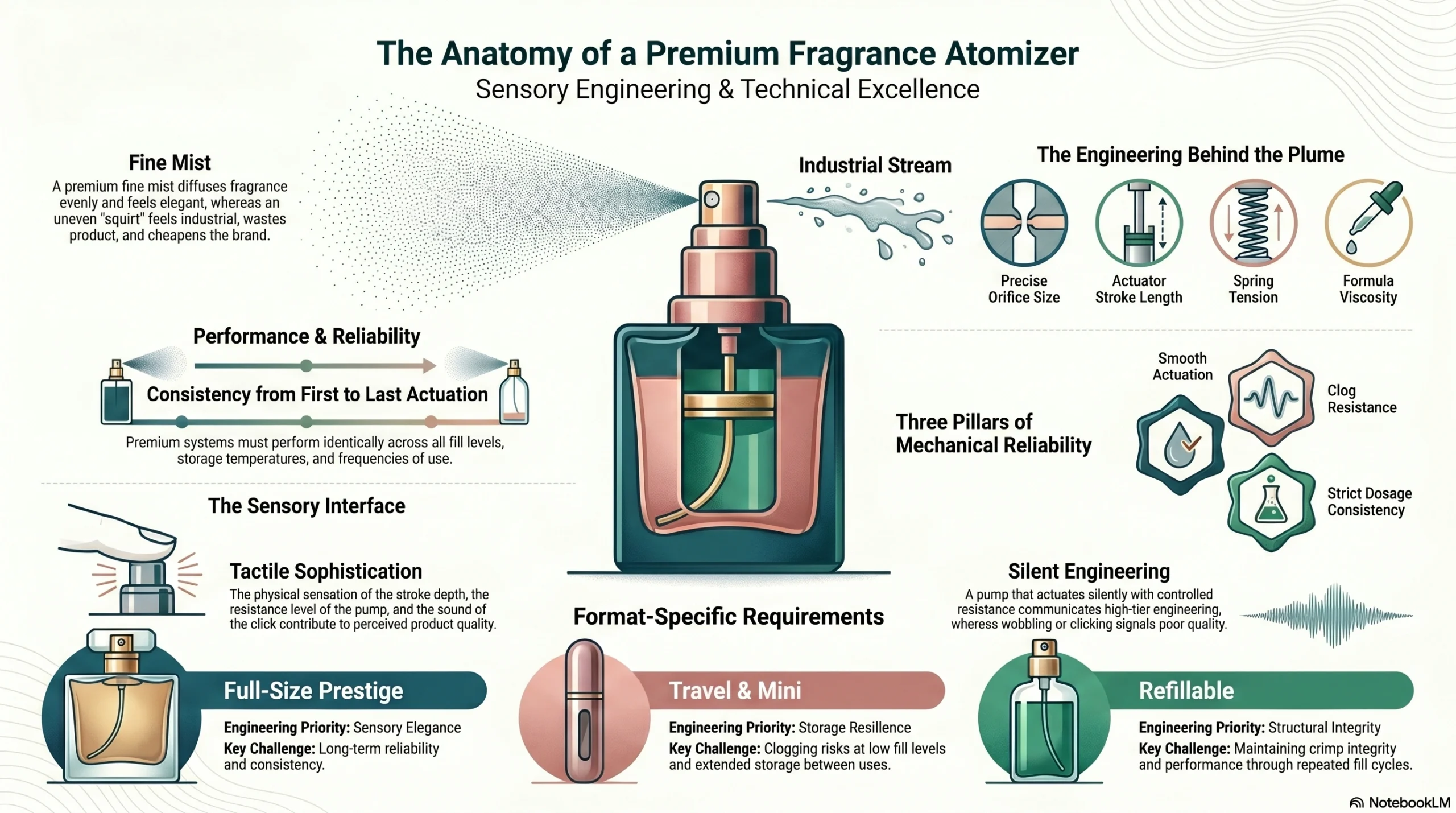
Spray plume quality is a direct sensory signal of refinement. A fine, even mist diffuses fragrance across the skin evenly, feels elegant, and reflects a calibrated delivery system. An uneven stream or squirt-like output feels industrial, wastes fragrance, and makes even an expensive perfume feel low-grade. The difference between these outcomes is determined by atomizer orifice size, actuator stroke length, spring tension, and the match between these parameters and the formula’s viscosity.
Performance Consistency Over Time
A premium atomizer must perform consistently from the first actuation to the last — across a full range of fill levels, storage temperatures, and use frequencies. This means clog resistance (nozzles that don’t dry and seal after infrequent use), smooth actuation (consistent spring return without mechanical noise or resistance increase), and dosage consistency (each spray delivering the same volume, not variable amounts based on pump fatigue).
Atomizer Quality Is Both Technical and Sensory
The tactile feel of pressing the spray head — the resistance level, the depth of stroke, the sound of actuation, the spray pattern — all contribute to perceived product sophistication. Premium fragrance buyers notice these details, even when they cannot articulate them explicitly. A pump that actuates silently with controlled resistance communicates engineering quality. A pump that wobbles, clicks noisily, or requires excessive force communicates the opposite.
Choosing Atomizers for Luxury, Travel, and Refillable Formats
Different product formats require genuinely different atomizer priorities. Full-size prestige SKUs require above all: consistency, sensory elegance, and long-term reliability. Travel and mini formats face different challenges — smaller dip tubes, higher risk of clogging at low fill levels, and the need to function after extended storage between trips. Refillable formats require pumps that maintain crimp integrity and spray performance through repeated fill cycles. These are not interchangeable requirements. Choosing a single atomizer spec across all formats is a value-engineering shortcut that premium brands should avoid.
Why Outer Packaging Can Make Perfume Failure Worse
Secondary packaging is often treated as a presentation decision. It is equally a protection decision.
Luxury Boxes Still Need Structural Logic
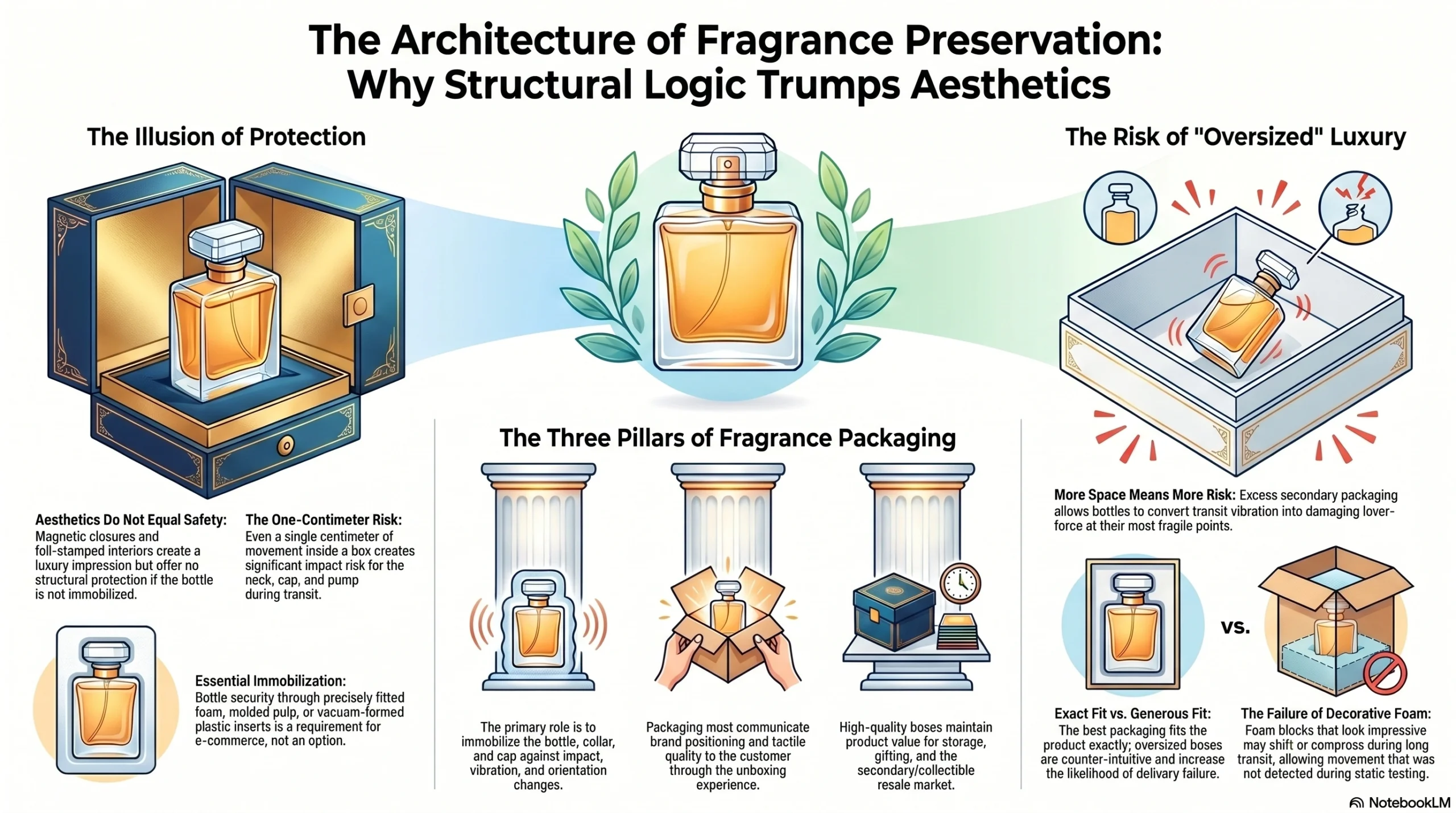
Rigid boxes with magnetic closures, embossed surfaces, and foil-stamped interiors create powerful brand impressions. But none of these aesthetic elements provides structural protection unless the box is designed to immobilize its contents. A bottle that can shift inside a rigid box — even by a centimeter — creates impact risk at the neck, cap, and pump during every movement in transit. Bottle immobilization through precisely fitted foam, molded pulp, or vacuum-formed plastic inserts is not optional in e-commerce fragrance logistics; it is the difference between delivery intact and delivery damaged.
Oversized Packaging Can Create More Risk
Counter-intuitively, excess secondary packaging can increase damage risk rather than reduce it. When a bottle has space to move inside its box, it converts transit vibration and impact into lever-force applied at its most fragile points. Decorative foam blocks that look impressive in a flat configuration may shift or compress over long transit, allowing movement that wasn’t present in static testing. The best secondary packaging fits the product exactly — not generously.
The Best Perfume Boxes Do Three Things
Protect — immobilize the bottle, collar, and cap against impact, vibration, and orientation changes during transit
Present — communicate brand positioning, tactile quality, and unboxing experience to the customer
Preserve value — maintain the perceived worth of the product through storage and, for collectible or limited-edition releases, through secondary market handling
Fragrance consumers who keep boxes do so because those boxes add meaningful value — for storage, gifting, or resale. Generic or flimsy secondary packaging is discarded immediately and contributes nothing to LTV or brand impression.
What Perfume Brands Should Ask Packaging Suppliers Before Production
This section is the most operationally actionable part of any packaging conversation. The questions below represent the minimum due diligence standard for any serious fragrance packaging engagement.
Compatibility and Tolerance Questions
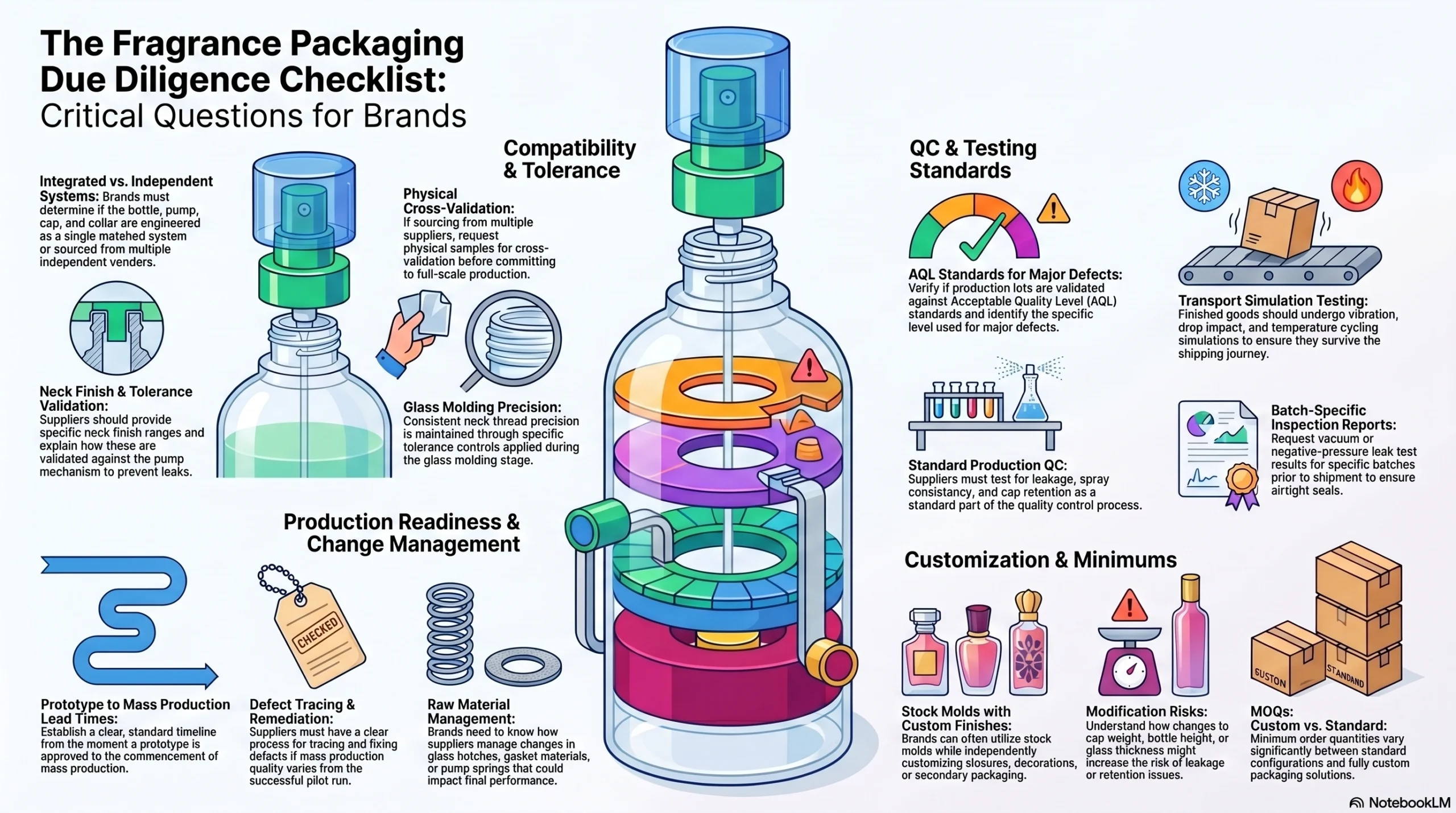
Are the bottle, pump, cap, and collar designed as one matched system, or sourced independently?
What are the neck finish specification and tolerance range for your bottles, and how are these validated against your pump mechanisms?
If I source bottles and pumps from different suppliers, will you provide physical samples for cross-validation before production?
What tolerance controls are applied at the glass molding stage to ensure consistent neck thread precision across production lots?
QC and Testing Questions
Do you test for leakage, spray consistency, and cap retention as part of standard production QC?
What transport simulations — vibration, drop impact, temperature cycling — are performed on finished goods before shipment?
Are your production lots validated against AQL standards? If so, at what AQL level for major defects?
Can you provide batch-specific inspection reports, including vacuum or negative-pressure leak test results, prior to shipment?
Production Readiness Questions
What is your standard timeline from prototype approval to mass production?
If the first pilot run performs well but mass production shows variance, what is your defect tracing and remediation process?
How do you manage changes in raw material suppliers (glass batch, gasket material, pump spring) that might affect performance?
Customization Questions
Can a brand use a stock mold while customizing the closure, decoration, or secondary packaging independently?
What design modifications — cap weight, bottle height, glass thickness — affect leakage or retention risk, and how are these communicated before tooling?
What is the minimum order quantity for custom versus standard configurations?
Asking these questions early — before samples are approved and before deposits are wired — is where Jarsking provides structural value to fragrance brand teams. The cost of getting these answers before production is trivial. The cost of not having them after production is not.
A Practical Framework for Choosing Better Perfume Packaging
Step 1: Define the Brand Promise
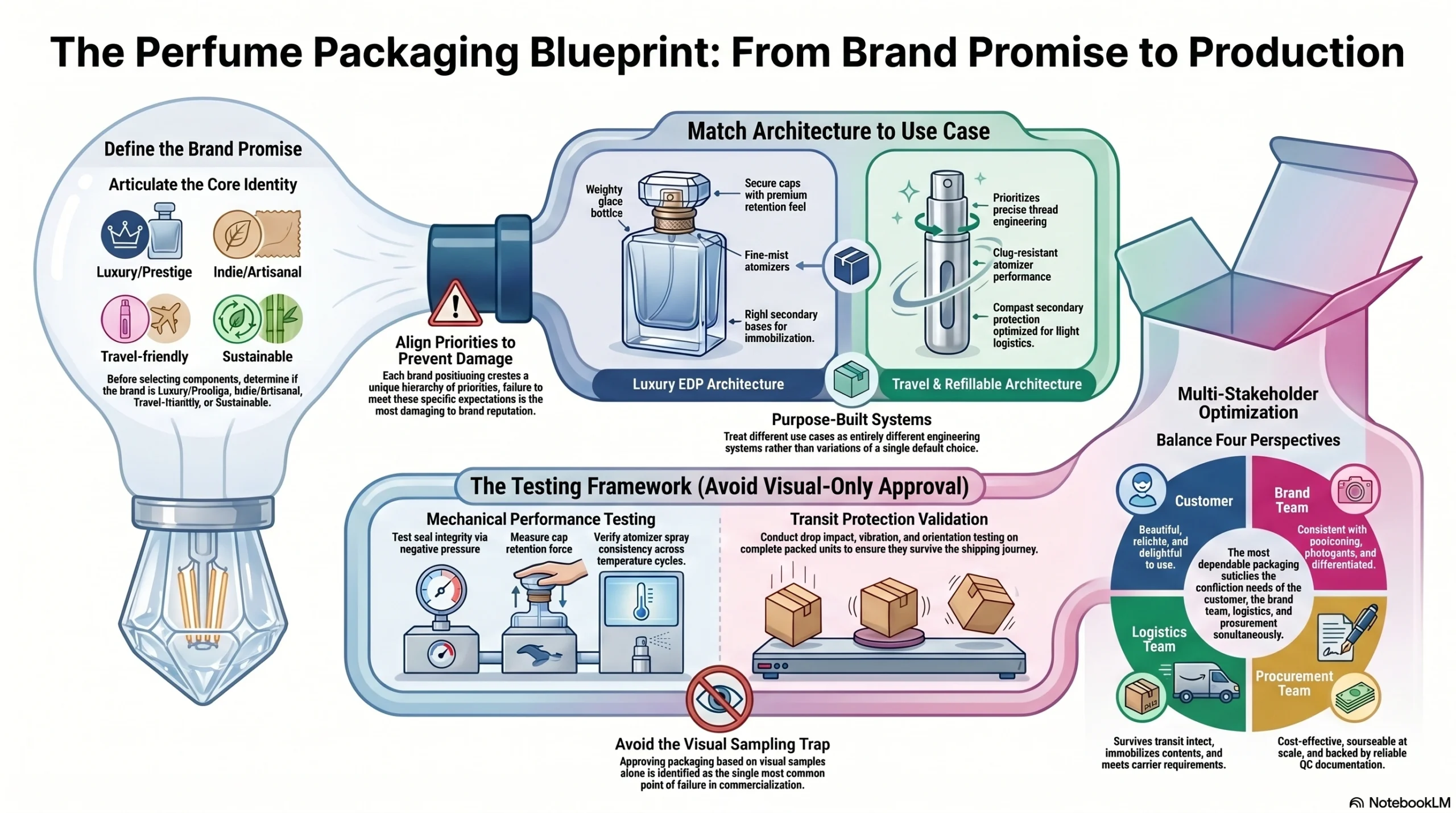
Before selecting any component, articulate what the packaging needs to communicate. Luxury and prestige? Indie artisanal? Travel-friendly and functional? Refillable and sustainable? Collector-oriented with archival box design? Each positioning creates a different hierarchy of packaging priorities — and changes which failures are most brand-damaging.
Step 2: Match Packaging Architecture to Use Case
Once the brand promise is defined, every component choice should support it. A luxury EDP requires a weighty glass bottle, a secure and elegant cap with premium retention feel, a fine-mist atomizer with consistent output, and a rigid secondary box with precise bottle immobilization. A travel-friendly refillable mini requires precise thread engineering, clog-resistant atomizer performance, and compact secondary protection optimized for carry-on logistics. These are genuinely different systems, not variations of the same default choice.
Step 3: Test Before Scaling
Not just appearance — test:
Seal integrity: negative pressure testing after fill
Cap retention force: measured across multiple production units
Atomizer performance: spray consistency from full to low fill levels, after temperature cycling, after 30 days of storage
Transit protection: drop impact, vibration, and orientation testing on complete packed units
Approval based on visual sampling alone is the most common single point of failure in fragrance packaging commercialization.
Step 4: Optimize for Both Experience and Operations
The best perfume packaging satisfies four stakeholders simultaneously:
Customer: beautiful, reliable, delightful to use
Brand team: consistent with positioning, photogenic, differentiated
Logistics team: survives transit intact, immobilizes contents, meets carrier requirements
Procurement team: cost-effective, sourceable at scale, with reliable QC documentation
Packaging that satisfies only the first two is a liability waiting to manifest. The best perfume packaging is not the most decorative. It is the most dependable expression of the brand.
Conclusion: Fragrance Brands Win When Packaging Performs Beautifully
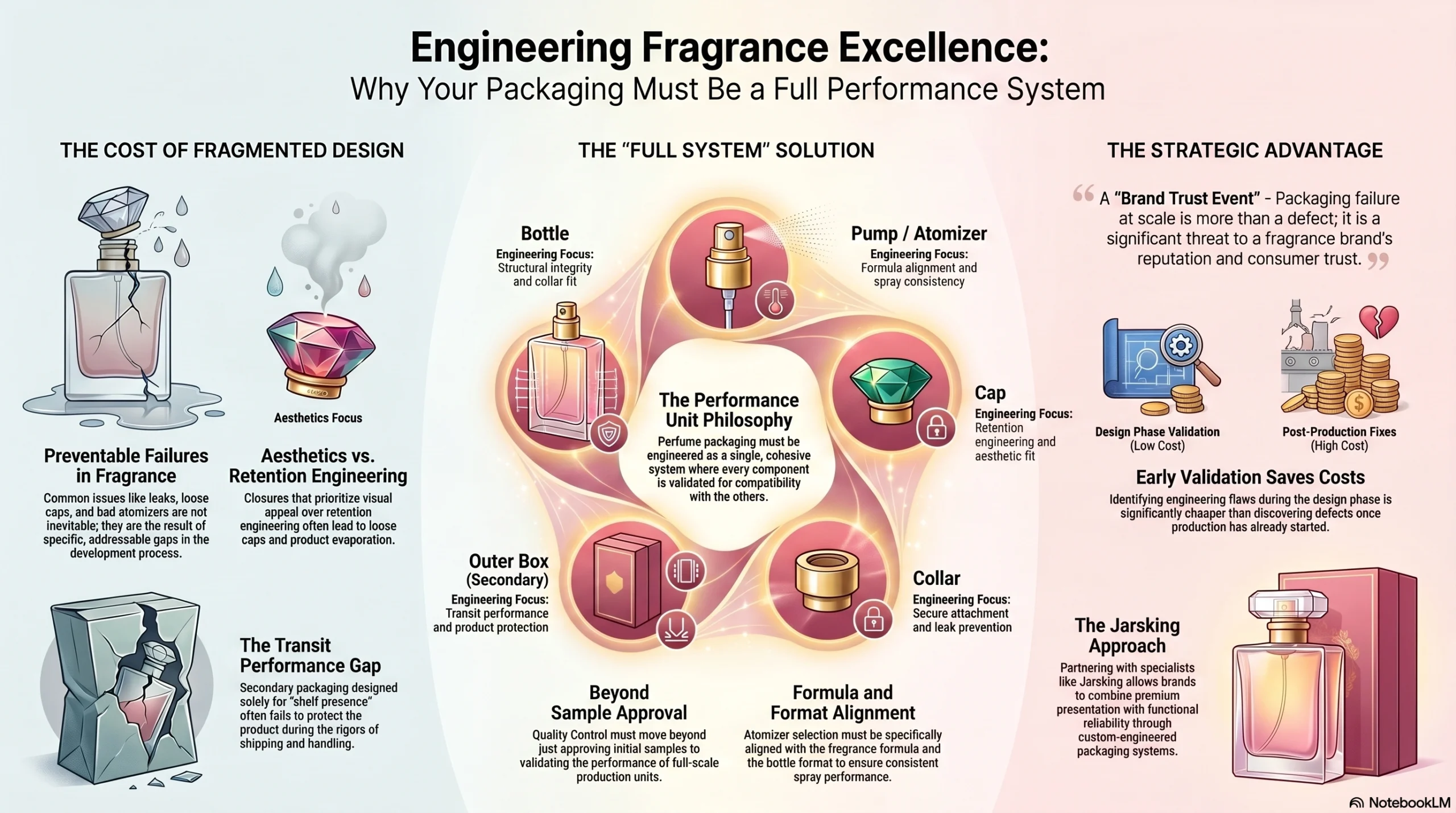
Leaks, loose caps, and bad atomizers are not inevitable features of perfume product development. They are preventable outcomes that trace back to specific, addressable decisions: component sourcing without compatibility validation, closure design prioritizing aesthetics over retention engineering, atomizer selection without formula or format alignment, secondary packaging designed for shelf presence rather than transit performance, and QC processes that approve samples but don’t validate production.
The unifying principle is that perfume packaging must be engineered as a full system — bottle, pump, cap, collar, and outer box working together as a single performance unit — not assembled from the cheapest compatible components and hoped into compliance.
For fragrance brands at any stage of development, the stakes of getting this right extend beyond the physical product. A packaging failure at scale is a brand trust event. A packaging system that performs consistently and beautifully, across every unit and every shipment, is one of the most durable investments a fragrance brand can make in its own reputation.
For perfume brands developing new packaging, improving an existing bottle, or reducing defect risk before launch, working with a supplier that understands both aesthetics and component performance can prevent costly mistakes far earlier — and far more cheaply — than discovering them in production.
Jarsking helps fragrance brands develop custom perfume packaging systems that combine premium presentation with functional reliability — from bottle and cap engineering to atomizer selection and secondary packaging design.
FAQs
The most common causes are a mismatch between the bottle neck finish and the pump mechanism, degraded or low-grade gaskets that break down under alcohol exposure, inconsistent thread precision in glass molding, and incorrect crimp torque applied during filling. All of these are preventable through compatibility testing and structured QC protocols.
Loose caps result from insufficient retention force in the closure design, tolerance variance across production lots, or caps that were designed primarily for aesthetics rather than functional grip. Heavy decorative caps on weak friction-fit connections are the most common offender.
Squirting typically indicates a broken or malfunctioning valve, a damaged nozzle, or an atomizer spec that doesn’t match the formula’s viscosity. An atomizer calibrated for low-viscosity alcohol-based EDTs will often over-spray with denser, oil-rich formulas.
Effective pre-launch testing includes negative-pressure leak testing, cap retention force measurement, atomizer spray consistency testing across fill levels, drop impact and vibration testing on complete packed units, and temperature cycling to simulate logistics and storage conditions. Batch-specific inspection reports should be required of suppliers before shipment.
Refillable formats introduce additional leak risk if thread precision is poor or if the closure system degrades over repeated open/close cycles. This risk is manageable through high-precision glass molding, high-quality gasket materials, and cycle-based seal validation during development — but it must be engineered explicitly, not assumed.
Yes, significantly. Secondary packaging that fails to immobilize the bottle allows it to move under transit vibration and impact, creating lever-force at the neck, collar, and pump — the three most mechanically vulnerable points. Precisely fitted inserts and structural rigidity throughout the box are both required for effective transit protection.
Premium brands select atomizers based on formula viscosity, desired spray plume quality, dosage consistency requirements, actuation feel, clog resistance, and format-specific needs (full-size prestige vs. travel vs. refillable). The spray engine should be chosen as a performance specification, not a decorative accessory.
Key questions cover component compatibility and tolerance standards, QC testing protocols (including vacuum leak tests and AQL defect limits), production readiness and defect tracing processes, and customization scope. Requiring contractual AQL clauses and batch-specific testing documentation separates professional suppliers from those relying on verbal quality assurances.