















Your product took months — maybe years — to perfect. But the moment a customer picks it up, the packaging speaks first. Before they read a single word of your copy, before they feel the texture of your product, your box has already made a promise. The question is: are you keeping it?
For brand managers, product packaging buyers, and e-commerce entrepreneurs, one of the most consequential — yet often rushed — decisions is choosing between a rigid box vs. folding carton. Get it right and your packaging becomes a silent salesperson. Get it wrong and even a great product can feel underwhelming.
In this guide, you’ll learn everything you need to make a confident, informed decision. We’ll break down the structural differences, compare cost and logistics trade-offs, explore customization potential, and help you identify exactly which format fits your brand strategy — backed by current industry data and expert insight.
What Is a Rigid Box?
Definition & Construction
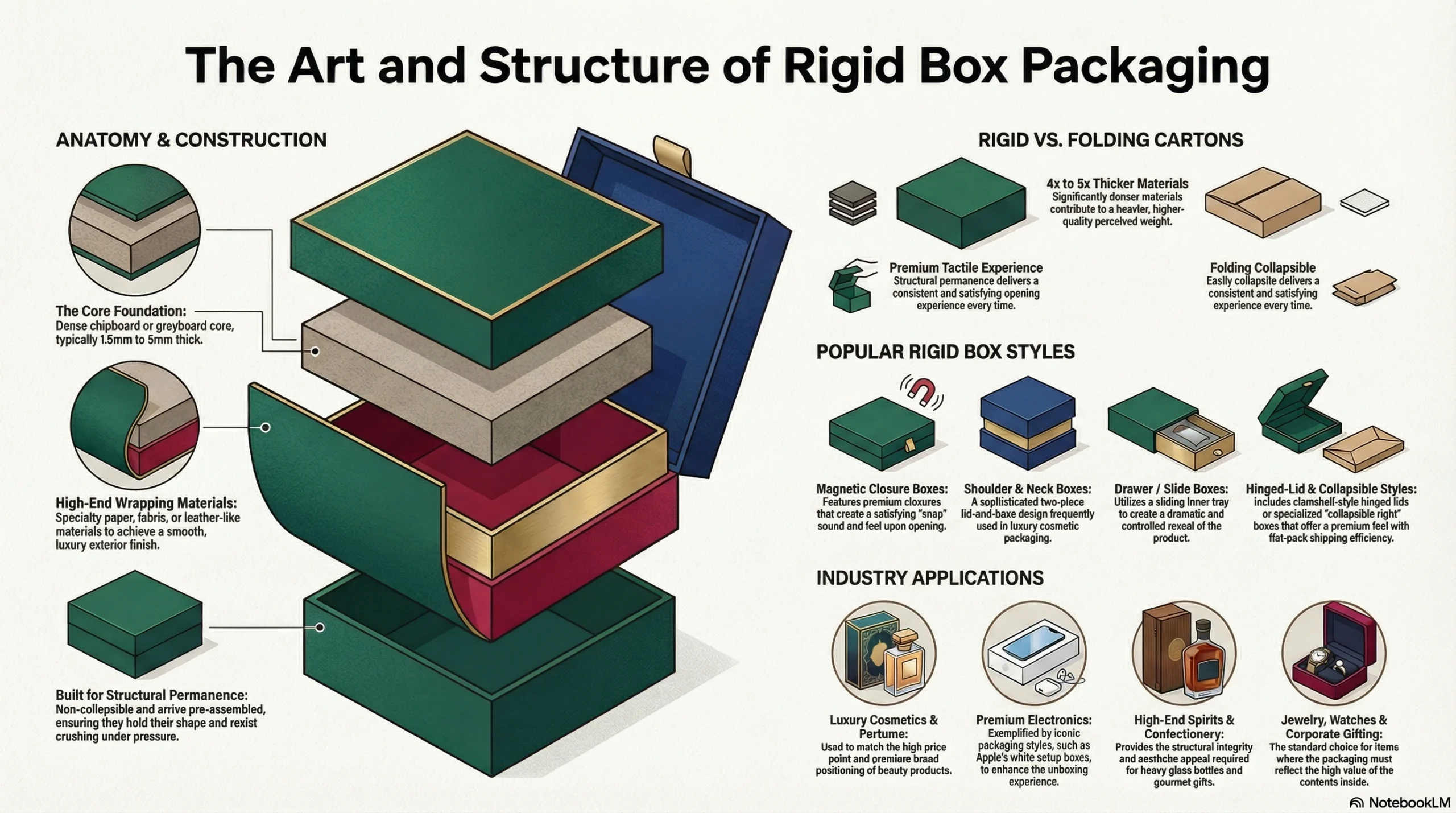
A rigid box — also called a setup box or luxury box — is a non-collapsible packaging structure built on a dense chipboard or greyboard core, typically ranging from 1.5mm to 3mm thick. This core is then wrapped in specialty paper, fabric, or leather-like materials to create a smooth, high-end exterior finish.
Unlike folding cartons, rigid boxes arrive pre-assembled and do not fold flat. That structural permanence is precisely what gives them their premium feel: they resist crushing, hold their shape under pressure, and deliver a consistent tactile experience every single time a customer opens one.
In fact, rigid box material is typically 4 to 5 times thicker than standard folding carton material — a structural difference that translates directly into the perceived weight and quality of the product inside.
Common Rigid Box Styles
Rigid boxes come in a wide range of formats to suit different product categories and brand personalities:
Magnetic closure boxes — premium closures that create a satisfying snap on opening
Shoulder & neck boxes — a two-piece lid-and-base design common in luxury cosmetics
Drawer / slide boxes — sliding inner tray for a dramatic reveal
Collapsible rigid boxes — premium feel with flat-pack logistics efficiency
Hinged-lid boxes — attached lid for a clamshell-style opening
Industries That Use Rigid Boxes
Rigid boxes are the standard in industries where the product price and brand positioning demand a packaging experience that matches the value inside. Common sectors include luxury cosmetics and perfume, fine jewelry and watches, premium electronics (think of Apple’s iconic white setup boxes), high-end spirits and confectionery, and corporate gifting programs.
Definition & Construction
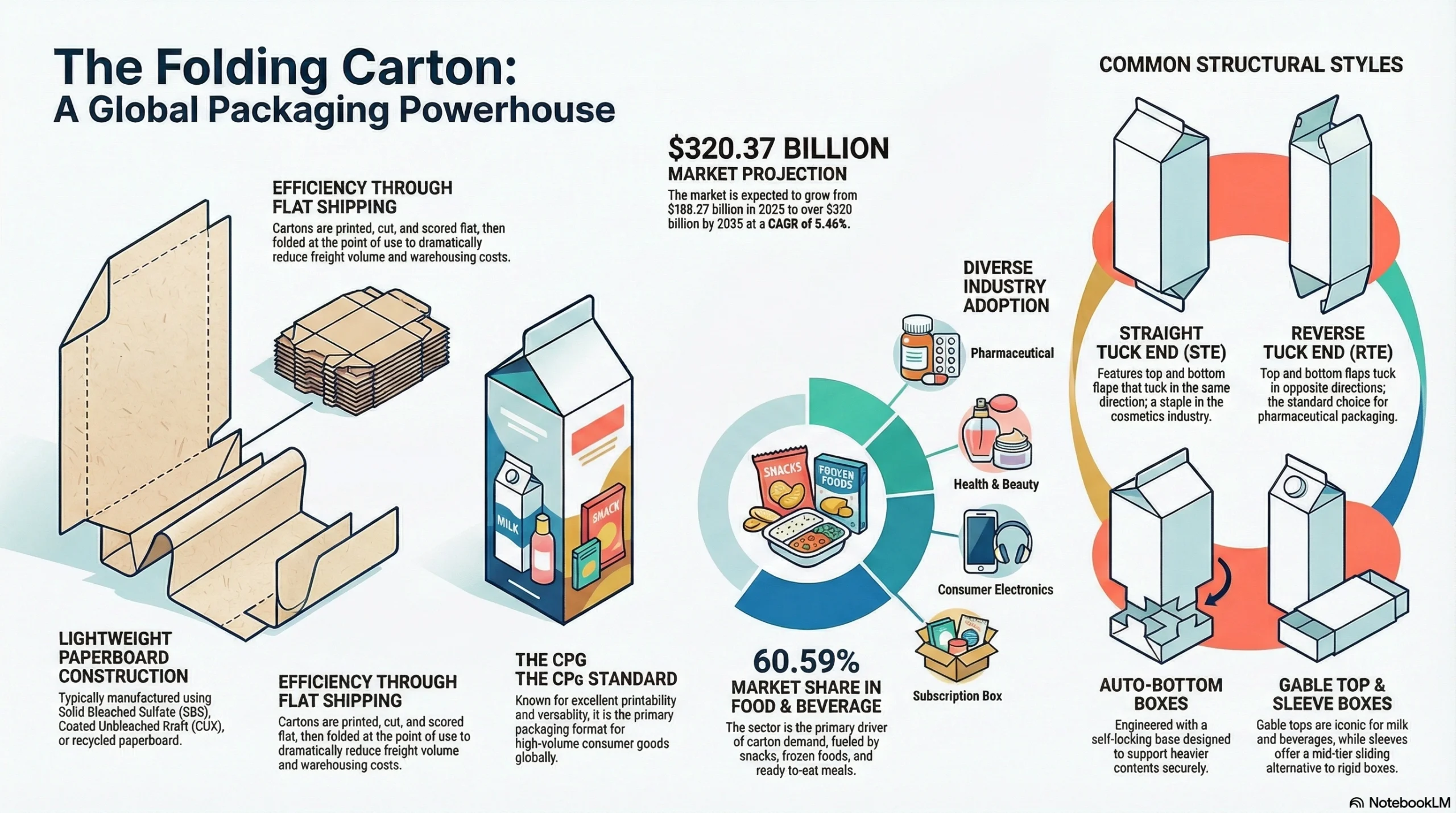
A folding carton is a packaging solution manufactured from lighter-weight paperboard — typically Solid Bleached Sulfate (SBS), Coated Unbleached Kraft (CUK), or recycled paperboard — that is printed, cut, and scored flat, then folded and glued at the point of use.
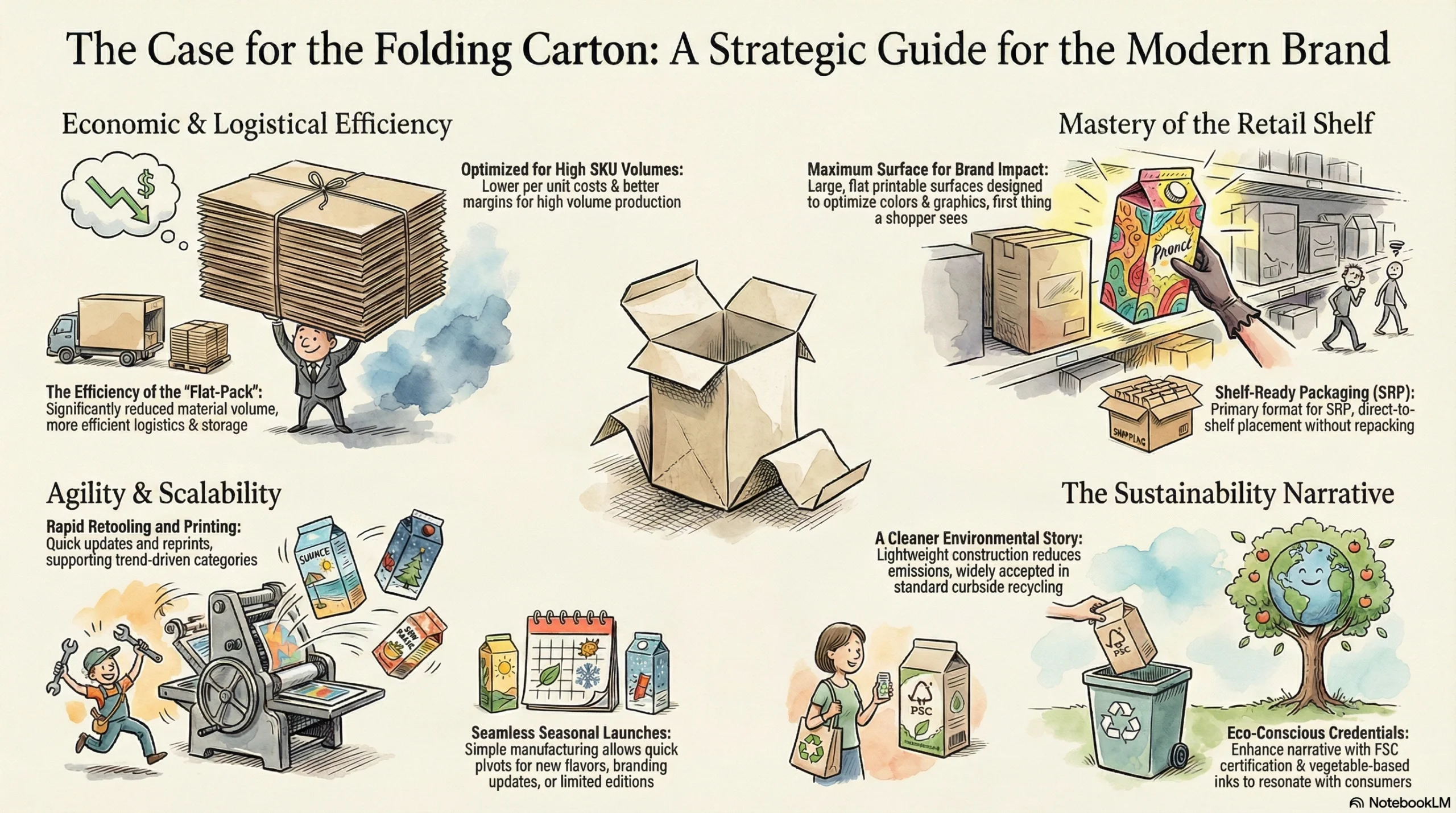
Because folding cartons ship and store flat, they dramatically reduce warehousing costs and freight volume compared to pre-assembled rigid boxes. They are highly versatile, offer excellent printable surface area, and are the dominant packaging format for high-volume consumer goods worldwide.
Common Folding Carton Styles
Straight tuck end (STE) — both top and bottom tuck in the same direction; common in cosmetics
Reverse tuck end (RTE) — top and bottom tuck in opposite directions; widely used in pharmaceuticals
Auto-bottom boxes — self-locking base for heavier contents
Gable top boxes — iconic milk carton-style used for food and beverage
Sleeve boxes — a sleeve that slides over an inner tray, a mid-tier alternative to rigid
Industries That Use Folding Cartons
Folding cartons are the backbone of fast-moving consumer goods. The global folding cartons market was valued at USD 188.27 billion in 2025 and is projected to reach USD 320.37 billion by 2035, growing at a CAGR of 5.46%. The food and beverage segment alone accounts for 60.59% of total market share, driven by demand for frozen foods, snacks, baked goods, and ready-to-eat meals. Other major sectors include pharmaceuticals, mass-market health and beauty, consumer electronics accessories, and subscription boxes.
Rigid Box vs. Folding Carton
| Factor | Rigid Box | Folding Carton |
|---|---|---|
| Material | Thick chipboard (1.5–3mm) | Lightweight paperboard (SBS/CUK) |
| Durability | Very high — crush and impact resistant | Moderate — susceptible to denting |
| Cost per unit | Higher ($1–$5+) | Lower (cents to ~$1) |
| MOQ | / | / |
| Customization | Deep structural & finish options | Strong print versatility |
| Unboxing experience | Premium, slow-reveal | Functional, shelf-optimized |
| Shipping efficiency | Low (pre-assembled, bulky); high if collapsible | Excellent (ships flat) |
| Sustainability | Improving; FSC-certified options | Easier to certify recyclable |
| Best for | Luxury, gifting, D2C, fragile items | Retail, FMCG, high-volume SKUs |
Material & Structural Durability
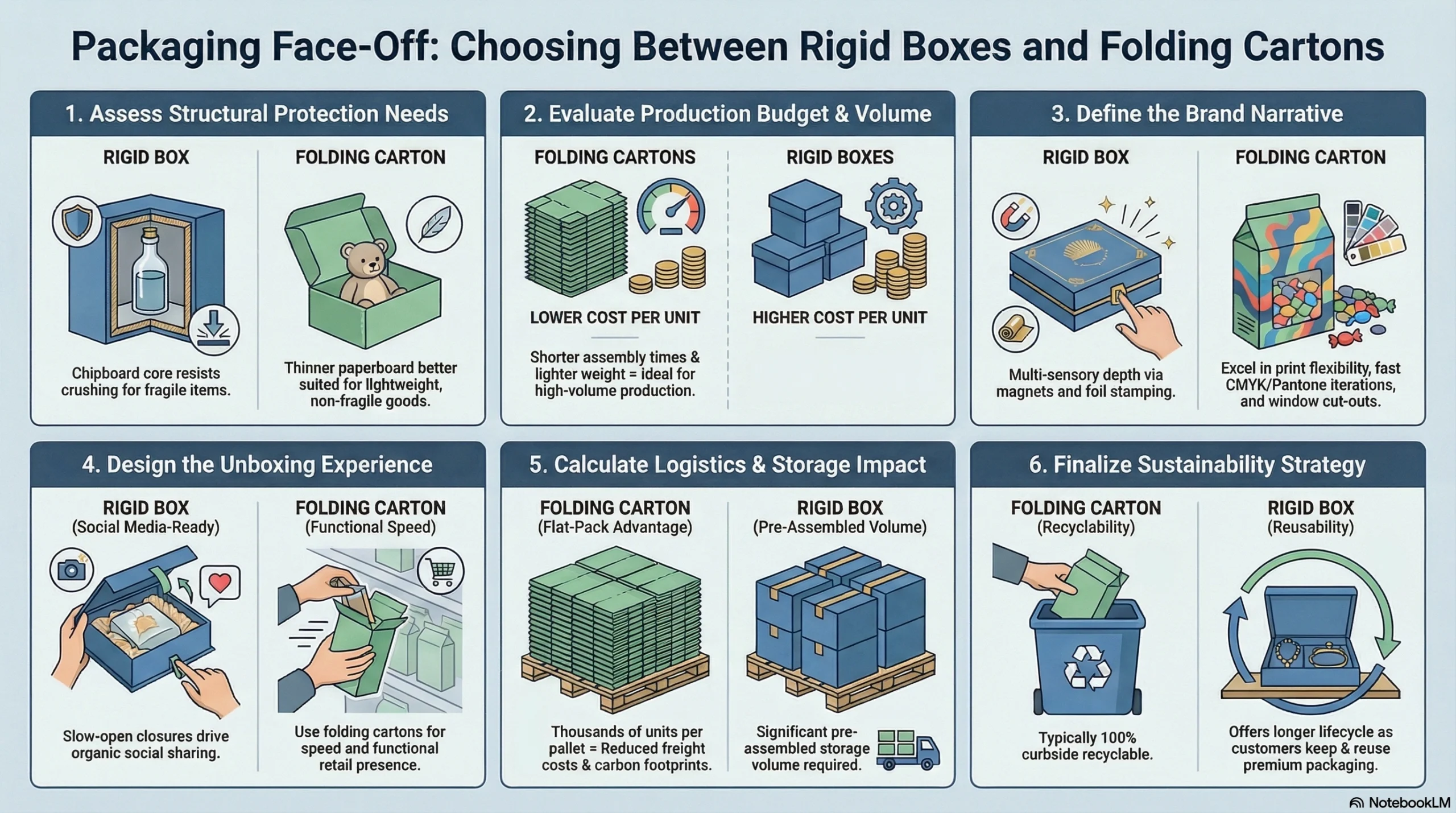
Rigid boxes are built to protect. Their chipboard core resists crushing and impact, making them ideal for fragile or high-value products that cannot afford damage in transit. The structure itself provides containment, which means brands often need less internal void fill, reducing both cost and waste.
Folding cartons, by contrast, are made from thinner paperboard and are more vulnerable to denting, moisture, and compression. For lightweight goods that don’t require heavy structural protection, this is rarely an issue. But for anything fragile, additional inserts or inner trays are typically required.
Verdict: Rigid boxes win on pure structural protection.
Cost & Minimum Order Quantities
Cost is often the deciding factor, especially for emerging brands. Folding cartons are significantly more affordable per unit — their flat-pack production process, shorter assembly time, and lighter material weight all contribute to lower manufacturing and shipping costs.
Rigid boxes require more material, more labor, and more storage volume, which is reflected in their higher price point. However, for premium brands where the packaging is integral to the product’s perceived value, that investment delivers measurable ROI through higher customer satisfaction and repeat purchases.
Verdict: Folding cartons are the smart choice for high-volume, budget-conscious production. Rigid boxes make economic sense when a premium price point supports the investment.
Customization & Branding Potential
Both formats offer strong customization options, but in different dimensions.
Rigid boxes can be enhanced with foil stamping, embossing, debossing, soft-touch lamination, ribbon pulls, magnetic closures, satin interior lining, and custom foam or cardboard inserts. The result is a fully immersive brand environment from the moment the box is touched.
Folding cartons shine in print versatility — full-surface CMYK and Pantone printing, spot UV coatings, gloss or matte varnishes, and window cut-outs are all standard options. Artwork changes are also fast and inexpensive since no structural retooling is required.
Verdict: Rigid boxes offer deeper, multi-sensory brand storytelling. Folding cartons deliver stronger print flexibility and faster iteration.
Unboxing Experience
The unboxing experience has become a legitimate brand marketing channel. Slow-open magnetic closures, ribbon pulls, and lift-off lids generate the kind of moment-of-delight content that drives organic social media sharing and strengthens customer loyalty.
Folding cartons, on the other hand, are engineered for speed and function — they’re designed to be opened quickly at retail or in the home, with the primary branding impact happening on the shelf rather than in the hands of the customer.
Verdict: If your product is discovered online and purchased directly, rigid boxes create a far more powerful and shareable post-purchase experience.
Storage, Shipping & Logistics
This is where folding cartons hold a decisive advantage. Because they ship and store flat, a single pallet of folding carton blanks can hold thousands of units. This dramatically reduces freight costs, warehouse space requirements, and the carbon footprint of transporting packaging before it even reaches a product.
Rigid boxes, being pre-assembled, consume significant storage volume — both at the manufacturer and in your own warehouse. Brands that carry wide SKU ranges need to plan carefully for this overhead. The emergence of collapsible rigid boxes is helping bridge this gap, offering the visual premium of a rigid box with flat-pack logistics efficiency.
Verdict: Folding cartons win decisively on logistics efficiency.
Sustainability & Eco-Credentials
Both formats have made significant strides toward sustainability. Folding cartons are generally easier to certify as 100% curbside recyclable, and their flat-pack shipping reduces transportation emissions.
Rigid boxes are catching up. Brands are increasingly sourcing FSC-certified chipboard, using water-based adhesives, biodegradable wrapping papers, and soy-based inks. The key is that the rigid box’s longevity works in its favor from a lifecycle perspective — customers keep and reuse them, extending the life of the packaging material well beyond a single use.
When Should You Choose a Rigid Box?
You Sell a Luxury or Premium-Priced Product
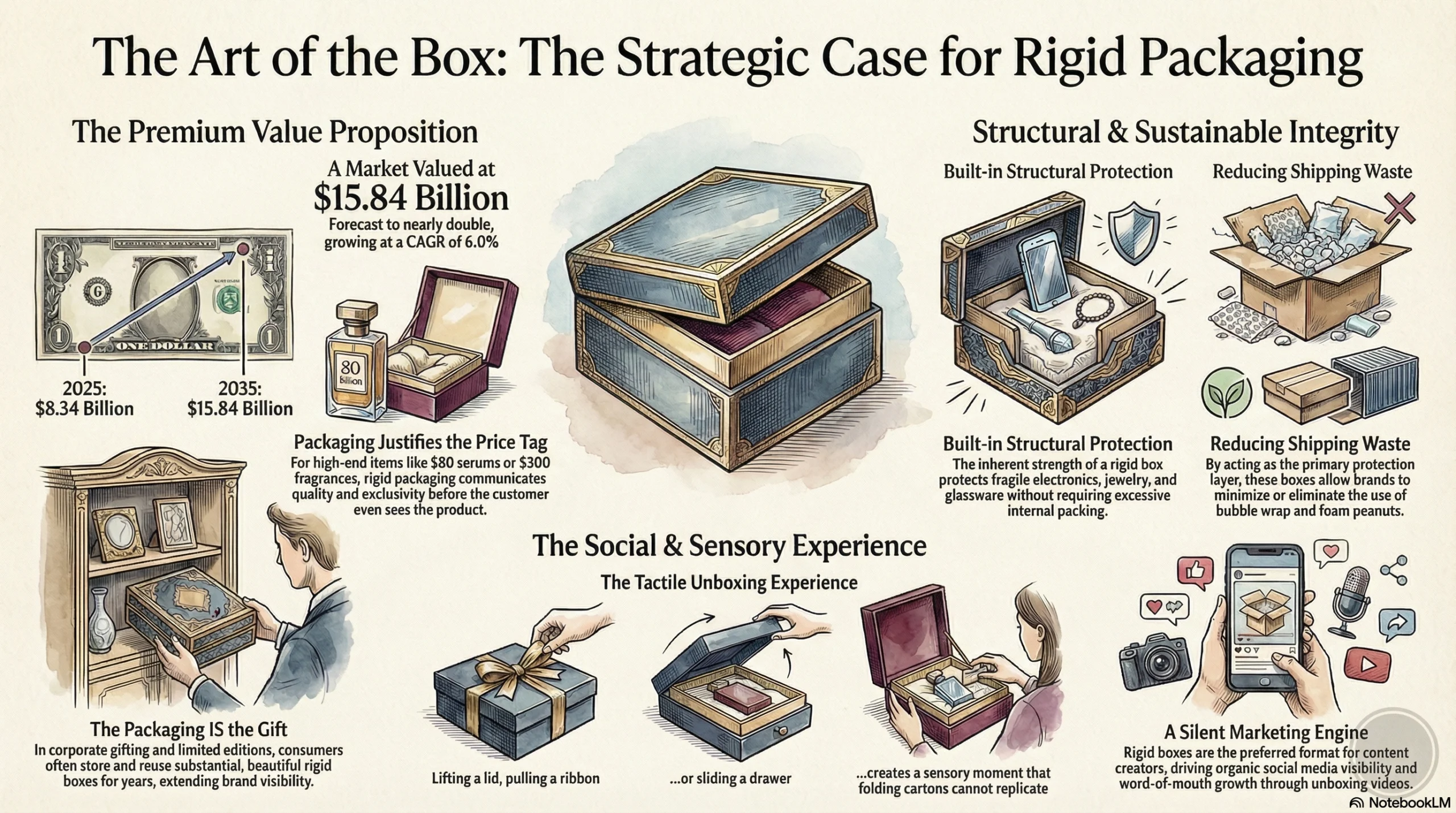
Packaging must justify the price. When a customer pays $80 for a skincare serum or $300 for a fragrance, the packaging experience is part of what they’re paying for. A rigid box communicates quality, care, and exclusivity before the product is even seen. The global luxury rigid box market reflects this reality — valued at USD 8.34 billion in 2025, it is forecast to reach USD 15.84 billion by 2035, growing at a CAGR of 6.0%.
Your Packaging IS the Gift
For corporate gifting programs, holiday sets, limited edition releases, and subscription gift boxes, the packaging is not just a container — it is the gift itself. Customers expect the box to be beautiful, substantial, and worth keeping. Many consumers store and reuse rigid gift boxes for months or years, extending your brand’s visibility long after the original purchase.
Your Product Requires Structural Protection
Fragile items, multi-component kits, jewelry, glassware, and electronics all benefit from the rigid box’s structural integrity. Because the box itself acts as the primary protection layer, brands can minimize additional packing materials like bubble wrap or foam peanuts — keeping the presentation clean and reducing waste.
You Want to Drive Unboxing Content & Social Sharing
Rigid boxes are the format of choice for unboxing content creators. The deliberate, tactile experience of lifting a lid, pulling a ribbon, or sliding open a drawer creates a shareable moment that folding cartons simply cannot replicate. If organic social media visibility and word-of-mouth are part of your growth strategy, the rigid box is a silent marketing engine.
When Should You Choose a Folding Carton?
You Have High SKU Volume & Need Cost Efficiency
For brands producing thousands to millions of units annually, folding cartons are the clear financial choice. Lower per-unit costs, shorter production runs, and flat-pack logistics all contribute to better margins — especially important for fast-moving consumer goods brands competing on shelf space.
Your Product Lives on a Retail Shelf
Folding cartons are designed for retail environments. Their large, flat printable surfaces are optimized for shelf impact — the colors, graphics, and product information are the first thing a shopper sees. Shelf-ready packaging (SRP) formats, which allow cases to be placed directly on shelves without repacking, are almost exclusively folding-carton-based.
Fast Turnaround & Scalability Matter
Need to launch a new flavor, update your branding, or spin up a seasonal SKU? Folding cartons can be retooled and reprinted far faster than rigid boxes. The simpler manufacturing process supports agile brand management, which is critical for brands operating in competitive, trend-driven categories.
Sustainability Is Central to Your Brand Identity
For brands whose sustainability credentials are a core value proposition, folding cartons offer a cleaner story. Their lighter weight reduces shipping emissions, their flat-pack format minimizes material volume, and they are widely accepted in curbside recycling programs. Pairing a folding carton with FSC certification and vegetable-based inks gives eco-conscious brands a packaging narrative that resonates with today’s environmentally aware consumer.
Can You Use Both? A Hybrid Packaging Strategy
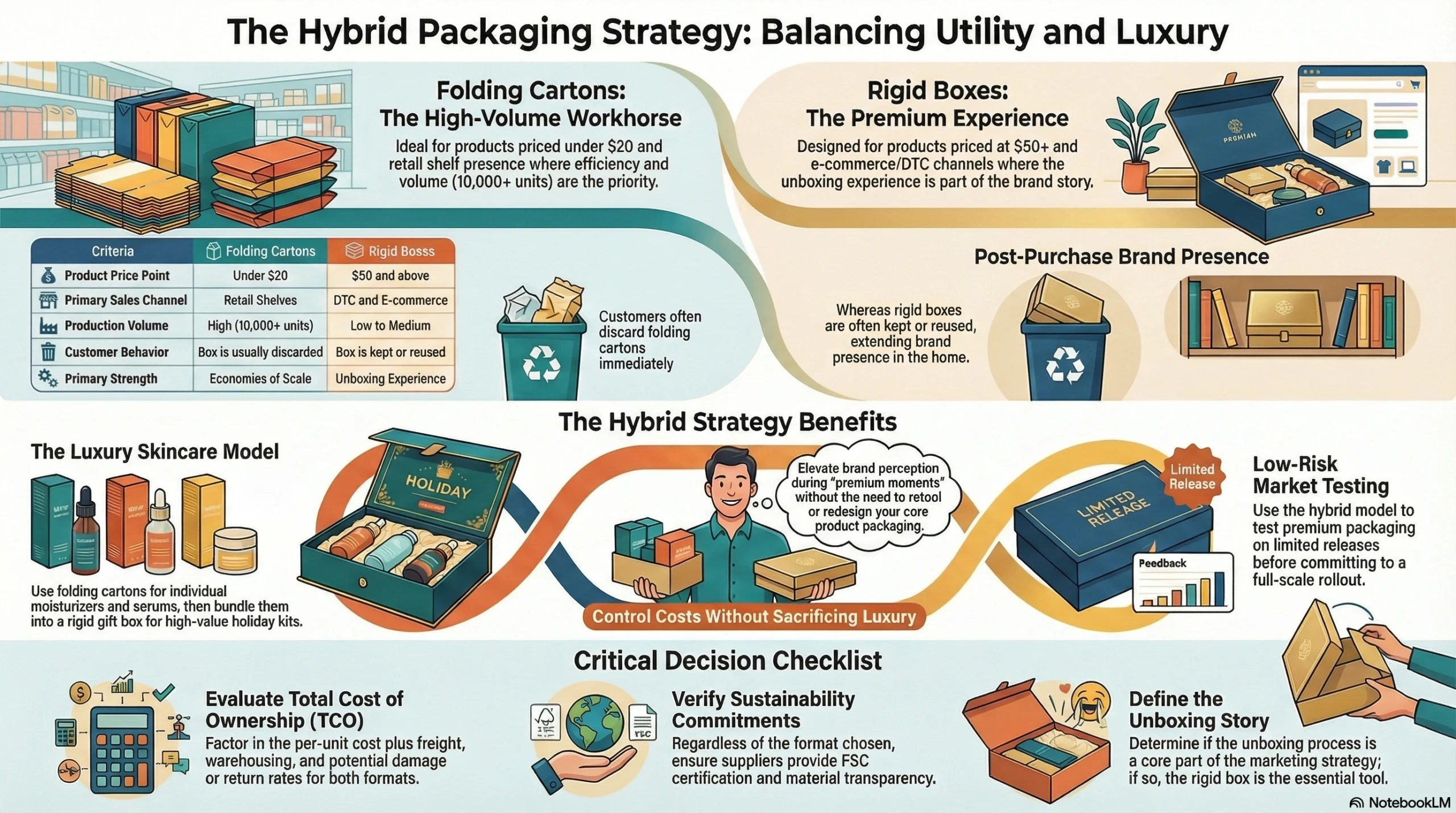
The smartest brands don’t frame this as a binary choice. A hybrid packaging strategy — using folding cartons for everyday SKUs and rigid boxes for premium moments — offers the best of both worlds.
Consider a practical example: a luxury skincare brand uses folding cartons for its individual serums and moisturizers sold through retail and online marketplaces. For the holiday season, the same brand packages those same products together in a custom rigid gift box with a magnetic closure, a satin ribbon, and a personalized insert card. The rigid box transforms an existing product line into a giftable, premium experience — at a fraction of the cost of redesigning the entire product range.
This approach allows brands to:
Control costs by using folding cartons for their highest-volume SKUs
Elevate brand perception through rigid boxes during high-value customer moments
Drive gifting revenue without retooling core product packaging
Test premium packaging on a limited release before committing at scale
Key Questions to Ask Before Making Your Decision
Use this decision-making checklist to guide your packaging strategy:
What is my product’s price point? Products priced under $20 are typically better served by folding cartons; products priced at $50 and above should seriously consider rigid boxes.
Where is my product sold? Retail shelf presence favors folding cartons; direct-to-consumer and e-commerce channels are ideal for rigid boxes.
What is my monthly or annual production volume? High-volume production (10,000+ units) benefits from folding carton economies of scale.
Is the unboxing experience part of my brand story? If yes, a rigid box is your most powerful tool.
What are my sustainability commitments? Both formats now offer credible eco options — ensure your supplier can provide FSC certification and material transparency.
What is my budget for packaging, including shipping and storage? Factor in not just per-unit cost, but the total cost of ownership including freight, warehousing, and any damage/return rates.
Does my customer keep or discard the box? If customers are likely to keep, display, or reuse the box, a rigid box extends your brand presence into their daily lives. If the box is discarded immediately, a well-printed folding carton delivers all the brand impact you need.
Industry Trends Shaping Both Formats in 2026
The packaging industry is evolving rapidly, and both rigid boxes and folding cartons are being transformed by several converging forces.
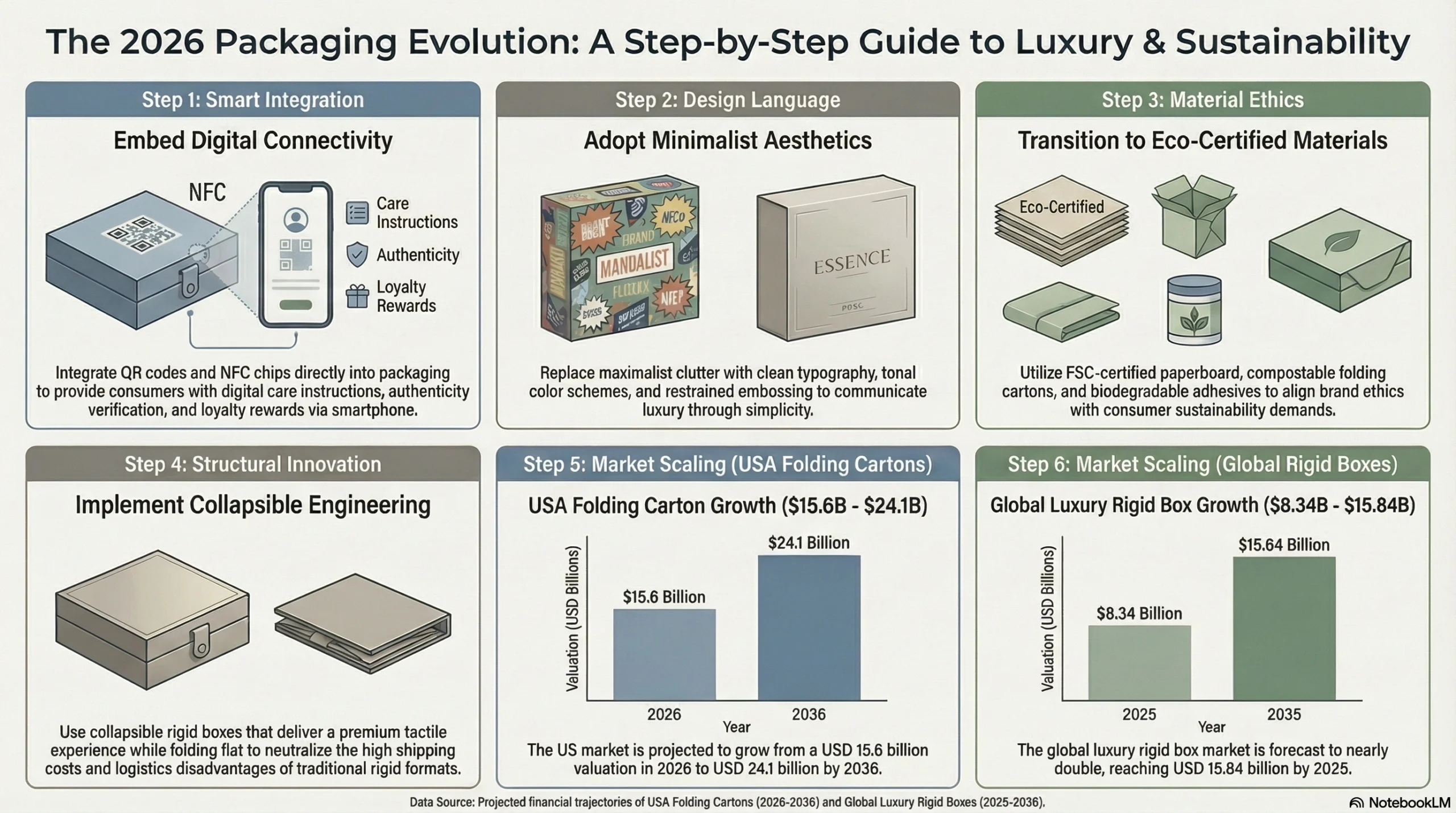
Smart packaging integration is gaining traction across both formats. QR codes and NFC chips embedded in packaging allow brands to deliver digital content — care instructions, authenticity verification, loyalty rewards, or personalized messages — directly from the box to the consumer’s smartphone.
Minimalist design continues to dominate the luxury rigid box segment, with clean typography, tonal color schemes, and restrained use of embossing replacing the ornate, maximalist aesthetics of earlier years. Less is communicating more in premium packaging.
Sustainable luxury is no longer a contradiction in terms. Brands are now investing in FSC-certified rigid boxes, compostable folding cartons, and packaging-free refill systems as consumers increasingly factor brand ethics into their purchase decisions. The luxury rigid box market specifically highlights recyclable paperboard, biodegradable adhesives, and eco-certified materials as key growth drivers going forward.
Collapsible rigid boxes represent one of the most significant structural innovations in recent years. These boxes deliver the tactile premium of a full rigid box but collapse flat for shipping — effectively neutralizing the logistics disadvantage that has historically favored folding cartons for cost-sensitive brands.
The numbers confirm the trajectory: the USA folding carton market alone is estimated at USD 15.6 billion in 2026 and is projected to reach USD 24.1 billion by 2036, while the global luxury rigid box market is forecast to grow from USD 8.34 billion in 2025 to nearly USD 15.84 billion by 2035. Both formats are growing — not competing for the same shrinking pie, but expanding together across an increasingly packaging-conscious global marketplace.
Conclusion: Making the Right Call for Your Brand
There is no universally “correct” answer in the rigid box vs. folding carton debate — only the answer that is right for your brand, your product, and your customer.
Here’s how to remember the core decision:
Choose a rigid box when your product is premium, your customer expects a luxury experience, protection is critical, or your packaging is part of the gift itself.
Choose a folding carton when cost efficiency, retail shelf performance, fast production turnaround, or flat-pack logistics are the driving priorities.
Consider a hybrid strategy when you have a product line that spans both everyday and premium moments — using each format where it delivers the most value.
Packaging is not just a container. It is the first physical touchpoint between your brand and your customer, and it shapes perception, drives repeat purchases, and — when done right — becomes a piece of marketing your customer carries home and keeps.
Ready to find the perfect packaging solution for your brand? Whether you’re exploring custom rigid gift boxes for a premium launch or high-impact folding cartons for retail, our team is here to help you build packaging that works as hard as your product does. Request a free consultation or sample today and let’s bring your brand vision to life.

FAQs
The main difference lies in structure and material. A rigid box is built on a thick chipboard core (1.5mm–3mm) that comes pre-assembled and does not fold flat, making it ideal for luxury and premium products. A folding carton is made from lighter paperboard, manufactured flat, and folded at the point of use — making it cost-efficient and better suited for high-volume retail products. In short, rigid boxes prioritize premium experience, while folding cartons prioritize cost and logistics efficiency.
Yes, rigid boxes generally cost more per unit than folding cartons. Rigid box pricing typically ranges from $1 to $5+ per unit depending on size, material, and finish, while folding cartons can cost as little as a few cents per unit at high volumes. However, the higher cost of rigid boxes is often justified for premium brands, as the enhanced unboxing experience can increase perceived product value, customer satisfaction, and repeat purchase rates.
Rigid boxes are generally the better choice for e-commerce brands selling premium or gift-oriented products. Because the customer never sees the product on a shelf, the unboxing moment becomes the most important brand touchpoint — and rigid boxes are engineered to make that moment memorable.
Folding cartons are a practical option for e-commerce brands with high order volumes and tighter margins, especially when the product itself carries the brand experience rather than the packaging.
Yes, absolutely. Modern rigid boxes can be produced using FSC-certified chipboard, recycled wrapping papers, water-based adhesives, soy-based inks, and biodegradable coatings. Additionally, the long lifespan of a rigid box — customers often keep and reuse them — gives the material a better lifecycle footprint than single-use packaging. When sourcing rigid boxes, always ask your supplier for FSC certification and material transparency documentation to support your brand’s sustainability claims.
A collapsible rigid box — also called a foldable rigid box — is a hybrid packaging innovation that delivers the premium look and feel of a traditional rigid box but is engineered to fold flat for storage and shipping. This makes it one of the most exciting developments in packaging today, as it eliminates the biggest logistical disadvantage of rigid boxes: bulky pre-assembled volume. For brands that want a luxury unboxing experience without the warehousing overhead, collapsible rigid boxes are an excellent and increasingly popular alternative.