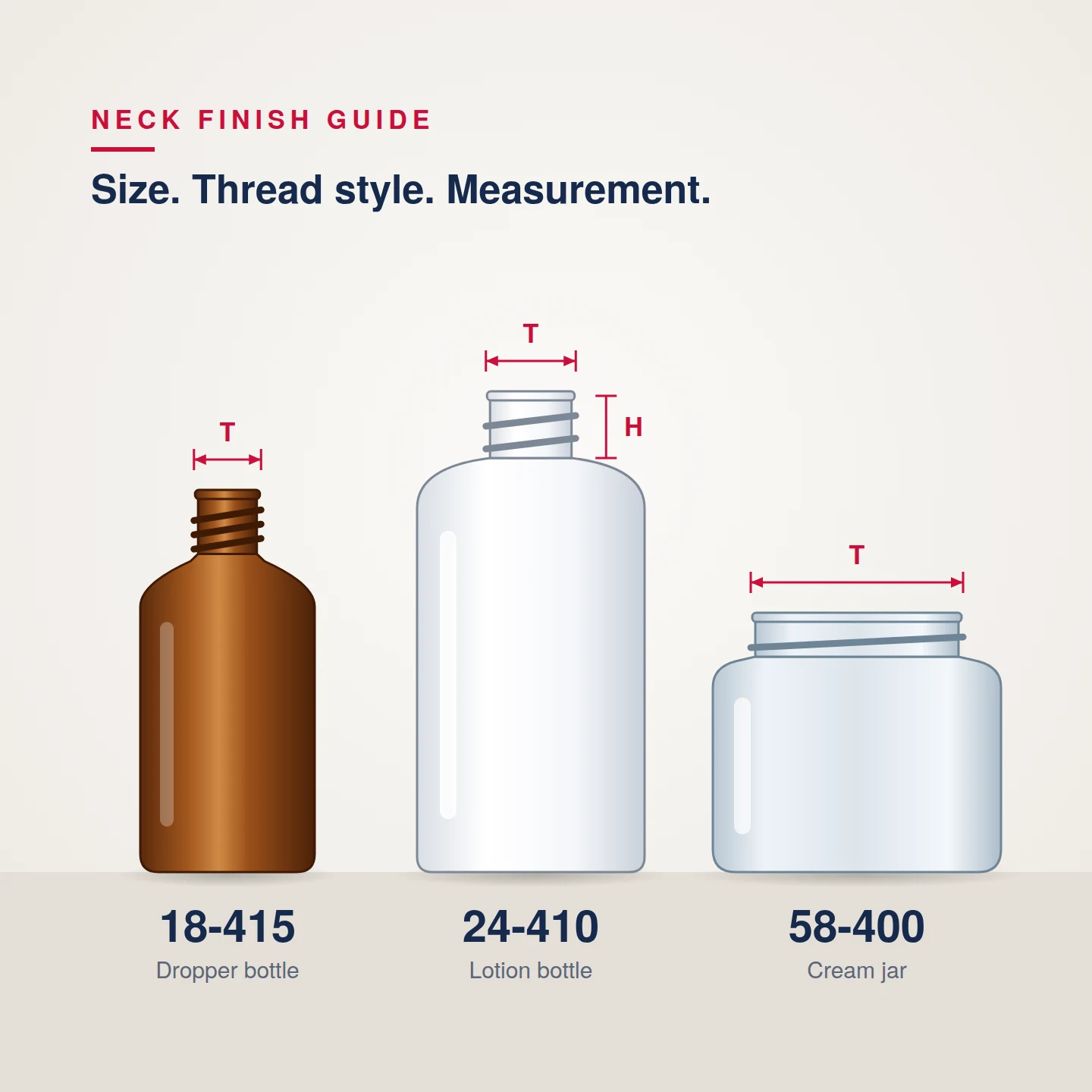













A neck finish code such as 20-410 has two parts. The first number is the outside diameter across the threads in millimeters. The second is the thread style: 400 is one turn of thread, 410 about one and a half, 415 two.
A closure fits when both numbers match. A 20-400 cap will often thread onto a 20-410 neck, but it sits at the wrong height and does not seal as designed.
Every bottle, pump, sprayer, dropper and cap in a beauty range has to agree on one thing: the neck finish. Get it right and components from different production runs fit, seal and dispense the same way. Get it wrong and a pump wobbles, a dropper leaks in transit, or a cap that looked right at the sample stage never quite tightens. This guide explains the codes, the dimensions behind them and how to measure a bottle you already have.
How to Read a Neck Finish Code
Most screw-thread finishes on cosmetic bottles and jars follow a system set by the Glass Packaging Institute (GPI) and the Society of the Plastics Industry (SPI). The code has two numbers separated by a dash or slash, such as 20-410 or 20/410.
- The first number is the nominal T dimension in millimeters: the outside diameter measured across the threads. It is not the size of the opening.
- The second number is the thread style, or finish series. It describes how many turns the thread makes and, with that, how tall the finish is.
So 24-410 means a finish about 24 mm across the threads with roughly one and a half turns of thread. A 24-410 lotion pump or cap is made for exactly that neck.
The Five Neck Dimensions
Behind every code are five measurements. Closure makers design to them, and they are the numbers to check on a drawing before you approve a bottle.
- T is the outside diameter of the thread. It gives the finish its first number.
- E is the outside diameter of the neck below the thread. (T − E) ÷ 2 gives the thread depth.
- I is the inside diameter of the neck. A minimum I is specified so filling nozzles, dip tubes and orifice inserts can pass.
- H is the height of the finish, measured from the top of the neck down to where the T diameter meets the shoulder.
- S is the distance from the top of the finish to the top edge of the first thread. It decides how the closure lines up and how much thread it grips.
Thread Styles: 400, 410 and 415
The three styles you will meet most often in cosmetics differ in how many turns the thread makes, and so in how tall the neck is.
One turn, short neck
The shortest finish. Used across a wide range of sizes, from 18 mm dropper bottles to 89 mm jars.
Typical on jars, Boston rounds and dropper bottles.
About 1.5 turns
A medium-height finish in the 18 to 28 mm range, where pumps and sprayers need a secure, upright fit.
Typical on treatment pumps, lotion pumps and fine mist sprayers.
Two turns, tall neck
The tallest of the three. The H dimension is roughly equal to the diameter, which gives a long, secure thread.
Typical on roll-on bottles and small 13–15 mm necks.
Other series exist, such as 425, 430 (buttress) and lug finishes such as 2030. Their definitions vary between suppliers’ charts, so for anything outside 400, 410 and 415, work from the closure maker’s drawing.
Neck Finish Dimension Chart
The chart below gives the SPI tolerances for plastic bottle finishes, converted from inches to millimeters. Each cell shows the minimum and maximum. Glass finishes follow the GPI standard and differ slightly, and individual molds have their own tolerances, so use this as a reference alongside the drawing.
| Size | T | E | I (min) | S | H · 400 | H · 410 | H · 415 |
|---|---|---|---|---|---|---|---|
| 13 mm | 12.75–13.06 | 11.23–11.53 | 5.54 | 0.56–1.32 | – | – | 11.10–11.86 |
| 15 mm | 14.45–14.76 | 12.93–13.23 | 6.55 | 0.56–1.32 | – | – | 13.77–14.53 |
| 18 mm | 17.48–17.88 | 15.34–15.75 | 8.25 | 0.56–1.32 | 9.04–9.80 | 12.90–13.67 | 15.29–16.05 |
| 20 mm | 19.48–19.89 | 17.35–17.75 | 10.26 | 0.56–1.32 | 9.04–9.80 | 13.69–14.45 | 18.47–19.23 |
| 22 mm | 21.49–21.89 | 19.35–19.76 | 12.27 | 0.56–1.32 | 9.04–9.80 | – | 20.88–21.64 |
| 24 mm | 23.47–23.88 | 21.34–21.74 | 13.11 | 0.79–1.55 | 9.78–10.54 | 16.03–16.79 | 23.93–24.69 |
| 28 mm | 27.13–27.64 | 24.74–25.25 | 15.60 | 0.79–1.55 | 9.78–10.54 | 17.60–18.36 | 27.10–27.86 |
| 33 mm | 31.52–32.13 | 29.13–29.74 | 20.09 | 0.79–1.55 | 9.86–10.62 | – | – |
| 38 mm | 36.88–37.49 | 34.49–35.10 | 25.07 | 0.79–1.55 | 9.86–10.62 | – | – |
| 43 mm | 41.25–42.01 | 38.86–39.62 | 29.59 | 0.79–1.55 | 9.86–10.62 | – | – |
| 48 mm | 46.74–47.50 | 44.35–45.11 | 35.08 | 0.79–1.55 | 9.86–10.62 | – | – |
| 53 mm | 51.61–52.50 | 49.23–50.11 | 40.08 | 0.79–1.55 | 9.98–10.74 | – | – |
| 58 mm | 55.60–56.49 | 53.21–54.10 | 44.07 | 0.79–1.55 | 9.98–10.74 | – | – |
| 63 mm | 61.62–62.51 | 59.23–60.12 | 50.09 | 0.79–1.55 | 9.98–10.74 | – | – |
| 70 mm | 68.61–69.49 | 66.22–67.11 | 57.07 | 0.79–1.55 | 9.98–10.74 | – | – |
| 89 mm | 88.29–89.18 | 85.24–86.13 | 74.12 | 1.14–1.90 | 13.21–13.97 | – | – |
Perfume Necks: FEA Crimp, Snap-On and Screw
Perfume bottles usually use a different system. Their sprayers attach to an FEA neck, named after the Fédération Européenne des Aérosols (European Aerosol Federation). The European standard EN 14854 covers glass neck finishes of around 11, 13, 15, 17, 18 and 20 mm, commonly called FEA 11 to FEA 20.
- Crimp-on: a metal ferrule is crimped permanently onto the neck with a crimping tool. This is the classic sealed perfume bottle.
- Snap-on: the pump snaps onto the FEA neck without crimping.
- Screw-on: a threaded collar screws onto a standard finish such as 18-400 or 20-400. The pump can be removed, which makes the bottle refillable.
FEA 15 is the most common perfume neck, but the neck is chosen for each bottle design rather than by volume. Real 100 ml bottles are produced with FEA 15 necks, and others with FEA 20. Specify the neck, the pump and the collar together, before the bottle mold is cut.
Our guide to crimp neck vs. screw neck perfume bottles compares the two closure types in more detail.
Common Neck Sizes by Package Type
These pairings appear repeatedly in published supplier catalogs. They are starting points: the right neck is the one your bottle, closure and formula were designed for together.
| Package type | Common finishes | Notes |
|---|---|---|
| Glass Boston round dropper bottles | 18-400 (½ oz), 20-400 (1–2 oz), 22-400 (4 oz) | Larger Boston rounds move to 24-400, 28-400 and 33-400 |
| European dropper bottles (5–100 ml) | 18 mm DIN | Longer neck with a ring below the threads; standard 18-400 or 18-410 caps do not seal properly |
| Treatment and serum pumps | 20-410 | Common on 1–4 oz round bottles |
| Lotion pumps | 24-410 | Common on 8–16 oz bottles |
| Fine mist sprayers | 20-410, 22-410, 24-410 | Typical output about 0.14–0.16 cc per spray |
| Perfume sprayers | FEA 13–20 crimp or snap-on; 18-400 to 24-400 screw-on | FEA 15 is the most common |
| Cosmetic jars | 33-400 to 89-400 | For example 48-400 on 1 oz glass jars, 58-400 to 89-400 on larger plastic jars |
| Roll-on bottles (10 ml) | 13-415 | Some designs use a 16 mm neck |
How to Measure a Neck Finish
If you have a sample bottle but no drawing, a caliper is enough to identify the finish.
To measure a cap, measure inside wall to inside wall. Thread depth is (T − E) ÷ 2, so measuring E at the root of the thread tells you whether a neck has shallow or deep threads. For crimp perfume necks, compare against the FEA sizes rather than the GPI/SPI chart.
For Brands: Specifying the Neck With the Closure
Most neck problems that reach a filling line come from choosing the bottle and the closure separately. Jarsking specifies the container, the closure and the dispensing system as one set, so the neck finish, liner, dip tube and dosage are matched before production starts.
Browse our droppers, pumps, fine mist sprayers, closures and caps and perfume bottles, or send us your bottle details and we will match the closure.
Frequently Asked Questions
What does 20-410 mean on a bottle?
It describes the neck finish. The first number, 20, is the T dimension: the outside diameter across the threads in millimeters. The second number, 410, is the thread style: about one and a half turns of thread. A 20-410 closure fits a 20-410 neck.
Will a 20-400 cap fit a 20-410 bottle?
It will usually thread on, because both share the same 20 mm diameter, but it will not seal as intended. A 400 finish is a shorter neck with one turn of thread, while a 410 finish is taller with about one and a half turns, so the cap skirt and liner sit at a different height. Match both numbers.
How do I measure a bottle neck size?
Use a caliper. Measure straight across the outside of the threads, through the center, including the threads. That is the T dimension and the first number of the finish. Then count how many times the thread wraps around the neck to identify the thread style: one turn suggests 400, about one and a half suggests 410, two suggests 415.
What neck size do perfume bottles use?
Perfume bottles with crimp-on sprayers use FEA neck finishes, named after the European Aerosol Federation. EN 14854 covers FEA 11, 13, 15, 17, 18 and 20. FEA 15 is the most common, but the size is chosen for each bottle design, so a 100 ml bottle can have an FEA 15 or an FEA 20 neck. Refillable perfume bottles often use a screw neck instead.
What neck size do dropper bottles use?
Glass Boston round dropper bottles commonly use 18-400 on small sizes and 20-400 or 22-400 on larger ones. European-style dropper bottles use an 18 mm DIN finish with a longer neck and a ring below the threads, which a standard 18-400 or 18-410 closure will not seal properly.
Sources
- ASTM, D2911, Dimensions and Tolerances for Plastic Bottles (the SPI finish standard)
- CEN, EN 14854, neck finishes for aerosol and spray glass containers (FEA necks)
- Aptar, VP4 fragrance pump (crimp, snap-on and screw-on fixations)
- Published neck finish guides and catalogs from Berlin Packaging, eBottles, SKS Bottle & Packaging, Saxco and Container & Packaging (dimension definitions, SPI chart, thread styles and common pairings)