











How We Verify Every Eco-Friendly Material Performs
Choosing sustainable packaging introduces a new layer of performance risk. Recycled content, plant-based polymers, and natural materials behave differently from conventional options — under UV light, humidity, temperature stress, and direct formulation contact. Every eco material Jarsking supplies is put through a rigorous physical and chemical testing protocol before it is approved for production.
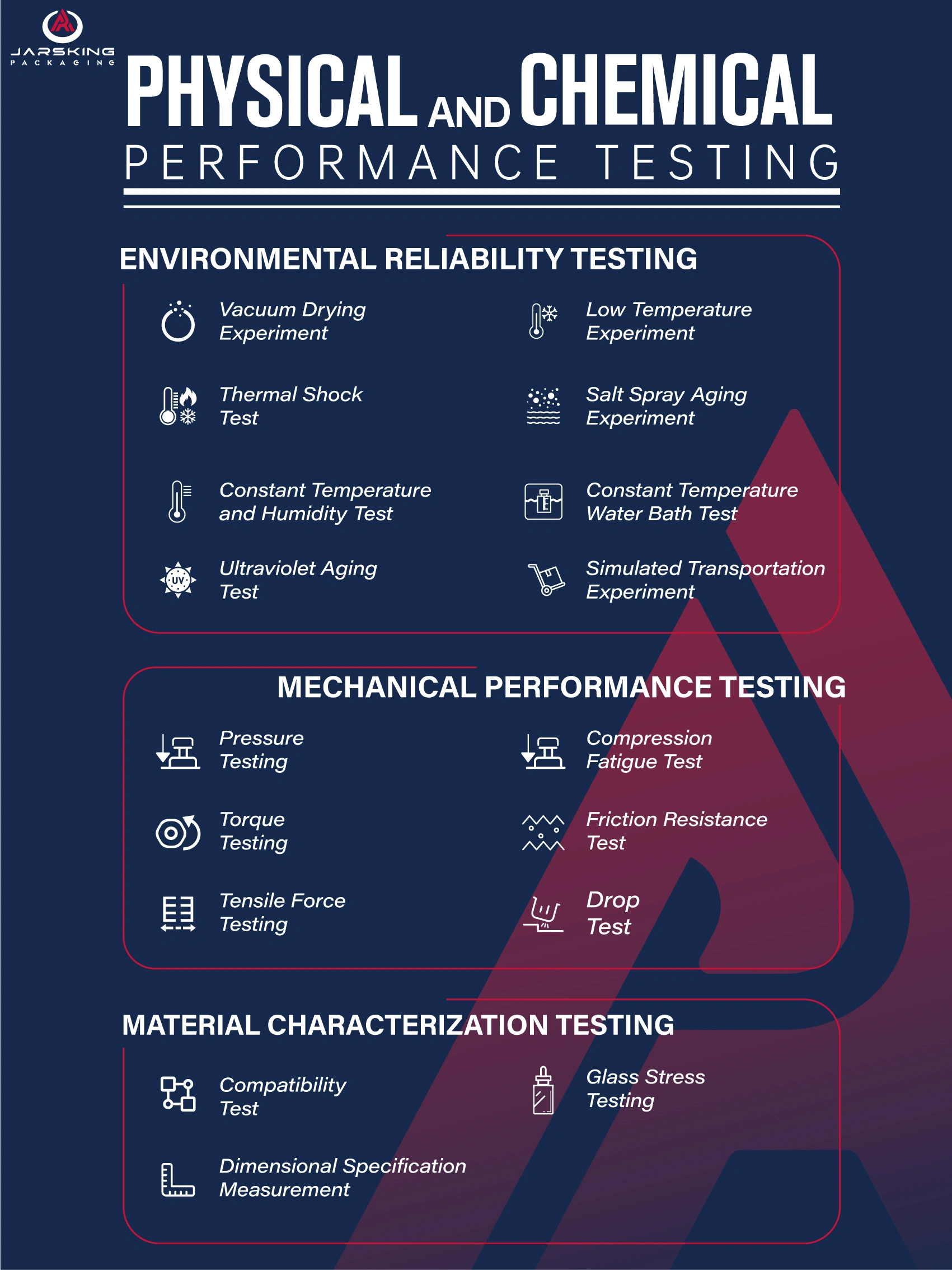
UV Aging Test
Eco materials are more UV-vulnerable than virgin plastics — this test proves yours won’t fail on shelf. PCR plastic, PLA bioplastic, and bamboo-composite packaging are exposed to concentrated UV radiation cycles that simulate months of sunlight exposure in compressed time. We measure color fading, surface chalking, structural weakening, and closure integrity before and after exposure.
Why it’s critical for eco materials:
PCR plastic contains recycled polymers with variable UV stabilizer levels — this test confirms batch-to-batch consistency
PLA bioplastic can become brittle under prolonged UV exposure if not correctly formulated
Bamboo-composite surfaces are prone to bleaching and micro-cracking under UV without proper sealing
Pass criteria: No visible discoloration, no measurable loss of tensile strength, and no compromise to closure torque after the full UV exposure cycle.
Thermal Shock Test
Temperature swings during global shipping are one of the most overlooked failure risks for eco packaging. Materials are cycled rapidly between extreme heat and cold to simulate the journey from a tropical distribution center to a refrigerated retail environment. Glass, aluminum, PLA, and PCR plastic are all evaluated for cracking, seal failure, and structural deformation.
Why it’s critical for eco materials:
PLA bioplastic has a lower heat deflection temperature than conventional plastics — thermal shock testing confirms it won’t warp in warm transit conditions
Glass is highly susceptible to thermal shock cracking; this test validates wall thickness and annealing quality of each batch
Aluminum tubes must maintain their rolled-edge seal integrity across temperature extremes
Pass criteria: Zero cracking, no delamination, no leakage, and no visible warping after a complete hot-to-cold thermal cycling sequence.
Constant Temperature and Humidity Test
Natural and recycled materials are more moisture-sensitive than conventional plastics — this test sets the baseline. Bamboo, FSC-certified paper secondary packaging, and CaCO₃-blended PP are held at sustained high-temperature and high-humidity conditions to assess moisture permeability, dimensional stability, surface delamination, and label adhesion performance.
Why it’s critical for eco materials:
Bamboo and FSC paper are hygroscopic — they absorb ambient moisture, which can cause warping, swelling, or mold growth if not properly sealed or coated
CaCO₃ PP (stone paper) must maintain its dimensional stability under humidity to ensure consistent closure torque
PCR HDPE barrier performance must be validated against virgin HDPE benchmarks, as recycled content can introduce micro-permeability
Pass criteria: Zero dimensional distortion beyond tolerance, no surface delamination, stable closure torque readings before and after conditioning.
Simulated Transportation Experiment
Eco-friendly materials are often chosen partly for their lighter shipping weight — but lightweight must never mean fragile. Using vibration tables and standardized drop-sequence protocols modeled on road, air, and last-mile courier conditions, this test validates that every eco material survives the full logistics journey without structural failure or seal compromise.
Why it’s critical for eco materials:
Glass, while infinitely recyclable, has a higher breakage risk during transit than plastic — this test validates wall thickness and carton protection specifications
PCR plastic and PLA containers must absorb the same transit stress as their virgin counterparts, at equivalent wall thicknesses
Bamboo-composite lids and closures are tested for hinge and thread integrity across the full drop sequence
Pass criteria: No breakage, no leakage, no closure failure, and no cosmetic damage across all simulated transit orientations.
Drop Test
A single drop in a consumer’s bathroom should never end in a broken product — regardless of how sustainable the material is. Packaging units are dropped from standardized heights onto hard surfaces at multiple orientations — base, side, shoulder, and closure — to assess impact resistance and post-drop seal integrity.
Why it’s critical for eco materials:
Glass requires validated wall thickness and base geometry to absorb impact without shattering
PLA bioplastic is more brittle than ABS or PP at low temperatures — drop testing is conducted across both ambient and cold conditions
Refillable systems (pumps, airless dispensers) must maintain full mechanical function after the drop sequence, since they are designed for repeated long-term use
Pass criteria: No fractures, no lid separation, no pump or dispenser failure, and no formulation leakage across all drop orientations.
Salt Spray Aging Experiment
Aluminum packaging destined for humid or coastal retail markets must prove its corrosion resistance. The Salt Spray Aging Experiment subjects aluminum tubes, bottles, and caps to a continuous saline mist environment to evaluate surface corrosion, coating adhesion, and print durability over an accelerated time period.
Why it’s critical for eco materials:
Aluminum is the most recyclable material in our portfolio — but its surface coating and anodization must hold up under marine or high-humidity retail conditions
Surface decoration (hot stamping, silkscreen, lacquer coating) on aluminum must remain intact; peeling or blistering under salt spray is a fail
Pass criteria: No base metal corrosion, no coating delamination, and no print degradation after the full salt spray exposure cycle.
Tensile Force Testing
Eco materials must maintain structural integrity under the pulling and stretching forces they experience in daily use. Tensile Force Testing measures how much force is required to separate a container from its closure, pull apart a laminate layer, or stretch a flexible tube wall to its breaking point. This test is especially important for materials with variable batch-to-batch consistency, such as PCR plastic.
Why it’s critical for eco materials:
PCR plastic has variable polymer chain lengths depending on the recycled feedstock — tensile testing confirms consistent structural performance across batches
PLA bioplastic has a lower elongation-at-break than conventional PET; tensile testing validates it meets the minimum threshold for pump and dropper bottle applications
FSC-certified paper components used in secondary packaging must achieve minimum tear resistance to protect primary containers in transit
Pass criteria: All tensile and elongation values meet or exceed the minimum specification defined for the material grade, across a statistically valid sample size per batch.
Compatibility Test
The most dangerous failure in eco packaging is invisible: your formulation slowly reacting with a recycled or bio-based material. Your actual formulation — or a certified benchmark equivalent — is placed directly inside the selected eco material and held at accelerated temperature conditions for 3 to 6 months. Both the packaging and formulation are evaluated at regular intervals.
Why it’s critical for eco materials:
PCR plastic may contain trace residual contaminants from previous use cycles that can interact with active ingredients — particularly AHAs, retinols, and essential oils
PLA bioplastic has different chemical resistance properties from PET; it performs well with water-based formulations but requires validation with oil-rich or high-concentration actives
Bamboo-composite packaging must be confirmed to have zero tannin migration into formulations in contact with the inner liner
Monitored parameters: pH, color, odor, viscosity, active ingredient concentration, and visible material changes.
Pass criteria: Zero measurable change in formulation integrity; no visible material swelling, softening, or leaching after the full test duration.
Dimensional Specification Measurement
A 0.1mm deviation in a recycled-material bottle neck can make your closure incompatible across your entire production run. Using precision measurement instruments including Coordinate Measuring Machines (CMM) and optical comparators, every critical dimension — neck diameter, wall thickness, height, and thread pitch — is verified against approved engineering drawings before production approval.
Why it’s critical for eco materials:
PCR plastic and CaCO₃ PP can exhibit slightly different shrinkage rates than virgin materials during molding — dimensional verification catches this before tooling is committed
Bamboo-composite components have natural dimensional variability that must be controlled to tight tolerances for consistent closure function
Refillable systems demand the tightest dimensional control of any packaging format — because the consumer will re-insert a refill pod hundreds of times over the product’s life
Pass criteria: All critical dimensions fall within ±tolerance specifications. Cpk values confirm process capability is maintained at production scale.