













Neither closure wins every crimp neck vs screw neck perfume bottles comparison. A crimp neck is usually the stronger fit when the pump will remain permanently attached and the filling partner operates a validated crimping process. A screw neck is usually the more adaptable choice when deliberate reopening, pump removal, or a defined refill experience belongs in the product brief.
The bottle drawing alone cannot make this decision. The correct neck finish must work with the pump, ferrule, gasket, decorative collar, cap, fragrance, filling equipment, distribution conditions, and intended consumer behavior. Approving any of those elements separately creates a packaging system that may look resolved in a rendering but fail during filling or use.
The practical rule is simple: choose the neck finish from the operating model backward—not from the bottle silhouette forward.
Key takeaways
– A crimp neck normally creates a non-removable pump assembly through controlled deformation of a metal ferrule around the glass finish.
– A screw neck uses a threaded closure or ferrule, making removal possible—but not automatically making the bottle refillable.
– The decorative cap is not normally the primary liquid seal. The critical interface is the glass finish, gasket, pump, and applied closure.
– Crimp performance depends on crimp tooling, setup, dimensional control, and repeatable application.
– Screw performance adds thread engagement, application torque, torque retention, and repeated-opening behavior to the validation plan.
– If refill is on the roadmap, decide the refill model before freezing the bottle mold, pump, collar, and cap.
Crimp neck vs screw neck perfume bottles at a glance
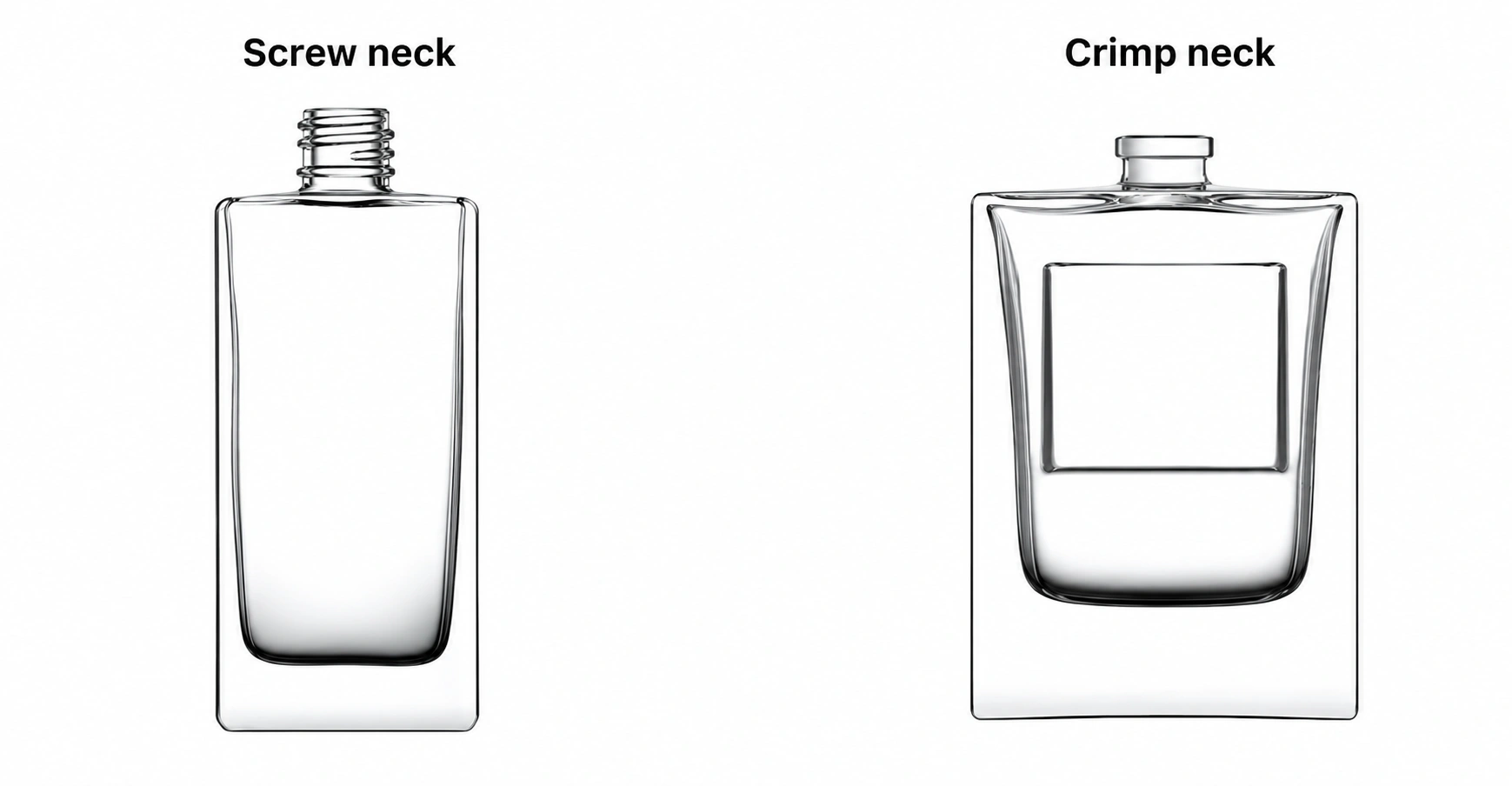
The main difference is how the atomizer assembly is attached and whether the package is intended to be reopened after filling.
| Decision factor | Crimp neck | Screw neck |
|---|---|---|
| Attachment method | A metal ferrule is mechanically formed around the glass neck finish | A threaded ferrule or closure is rotated onto a matching threaded finish |
| Opening after filling | Normally treated as a permanent assembly | Designed to be removable when reopening is part of the brief |
| Filling-line requirement | Compatible crimping equipment, tooling, setup, and inspection | Controlled threaded application and project-defined torque method |
| Refill potential | Limited in a conventional permanent-pump configuration | More adaptable to selected refill models |
| Tamper strategy | Permanent attachment can discourage casual opening, but formal tamper evidence requires separate validation | Reclosability may require an additional tamper-evident feature |
| Primary controls | Neck dimensions, ferrule geometry, gasket compression, crimp application | Neck dimensions, thread fit, gasket compression, application torque, torque retention |
| Typical hidden risk | A decorative collar can conceal an incorrect or inconsistent crimp | A closure can feel tight initially but loosen after storage, vibration, or repeated use |
| Best starting question | Can the filler apply and inspect this pump consistently? | Who needs to reopen the bottle, how often, and why? |
Neither system is inherently leak-proof. Test liquids, storage conditions, line settings, sampling plans, and acceptance criteria must be confirmed per project.
What actually seals a perfume bottle?
The decorative cap rarely seals the fragrance. The bottle–gasket–pump interface performs the critical containment work.
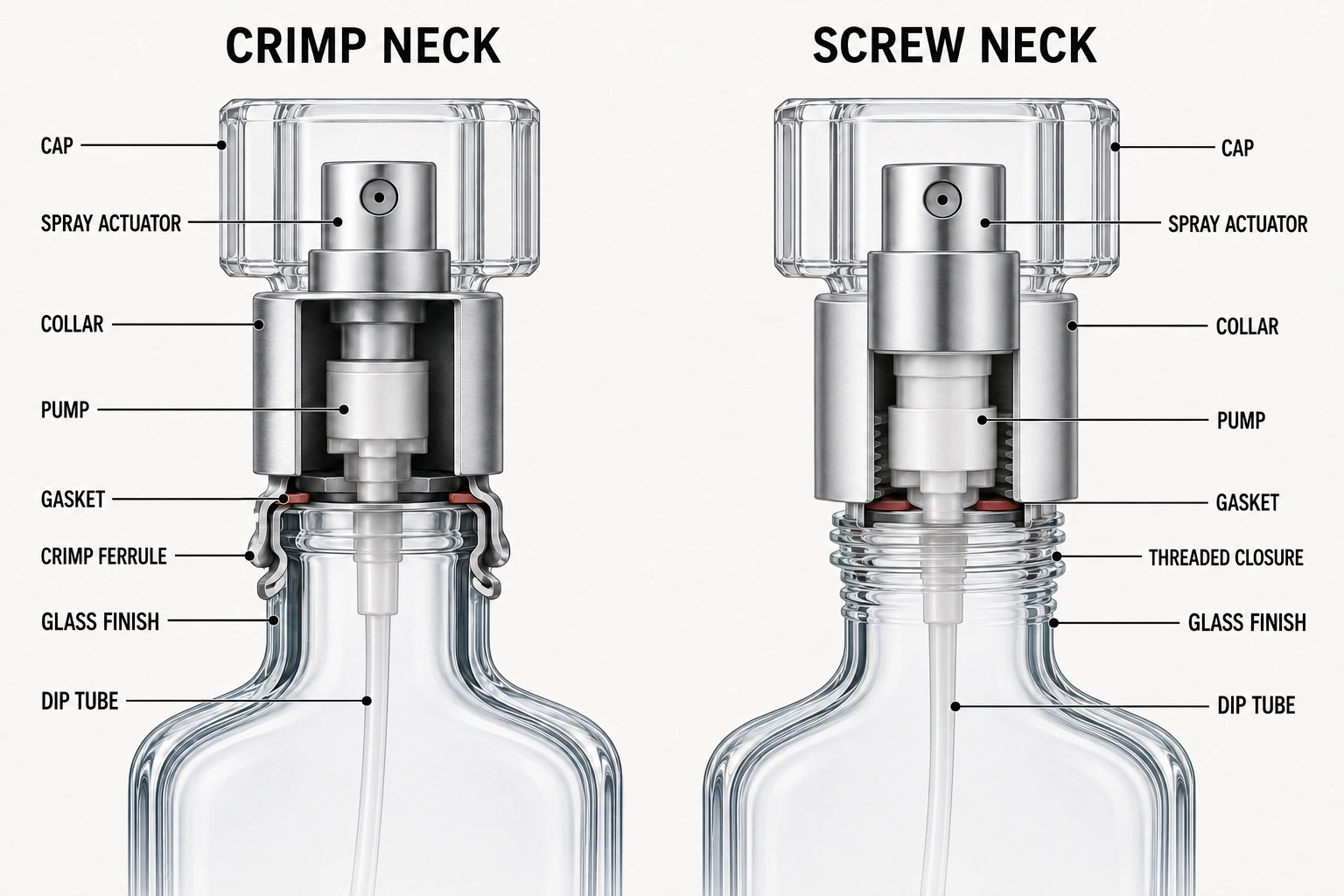
A typical perfume spray system brings several components into a very small area:
- Glass neck finish
The molded glass geometry receives the pump assembly. Its dimensions must match the selected ferrule, gasket, and application process.
- Gasket
The gasket is compressed between compatible surfaces to create the seal. Its material must be evaluated with the actual fragrance or an approved representative test liquid.
- Atomizer pump
The pump contains the valve and dispensing mechanism, including the actuator and dip tube. It must be evaluated for spray behavior as well as closure compatibility.
- Ferrule
The ferrule is the component that is crimped or screwed onto the bottle finish.
- Decorative collar
The collar covers or integrates the pump connection. It contributes to appearance, but it can also affect pump height, cap engagement, and assembly.
- Cap
The cap protects the actuator and creates an important tactile interaction. Its retention system is separate from the primary liquid seal.
A cap can fit beautifully while the closure underneath is wrong. Conversely, a pump can seal correctly but sit too high for the approved collar, creating a visible gap or preventing the cap insert from engaging.
That is why “the bottle passed” and “the pump passed” do not necessarily mean “the complete package passed.”
Why tolerance stacking matters
Tolerance stacking occurs when permitted variation in several components accumulates in one assembly.
In a fragrance package, relevant interfaces include:
- The glass finish and ferrule
- The glass sealing surface and gasket
- The pump height and decorative collar
- The collar and cap insert
- The bottle shoulder and box insert
- The applied closure and filling-line handling system
Consider a pump that sits slightly higher within its permitted range, a collar that is slightly shorter, and a cap insert that is slightly shallower. Each component may be acceptable individually, but the assembled cap may no longer seat correctly.
The request for quotation should therefore describe a matched component system, not a shopping list of visually compatible parts.
If the bottle, pump, collar, and cap come from different sources, physical cross-validation should happen before final approval.
How a crimp neck perfume bottle works
A crimp neck uses controlled mechanical forming to secure an aluminum ferrule around a compatible glass finish.
During assembly, the pump and gasket are placed on the bottle. A crimping tool forms the ferrule under and around the intended part of the neck finish. A decorative collar may then cover the ferrule and complete the visible design.
CETIE’s bottling guidance describes specific rules for crimping an aluminum pump ferrule on an FEA-type glass finish used in perfumery. It also distinguishes crimping with a dedicated tool from application using rotating heads.
In other words, “crimped” is not one universal process. The bottle finish, ferrule, gasket, application equipment, and inspection method must belong to the same controlled system. Review CETIE Guide No. 12.
When crimp necks make sense
A crimp neck is a logical starting point when:
- The pump is intended to remain attached for the life of the product.
- The filling partner already operates compatible crimping equipment.
- The component set is developed around a recognized finish architecture.
- The brand wants a conventional prestige-fragrance presentation.
- Consumer refill or pump removal is not part of the current business model.
A crimped system can create a clean, compact connection that is easily covered by a collar. Its familiarity in commercial fragrance packaging, however, should not be confused with automatic performance.
The applied closure still depends on the glass finish, ferrule, gasket, tooling, line setup, inspection method, and fragrance compatibility.
Crimp-neck risks buyers overlook
The filler is consulted too late.
The selected pump may need tooling, handling equipment, or inspection capabilities that the proposed filling line does not have.
The collar hides the connection.
A decorative sleeve can cover the ferrule before the applied closure has been measured and documented. The result may look finished while concealing an incorrect application.
One sample becomes the specification.
A carefully prepared prototype does not prove that the closure can be applied consistently across production.
A nominal finish name replaces the drawing.
A general designation such as “15 mm crimp” is not a substitute for a controlled neck-finish drawing, compatible pump specification, and agreed application method.
Removal is assumed to be harmless.
A conventional crimped pump is not designed to be repeatedly removed and reapplied by the consumer. Removing it may deform the ferrule or disturb the sealing system.
For a deeper discussion of leakage, loose caps, and poor atomizer behavior, see Jarsking’s guide to why perfume packaging fails.
How a screw neck perfume bottle works
The pump assembly is rotated onto a compatible threaded finish until the project-defined application condition is reached. Unlike a conventional crimped ferrule, the assembly can be intentionally removed.
That property creates new options, but it also introduces additional variables.
When screw necks make sense
A screw neck is a logical starting point when:
- The pump must be removable for a defined reason.
- At-home refill is part of the consumer journey.
- The package needs to be serviced or separated into components.
- The filling operation is designed around controlled threaded application.
- The brand wants to preserve a credible pathway to a future refill format.
The main benefit is not simply easier assembly. It is controlled reversibility.
If no one has defined who will reopen the bottle, how it will be refilled, and how the closure will be reapplied, reversibility is merely an untested feature.
Screw-neck risks buyers overlook
“Hand tight” is not a production specification.
A screw-neck development plan should address:
- Matching bottle and closure threads
- Sufficient and repeatable thread engagement
- Gasket compression
- Application torque
- Removal torque and torque retention
- Resistance to unintended loosening
- Consumer opening force and grip
- Repeated opening and reclosing
- Interaction with the collar and cap
- Tamper evidence, when required
ASTM D2063/D2063M-24 is one recognized method for measuring removal torque and torque retention in continuous-thread container and closure systems under controlled conditions.
The standard does not prescribe the correct torque for a perfume bottle. The applicable method and acceptance range must be agreed for the actual bottle, closure, gasket, filling process, and intended use. View the ASTM standard record.
Does a screw neck automatically make a bottle refillable?
No. A removable pump creates access; refillability requires a complete, repeatable operating system.
| Refill model | Who handles the bottle? | Neck-finish implication | Questions to resolve |
|---|---|---|---|
| At-home refill | Consumer | Usually requires intentional reopening and reliable reclosing | Instructions, spill control, repeated cycles, refill package, tamper strategy |
| Retail refill | Consumer or trained staff | Must work with the refill station and operating procedure | Container eligibility, hygiene information, dosing, inspection |
| Brand-controlled return and refill | Brand or service partner | Consumer removal may not be necessary | Collection, reconditioning, traceability, replacement criteria |
| Replaceable inner unit | Consumer replaces an inner bottle or cartridge | The decorative outer package can remain in use | Fit, orientation, locking, separation, refill availability |
A credible refill brief defines:
- What part of the package is reused
- Who opens the bottle
- How the fragrance is transferred
- How spills are controlled
- How the bottle is reclosed
- How many cycles the closure must survive
- How the user identifies the correct refill
- What happens to the refill container
- How tamper evidence works after the first opening
Without these decisions, “refillable” describes an opening rather than a functioning business model.
EU Regulation 2025/40 treats refill and reuse as systems rather than labels. Where refill is offered, the regulation includes requirements involving suitable containers, hygiene information, and user responsibility.
It does not mean every perfume bottle must use a screw neck or become refillable. It does mean that a refill claim should be supported by a real operating design. Read Regulation (EU) 2025/40.
Can a brand preserve the option to switch later?
Selected interchangeable neck-finish systems can preserve a migration path between crimp and screw closures, but only within a defined architecture.
CETIE’s published GME40.20 screw finish covers nominal neck-finish diameters around 13, 15, and 17 mm. The related GME40.25 and GME40.30 finishes with an additional bead are designed to:
- Support interchangeability between selected screw and crimp variants
- Retain surrounding components such as collars and caps when switching
- Enable refilling with a plastic screw ferrule
CETIE uses SNI 15 for Screw Neck International diameter 15 and CNI 15 for Crimped Neck International diameter 15. Review CETIE’s published finish records.
This does not mean any nominally 15 mm pump, collar, cap, or mold is automatically interchangeable. The published geometry, component drawings, ferrule material, bottle mass, and glassmaker validation still govern the project.
CETIE also notes that its screw finish without the additional bead is not compatible with heavy bottles. The bottle-weight limit must be validated with the glassmaker according to the bottle shape.
That detail matters in prestige fragrance, where a heavy glass bottle is often treated as a luxury signal.
Choose the closure from the operating model backward
The filling partner should enter the project before the neck finish, pump, collar, and cap are frozen.
A practical development sequence is:
- Define the business model.
- Confirm filling and assembly capabilities.
- Select the neck-finish architecture.
- Match the pump, ferrule, and gasket.
- Develop the collar and cap around the approved closure stack.
- Validate the formula, filling operation, consumer use, storage, and transport conditions.
- Convert the approved system into controlled production specifications.
Confirm the filling operation
Ask the filler:
- Does the line apply crimped assemblies, threaded assemblies, or both?
- Which finish and pump systems are already qualified?
- What setup controls and gauges are available?
- Which application data can the filler record?
- Can the bottle, collar, and cap move through the line without interference?
- Will the production-intent pilot use the same process planned for mass production?
Do not choose screw merely because it appears easier for a small development run. Do not choose crimp merely because it looks more premium.
The line and package must be developed together.
Decide whether the closure is permanent
Classify the project as one of the following:
- Permanent pump
- Serviceable by the brand or filling partner
- Refillable by the consumer
- Refillable in retail
- Returnable for controlled reconditioning
- Not refillable today but required to preserve a migration route
This classification is more useful than asking whether the brand prefers screw or crimp.
Freeze the complete component stack
The packaging specification should connect the bottle finish to the pump, gasket, ferrule, dip tube, collar, cap, and secondary-packaging insert.
Replacing one component requires a documented assessment of every interface it affects.
A gasket change may affect closure integrity. A collar-height change may affect cap seating. A heavier cap may change handling and transport behavior around the neck.
Illustrative case study: a 50 ml launch with a refill roadmap
The following case is an illustrative sourcing scenario, not a reported Jarsking customer project.
An emerging fragrance brand is developing a rectangular 50 ml glass bottle for an alcohol-based eau de parfum. The first launch will sell through direct-to-consumer and specialty-retail channels.
The contract filler already operates a crimping line. The brand also wants to introduce an at-home refill offer in a later phase without redesigning the cap, collar, and complete visual identity.
The concept includes:
- A clear rectangular glass bottle
- A fine-mist atomizer
- An aluminum-look collar
- A weighted decorative cap
- A rigid carton with an immobilizing insert
- A future refill package that has not yet been defined

The apparent decision
The fastest launch path appears to be a conventional crimp finish because the filler already supports it.
The future-looking path appears to be a screw finish because the consumer could remove the pump.
Choosing either option immediately would be premature.
Comparing the three routes
| Route | Launch advantage | Future constraint | Evidence required |
|---|---|---|---|
| Conventional crimp only | Aligns with the current filler and permanent-pump launch | Consumer refill may later require a different bottle finish and closure stack | Crimp validation, formula compatibility, pump performance, transport testing |
| Screw from launch | Preserves a direct reopening route | Requires torque control, repeated-use testing, and tamper strategy immediately | Thread match, torque study, cycle testing, formula compatibility, filler trial |
| Interchangeable finish family | May allow a crimp launch while preserving a screw migration path | Works only when bottle, mold, pump, ferrule, collar, and cap follow the compatible architecture | Controlled drawings, glassmaker review, dual prototypes, filling-line trials |
The hypothetical recommendation
The team does not claim that the first launch is refillable because no refill package or consumer procedure exists yet.
Instead, it evaluates an interchangeable finish family before final tooling and develops two production-intent closure stacks:
- A crimped launch configuration aligned with the current filling line
- A screw configuration reserved for the future refill program
The collar and cap are developed around a shared external envelope only after both configurations have been assembled.
This prevents the cap—the most visible but functionally secondary component—from becoming the part that blocks the future refill plan.
The approval gates
Geometry gate
Controlled neck-finish and component drawings are reviewed by the glass, pump, and filling stakeholders.
Assembly gate
Both closure stacks are built with production-intent parts. Pump height, collar alignment, cap seating, dip-tube configuration, and actuation are reviewed.
Formula gate
The actual fragrance or an approved representative test liquid is used for compatibility and closure-integrity testing.
Operations gate
The crimp version runs on the intended filling equipment. The screw version receives an agreed application and removal-torque study.
System gate
Filled, decorated, capped, and boxed units undergo the project’s storage, handling, and transport sequence.
ISO 2247 provides one recognized method for evaluating complete, filled transport packages under fixed low-frequency vibration. The final test schedule should reflect the actual distribution system rather than relying on one isolated test. View ISO 2247.
What the case teaches
Future-proofing does not mean claiming that a bottle is refillable before the refill system exists.
It means discussing the refill business model, neck-finish migration, component envelope, filling operation, and validation requirements before tooling locks the expensive decisions in place.
Decision matrix for common fragrance projects
| Project situation | Stronger starting point | Reason | What could change the decision? |
|---|---|---|---|
| Prestige fragrance with permanent pump and validated crimp filler | Crimp | Matches the current permanent-pump operating model | Consumer refill becomes a confirmed requirement |
| At-home refill with user-removable pump | Screw or purpose-designed refill system | Supports deliberate reopening | Refill changes to a replaceable inner unit |
| Retail refill controlled by trained staff | Depends on the station and procedure | Consumer removability may not be central | Retail equipment requires a different interface |
| Brand-controlled return and reconditioning | Either, after system design | The service partner may use controlled tools | The closure cannot survive or be replaced during reconditioning |
| Heavy prestige bottle with future screw migration | Interchangeable architecture subject to validation | Keeps refill planning upstream | Bottle shape or weight falls outside the selected finish system |
| Project with a fixed third-party filling line | Match the qualified line first | Operations can outweigh aesthetic preference | The brand changes filler or validates new equipment |
Validation plan before mass production
Validation should cover the complete package in the condition in which it will be filled, transported, stored, opened, and used.
Dimensional and assembly checks
Review:
- Neck-finish dimensions and gauges
- Bottle sealing-surface condition
- Pump, ferrule, and gasket match
- Dip-tube fit and configuration
- Collar height and alignment
- Cap seating and retention
- Compatibility with the secondary-packaging insert
Crimp-specific checks
Review:
- Applied ferrule geometry using the agreed method
- Visible ferrule damage or distortion
- Gasket compression and closure integrity
- Repeatability across production-intent samples
- The effect of collar installation on the applied pump
- Performance after defined storage and transport conditioning
Screw-specific checks
Review:
- Thread engagement
- Cross-threading risk
- Application torque using the agreed method
- Removal torque and torque retention
- Unintended loosening after handling or vibration
- Consumer opening and reclosing behavior
- Repeated cycles when refill is intended
- Tamper-evident features when required
Complete-package checks
Review:
- Compatibility with the actual fragrance
- Closure integrity in relevant orientations
- Spray pattern, actuation, and delivery consistency
- Temperature and storage conditioning
- Vibration and transport performance of filled, boxed units
- Decoration resistance where fragrance or handling can contact the finish
- Pilot filling on the intended production equipment
Standards can provide testing methods, but they do not provide one universal perfume-bottle acceptance limit.
Test liquids, temperatures, durations, sample sizes, torque ranges, crimp dimensions, and pass/fail criteria must be confirmed per project.
What to include in a perfume bottle RFQ
A useful request for quotation makes the operating model visible before the supplier quotes components.
Include:
- Bottle capacity, shape, and development route
- Controlled neck-finish designation and drawing
- Crimp, screw, or migration requirement
- Filling partner and available equipment
- Pump, ferrule, and actuator requirements
- Gasket and formula-contact expectations
- Dip-tube requirements
- Collar and cap construction
- Actual fragrance or approved test-liquid plan
- Target markets and distribution channels
- Permanent, refillable, returnable, or refill-ready model
- Intended opening and closing cycles
- Required compatibility, dispensing, transport, and inspection documents
- Production-intent pilot requirements
- Change-control expectations for the glass, pump, gasket, and finishing components
Jarsking can approach the bottle, atomizer, cap, collar, decoration, and secondary packaging as one development system.
Our approved capabilities include 3D rendering, prototyping, design for manufacturing, design for recycling, glass stress testing, multi-stage quality control, AQL ISO 2859 sampling, and lot-number traceability.
The exact closure, formula, filling-line, testing, MOQ, and acceptance requirements must be confirmed per project.
Foire aux questions
Neither neck type is inherently leak-proof.
Closure integrity depends on compatible glass geometry, pump, ferrule, gasket, application process, fragrance, storage conditions, and handling. A correctly developed screw system can outperform a poorly applied crimp, while a controlled crimp system can outperform a mismatched screw assembly.
Compare complete, filled packages under the same project-defined conditions.
A conventional crimped pump is normally treated as a permanent assembly. Removing it may deform the ferrule or disturb the sealing system.
Some purpose-designed architectures support migration between crimp and screw configurations, but that capability must be built into the glass finish, closure components, and operating model before tooling and validation.
No. A screw neck makes intentional reopening possible.
Refillability also requires a refill package or station, reliable reclosing, repeated-use validation, instructions, spill and hygiene controls, and an end-of-use plan for each component.
Without that system, “screw neck” and “refillable” are not synonyms.
Sometimes.
CETIE publishes selected finish families intended to retain surrounding components when moving between defined crimp and screw variants. Compatibility is not guaranteed by nominal diameter alone.
The external component envelope, ferrule material, bottle weight, drawings, and assembled prototypes must all be reviewed.
Both may be suitable, but material and closure compatibility must be validated with the actual fragrance or an approved representative test liquid.
Do not approve a gasket, pump, coating, or closure solely because it worked with a different formula.
The filling partner should join before the neck finish and pump are frozen.
Early review confirms whether the line can apply, inspect, and handle the proposed closure consistently. It also prevents the cap, collar, or bottle shape from creating an avoidable line constraint after tooling has begun.
Choose the operating model before the neck finish
The correct perfume bottle neck is the one that works with the fragrance, filling line, pump, gasket, cap, distribution route, and future business model as one controlled system.
Crimp is not automatically more premium. Screw is not automatically refillable. Both can be credible when their application and use cases are defined before tooling.
If you are developing custom perfume bottles, send Jarsking your bottle concept, target market, filling-line information, component preferences, and refill intent. We can review the bottle–pump–cap architecture, prepare a development route, and identify which specifications and validation gates must be confirmed before production.