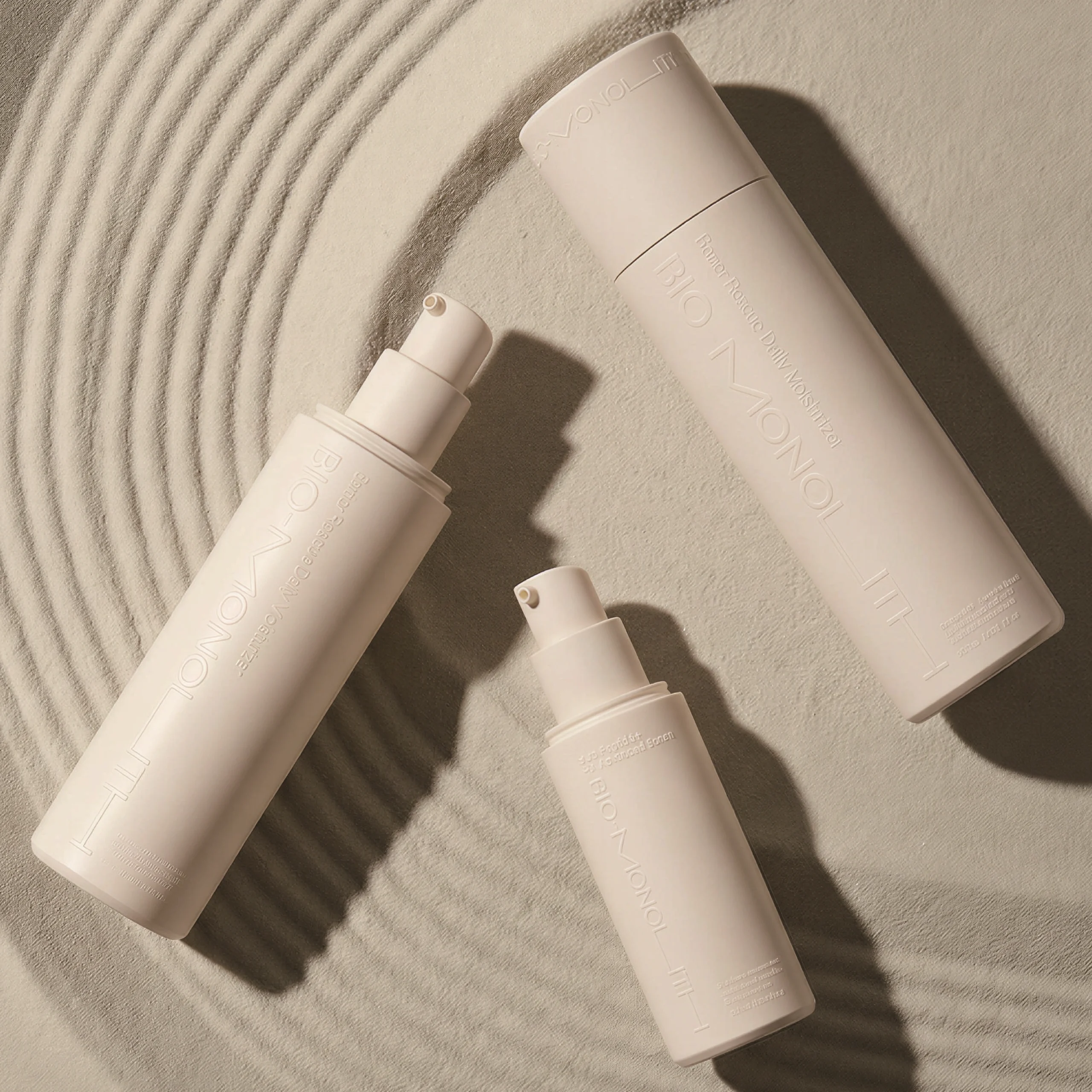


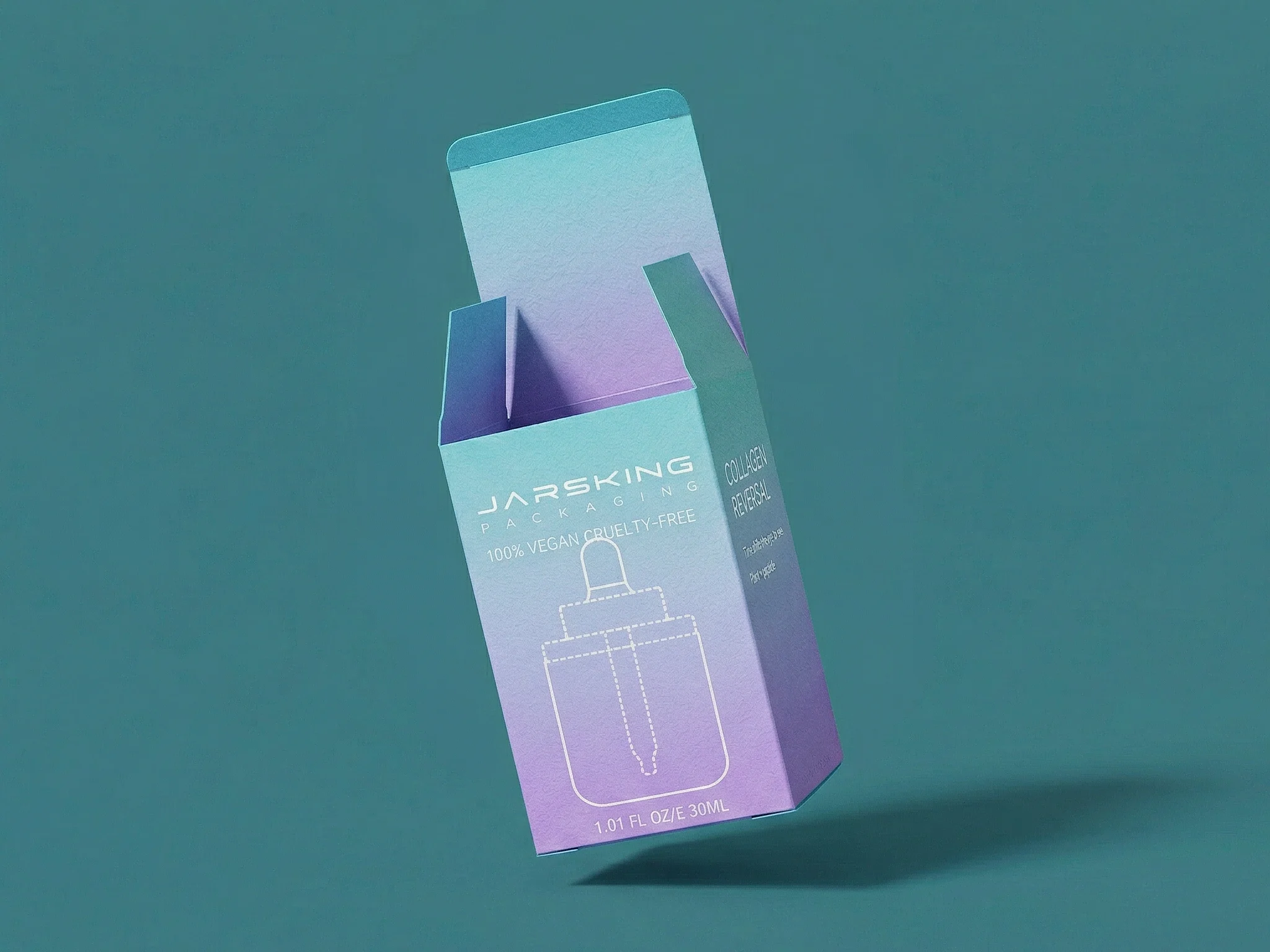












Most switches to eco-friendly cosmetic packaging fail at the component nobody changed. The bottle goes to PCR, the brief is signed off, and then the label makes the bottle unrecyclable, the pump turns out to contain a steel spring, or the paper tube needs a liner that contradicts the claim printed on it.
Three components decide whether a sustainable pack works: the decoration, the closure and the barrier. None of them is the container, and all three are settled at tooling stage rather than at artwork stage.
This guide assumes you have already decided you want a more sustainable pack, and want to know what each route costs in barrier, decoration, tooling and lead time before you commit a mould. If you are still comparing materials, start with the eco-friendly cosmetic packaging range. If the question is which claims you are allowed to print on the result, that has hard deadlines attached — see what beauty brands can still claim in 2026.
The three components that decide the outcome
The label, ink and finish
The most common reason a pack loses its recyclability claim, and the least anticipated, because decoration is usually chosen after the container is approved.
Does the substrate separate cleanly from the container polymer?
The pump or dispenser
Dispensing systems contain more material families than any other part of a beauty pack, which is where mono-material ambitions meet engineering reality.
Can the dose be held without a mixed-material assembly?
The liner behind the fibre
Every paper, pulp or carton format needs one for anything wet, oily or volatile — and the barrier defines what the pack really is at end of life.
Which layer is actually touching the formula?
Take them in that order, because it is roughly the order in which they will surprise a project.
Why a label can disqualify a bottle
This is the one that catches experienced teams. The container is right; the decoration disqualifies it.
The APR Design® Guide for PET rigid packaging sorts every component into four categories. The fourth is not a warning — it means the container is rejected.
| APR category | What it means in the plant |
|---|---|
| Design Preferred | Compatible with recycling, highest recovered value |
| Detrimental to Recycling | Reduces quality and value, but the pack still processes |
| Requires Testing | Impact unknown until lab protocols decide it |
| Renders Package Non-Recyclable | Rejected, or sent to the waste stream |
Three findings from that guide reverse what most brand teams assume.
- PLA and PVC label films render a PET package non-recyclable. Their density is close enough to PET that sink-float separation cannot tell them apart, so they contaminate the flake. A compostable label on a recyclable bottle is one of the least compatible combinations in packaging — and it is routinely sold as the sustainable option.
- Paper labels are classed as detrimental. The fibre pulps in the caustic wash and contaminates the system. The kraft look that reads as environmental on shelf behaves differently in the plant.
- Metal decoration above the guide’s surface-area thresholds renders the package non-recyclable, because metal detectors reject it. Metallised finishes are a recyclability decision, not only a decorative one.
A label film at or below 1.0 g/cm³ floats and separates cleanly from PET, which sinks. Anything heavier sinks with the flake and stays in it. Coverage matters too — APR treats up to 55% label coverage as preferred on containers of 550 ml or less, and up to 75% above that size. Full-body shrink sleeves exceed those thresholds by design, which is why they need a crystallisable PET-based sleeve with a perforation pattern that comes off mechanically.
The practical rule: choose the label substrate, ink and adhesive in the same meeting as the bottle material. A floating polymer film with caustic-resistant ink and a releasing adhesive keeps a PET bottle in the preferred category.
Where mono-material design meets the pump
Mono-material design is the most reliable route to a recyclable pack: when body, closure and label share one polymer family, the pack moves through an existing stream intact. It works cleanly on jars and tubes. It becomes an engineering question the moment the pack has to dispense.
A conventional lotion or serum pump is an assembly — housing, actuator, dip tube, gasket, and usually a metal spring. The spring is both what makes the pump work and what makes it a mixed-material component. All-plastic designs exist and the category is moving quickly, but each one is qualified against the formula, the dose and the viscosity rather than treated as a drop-in.
- A pack described as mono-material is usually mono-material except the dispenser, and that distinction belongs in the specification and in the copy.
- Changing a pump changes dose, which changes how the product feels in the hand. It is a formulation-adjacent decision, not a procurement one.
- Airless systems concentrate the question, because they contain more mechanism — while solving a different problem, protecting actives with less preservative load. The trade is rarely one-sided.
Fibre formats and the barrier question
Paper tubes, moulded pulp and carton primary packs read as the greenest option on shelf. Each needs a barrier for anything wet, oily or volatile, and that layer determines the pack’s real end-of-life route. A paper tube with a PE liner is a multi-material pack with a paper exterior — an excellent format, described accurately.
Cost and lead time land here too. Barrier-lined fibre carries different tooling from plastic and a smaller pool of suppliers who run it well, so the barrier specification, formula compatibility and achievable shelf life are settled per project, before the format is approved.
PCR: the constraint is colour, not supply
Post-consumer recycled resin is the most defensible sustainability statement most beauty brands can make, because a percentage is documentable in a way an adjective never is. The constraint is not availability. It is what recycled feedstock does to appearance, because it carries the colour history of what it was made from.
- Deep and opaque shades are easiest. A dark navy or black absorbs batch variation invisibly.
- Pale and pastel shades are hardest. The base tone has to be covered, and covering it takes pigment load that can itself affect recyclability.
- High clarity is hardest of all. This is usually where virgin material, or a lower percentage, earns its place.
- Specify a tolerance, not a target. An agreed acceptable range prevents the argument at inspection. Achievable percentages per colour and resin are confirmed per project.
The brands that succeed with PCR usually prove it on the darkest SKU in the range first, establish the colour control, then expand — rather than starting with the hero pastel.
PLA and bamboo, specified properly
PLA rewards the right route to market
PLA softens at temperatures an ordinary supply chain reaches — a container on a dock in summer, an unconditioned warehouse, a hot-fill line. Specified for the right product and the right shipping lane it is a strong option, and where the compostable route is chosen, certification to EN 13432 or ASTM D6400 is what makes the claim usable. Those two facts decide together whether PLA belongs in a given project.
Bamboo is a two-part construction, and that is its strength
A bamboo jar is a bamboo outer over a stable inner, because the thread has to hold a tolerance and the formula needs a consistent surface against it. That construction is what makes the finish possible, and it separates into two clean streams at end of life. Bamboo also moves with humidity, so thread fit and liner seal are checked on physical samples rather than on renders.
What each route gains and costs
| Route | What you gain | What it asks of you | Where it needs care |
|---|---|---|---|
| PCR resin | A documentable percentage claim, and a drop-in for most existing moulds | Colour control and batch consistency | Pale, pastel and high-clarity packs |
| Mono-material | Recyclable through an existing stream, with no testing argument | A narrower dispenser choice | Pumps and airless systems |
| Refillable | A claim verifiable by inspection, and a strong repeat-purchase story | Two packs to tool instead of one | Ranges where the refill costs nearly as much as the original |
| Paper and pulp | Distinctive shelf presence and a fibre-based story | A qualified barrier and different tooling | Anything wet, oily or volatile |
| حمض البوليلاكتيك | Certified compostability where facilities exist | Certification, and a defined shipping lane | Hot climates, hot fill, and as a label film on PET |
| خيزران | A premium natural finish that photographs beautifully | Two-part construction and humidity control | Thread fit and liner seal |
| زجاج | Infinitely recyclable, with premium perception | Freight weight and transit protection | The closure, which decides the pack’s claim |
The order to decide in
Most of the cost of getting this wrong comes from deciding in the wrong sequence.
Step five is where the savings are. A structure engineered first will support a confident claim; a claim chosen first often commits a project to a structure that cannot carry it.
Where a manufacturer earns its place
Jarsking works in PCR plastics, refillable and airless formats, PLA and bamboo, applying design for manufacturing and design for recycling through mono-material approaches. Those decisions are taken by a 30-strong packaging design team alongside an in-house mould manufacturing centre, so the structure carrying your claim is engineered rather than selected from a catalogue — and 30,000+ existing moulds mean a great deal can be achieved before new tooling is needed at all.
Behind the structure sits the paperwork a serious buyer asks for: supply-chain traceability, lot-number traceability on every batch, AQL ISO 2859 sampling with multi-stage quality control, and third-party audit and documentation support when a retailer or an authority wants to see the file. Our standing compliance set — ISO 9001, BSCI, RoHS, CE, REACH, MSDS and LFGB — covers the quality, ethical-sourcing and material-safety questions that come with it, with further documentation confirmed per target market.
Tell us the claim you want to make. We will tell you which structure supports it, and what documentation comes with it.
Frequently asked questions
Can a compostable label go on a recyclable bottle?
It is one of the worst combinations available. The APR Design Guide classes PLA and PVC label films as rendering a PET package non-recyclable, because their density is close enough to PET that sink-float separation cannot tell them apart and the flake is contaminated. If the bottle is meant to be recycled, the label needs to be a floating polymer film, not a compostable one.
Why do paper labels cause a problem if paper is recyclable?
Paper is recyclable in a paper stream, not in a plastics wash line. On a PET container the APR guide classes paper labels as detrimental to recycling: the fibre pulps in the caustic wash and contaminates the system. The kraft look that reads as environmental on shelf is a contaminant in the plant.
How much of a bottle can a label cover?
The APR Design Guide treats up to 55% coverage as preferred on containers of 550 ml or less, and up to 75% on larger ones. Beyond that the package needs testing rather than an assumption. Full-body shrink sleeves exceed those thresholds by design, which is why they need a crystallisable PET-based sleeve with a perforation pattern that lets the sleeve come off mechanically.
Can a cosmetic pump be mono-material?
Increasingly, but it cannot be assumed. A conventional pump is an assembly of housing, actuator, dip tube, gasket and usually a metal spring, and the spring is what makes it a mixed-material part. All-plastic designs exist and the category is moving, but a swap changes dose and has to be qualified against the formula and viscosity rather than treated as a drop-in.
Is PCR resin available in any colour?
Availability is not the constraint; colour control is. Recycled feedstock carries the colour history of what it was made from and shifts batch to batch, so deep and opaque shades are easiest, pale and pastel shades are hard, and high clarity is hardest. The practical approach is to agree a colour tolerance rather than a single target, and to prove PCR on the darkest SKU in a range first.
Is a bamboo jar plastic-free?
Almost never. A bamboo jar is usually a bamboo outer over a plastic inner, because the thread has to hold a tolerance and the product needs a stable material against it. That is a legitimate construction and it looks excellent, but the two parts separate into two waste streams and the pack is not plastic-free. Describing the structure honestly is safer than a claim that anyone can disprove by unscrewing the lid.
Where to start
If one thing here is worth acting on this week, it is the label. It is the cheapest component to change, it is usually specified last, and on a PET pack it is the single decision most likely to decide whether the bottle is recyclable at all. Fix the label, then work outward to the closure and the dispenser.
Bring us the formula, the destination market and the shelf you are trying to win, and our packaging team will tell you which structures support the claim you want to make — and what the tooling, the lead time and the documentation look like for each. Talk to our packaging team.
Related reading: what the PPWR, the Green Claims Directive and California SB 343 require of your pack · how biodegradable and compostable materials actually behave.